Khidmat: Where Code Meets Compassion at Habib University
At Habib University, learning does not just stop at the lectures or labs but flows into the world. The Khidmat (lit. service) program has been an integral part of the Dhanani School of Science and Engineering. Khidmat is a noncredit but mandatory requirement for Computer Science majors that requires students to combine their technical knowledge with social awareness.
Khidmat is based on the Yohsin (thoughtful self-cultivation) value of service, and transforms computing into a civic action. It makes Habib students think beyond grades or code and pose the question: How can my skills make a difference? This piece examines the core of Khidmat, its design, the committee that runs it, the projects redefining community engagement, and the transformative experiences of those who’ve done it.
What Is Khidmat?
A Bridge Between Technology and Humanity
Khidmat, meaning service, is Habib University’s distinctive approach to experiential learning. It invites Computer Science students to use their technical abilities for real-world social impact, working directly with NGOs, schools, hospitals, and community initiatives.
The Khidmat syllabus describes it as a hands-on field experience that exposes the learners to real-life scenarios, challenges, and problems that arise within our society. Each student must have finished at least 40 hours of work with an external organization, also known as a client, where they use their knowledge of computing to help the community.
Students design, develop, and implement solutions under two forms of engagement:
- Teaching-based projects, where they conduct workshops, train NGO staff, or teach digital literacy.
- Project-based activities, where they build software, design websites, create mobile applications, or automate processes.
Each project includes internal (faculty) and external (client) supervision. Upon approval of the proposal by the Khidmat Committee, students set off on their journey and eventually complete it with a final report and reflection essay describing their impact.
Khidmat is not an internship. It is noncommercial, human, and voluntary. Its results are fully community-centered; it is important to stress that technology is greatest when it is selflessly shared.
The Khidmat Committee
The Khidmat Committee at the Dhanani School of Science and Engineering is the backbone of the program. The committee oversees proposal approvals, partnerships, supervision, and evaluation. It also evolves, as faculty members rotate within it as part of their service requirement, ensuring fresh perspectives over different academic years.
Currently, the committee is led by Dr. Behroz Mirza, with Maria Samad, Dr. Unaiza Ahsan, and Nadia Nasir as members. Together, they bring a remarkable blend of academic rigor, industry experience, and compassion to the program.
Dr. Behroz Mirza, Committee Lead
Assistant Professor, Computer Science
Ph.D., FAST-NUCES; PMP Certified
Dr. Behroz Mirza, a renowned scholar of theoretical machine learning and generative modeling is the head of the Khidmat Committee. With an academic and industrial career, Dr. Mirza stands as a symbol of the balance that Khidmat desires, an academic mastery of technical skills and social consciousness.
Dr. Mirza, having obtained several academic awards such as ten gold medals at SZABIST, is currently the leader of Khidmat Committee that helps to bridge the gap between technology and organization strategy. Khidmat has been able to stay focused on intellectuality and develop community-based innovation among students of CS under his leadership.
Maria Samad, Lecturer, Computer Science
MASc. in Computer Architecture & Design, NED; BE, Carleton University
Maria Samad plays an essential role in mentoring students throughout their Khidmat journey. With her background in data structures, software engineering, and machine learning, she helps students design technically robust yet socially grounded projects.
She describes Khidmat as a “bridge between classroom knowledge and civic purpose.”
“Other universities are only now exploring volunteerism as a mandatory requirement,” she says. “Habib has built it into the heart of the degree. Khidmat allows students to apply their CS skills to help others, and that’s what true education is.”
Her advice to students is candid: “Don’t treat it as a checkbox. Treat it as a learning opportunity. Do it yourself. Challenge your skills. That’s how you grow.”
Dr. Unaiza Ahsan, Assistant Professor, Computer Science
Ph.D., Georgia Institute of Technology
Dr. Unaiza Ahsan, a machine learning and computer vision researcher, adds international experience to the work of Habib in classrooms and community activities. Her career as a Lead Data Scientist at The Home Depot (Atlanta) and her Data Science for Social Good experience at Georgia Tech reflects the type of problem-solving cross-disciplinary approach Khidmat encourages.
She uses her mentorship to make students understand how computing principles can be applied to solve real problems- healthcare analytics to digital education. The advice of Dr. Ahsan prompts the Khidmat projects to be technologically outstanding yet grounded in empathy.
Nadia Nasir, Lecturer, Computer Science
M.S., NED University
Having been in the teaching profession for more than a decade, with teaching experience in institutions such as FAST-NUCES, Aptech among others, Nadia Nasir brings experience to Khidmat by assisting students to conceptualize projects that are within scope, creative, and community requirement. Her experiences in data science and artificial intelligence direct her practice in mentoring students who have desires to use advanced computing in purposeful fashions.
Khidmat Case Studies
Real stories from students demonstrate how Khidmat shapes both careers and character. These projects exemplify how CS students at Habib apply technical knowledge to create human-centered solutions.
Touch N Tap: An App for Inclusive Education
Students: Minhaj Hassan, Salman Kamal, and team
Client: Karachi Down Syndrome Program (KDSP)
When Minhaj Hassan and Salman Kamal began their Khidmat, they sought something beyond a standard website or data tool. Their journey led them to the Karachi Down Syndrome Program, where they noticed that math lessons for children were entirely paper-based, making engagement challenging.
Their solution was Touch N Tap, an interactive learning app that digitized KDSP’s math syllabus. The app featured four modules with gradual difficulty levels, colorful visuals, and an animated bunny character that helped children count forward and backward, making learning fun and accessible.
The project took two months, requiring meticulous teamwork, UI/UX design, and coding. What started as a volunteer project soon became a transformative learning experience.
“We wanted to create something lasting, something that would outlive our time here,” Minhaj reflects. “Seeing the children use the app—it was one of the most satisfying moments of my life.”
For Salman, the project redefined his perspective on computing:
“Khidmat taught me that code can be a form of care. It showed me that empathy and innovation go hand in hand.”
Muskan, the KDSP coordinator, praised their professionalism and creativity:
“They were patient, flexible, and communicated everything in layman’s terms. The app’s visuals and design have made a real difference in our students’ learning. It’s free, intuitive, and genuinely meaningful.”
Their project now serves as a lasting digital resource for KDSP, used by educators and families alike, proof that student-led initiatives can create long-term community benefit.
Indus Hospital Crowdfunding App: Tech for Healthcare
Student: Ikramah Elahi and team
Client: Indus Hospital, Korangi Campus
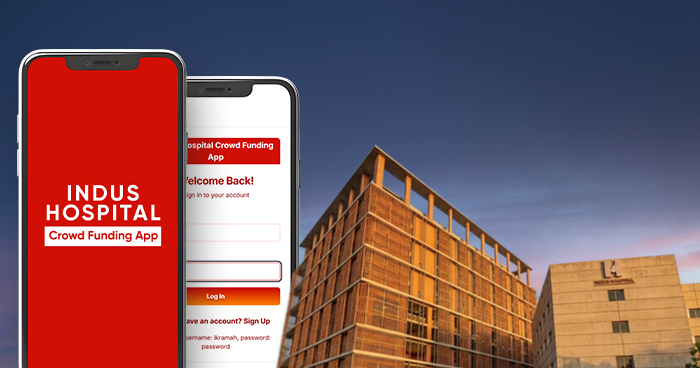
Ikramah Elahi, along with his teammates, took on the challenge of helping Indus Hospital, a nonprofit healthcare institution reliant on donations. Their project was to design a prototype for a youth-friendly crowdfunding app that could engage new donors.
Working on-site, the students collaborated with hospital supervisors to understand funding mechanisms and user needs. Ikramah focused on UI design in Figma and front-end development in JavaScript, bridging creativity with technical execution.
“It was eye-opening,” Ikramah says. “I learned how CS connects to healthcare, teamwork, and real-world problem-solving.”
Arif Rahman, their supervisor at Indus Hospital, shared glowing feedback:
“They were knowledgeable, hardworking, and dedicated. They even worked extra hours and presented their final product to our management, receiving very positive feedback.”
The experience not only sharpened Ikramah’s technical skills but also clarified his professional path:
“It helped me discover what I don’t want, pure development, and what I might love: UI design and user experience.”
Advice for Khidmat Aspirants
For many Computer Science students, Khidmat becomes a turning point; a first encounter with real-world challenges that demand empathy, patience, and creativity.
Here’s what those who’ve been through it have to say:
The faculty says, “Do it wholeheartedly. Don’t see it as a degree requirement; see it as a chance to contribute. When you take ownership, the learning multiplies.” The Khidmat Committee advises, “Khidmat is self-learning in its purest form. You can explore new areas, experiment, and grow.” Industry Partners guide, “Start early. Choose partners who allow creative freedom and share your project interests so you can give your best to the client.” A student shares, “It reshaped my idea of a career. I now see originally distant concepts as avenues where I can make a real impact.”
Conclusion
Khidmat is a monument to the mission of Habib University to produce not only good professionals but also responsible citizens. In the case of CS majors, it is a connection between algorithms and altruism, logic and love, data and dignity.
In Khidmat, students find out that it is not only the programs that run smoothly that are the best, but also those that make a difference.
Habib University, through Khidmat, keeps humanity central in a world that is technology-driven.