
Pros and Cons of Big Data: How to Use Big Data Analytics Without Losing Trust
Big data has quietly become the operating system of modern life. It powers the routes we choose, the content we consume, the products we buy, and increasingly, the policies governments and institutions design. But if you’re studying, building, or leading in Pakistan’s growing digital economy, you’ll hear a more important question than “What can big data do?”:
Can we use it in ways that are accurate, fair, secure, and worthy of public trust?
This is the real story behind the pros and cons of big data. Big data analytics can unlock breakthroughs in health care, education, public services, and climate resilience, but it also raises hard challenges around privacy, security, cost, and bias.
If you’re exploring how data fits into modern computing careers, you may also like: Top Computer Science Fields in Pakistan.
Let’s unpack both sides and finish with a practical playbook for using big data responsibly.
What Big Data Actually Means (Beyond the Buzzword)
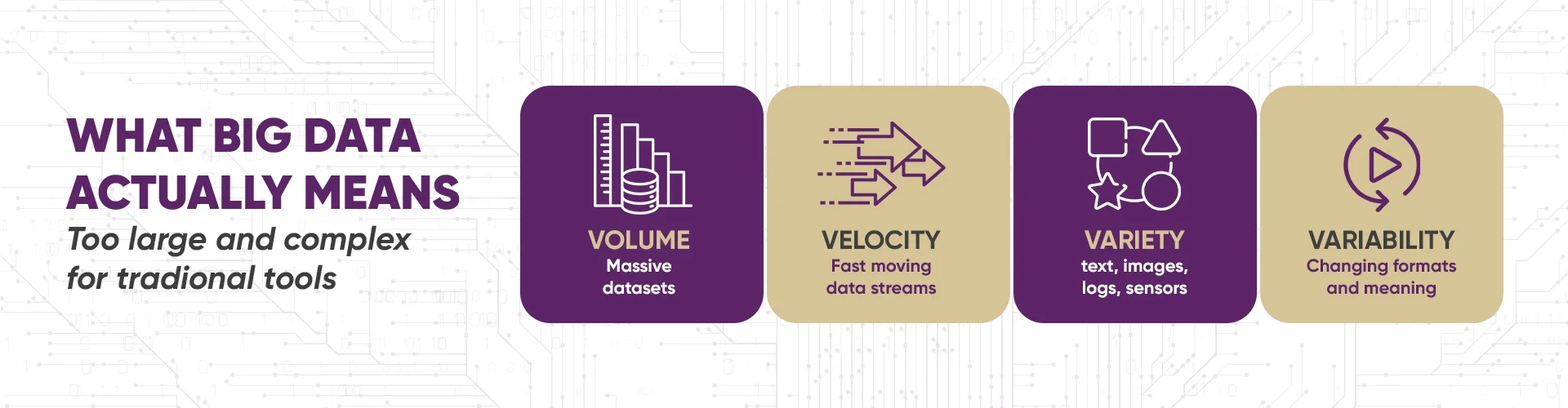
Big data isn’t just lots of data. It’s data whose scale and complexity overwhelm traditional tools, requiring scalable architectures to store, process, and analyze it effectively. The NIST Big Data Interoperability Framework describes big data as extensive datasets characterized by factors like volume, velocity, variety, and variability, which require scalable approaches to handle efficiently.
In plain terms, big data shows up when you’re dealing with:
- High volume (massive datasets)
- High velocity (rapidly arriving streams, near real-time)
- High variety (text, images, transactions, sensors, audio, logs)
- High variability (shifting formats, rates, and meaning over time)
Why Big Data Matters Right Now in Pakistan
Pakistan is moving toward a more data-first governance and innovation culture. A major step was the launch of Open Data Pakistan, described as a national portal offering open access to 1,100+ government datasets across 14 sectors (health, economy, education, environment, and more), designed to support evidence-based policy and public accountability.
For students, researchers, and builders, this matters because it lowers the barrier to:
- real-world capstone projects,
- civic-tech prototypes,
- policy research grounded in local datasets,
- and entrepreneurship based on real demand signals.
If you’re deciding whether to specialize in traditional CS foundations or AI-heavy paths, this will help clarify the tradeoffs: Computer Science vs AI in Pakistan
The Pros of Big Data
1) Better, Faster Data-Driven Decisions
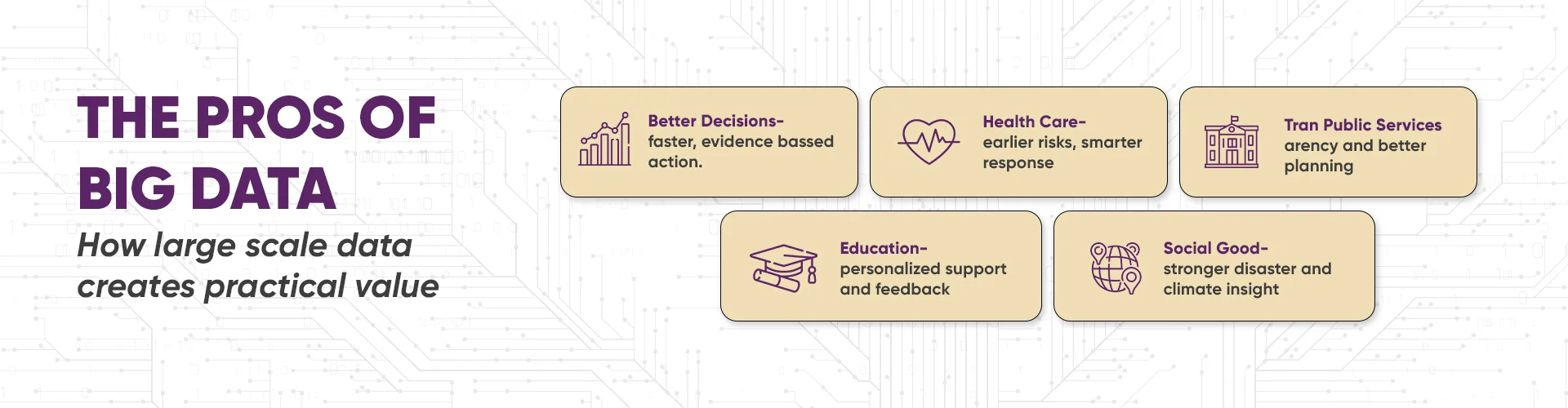
At its best, big data analytics helps institutions replace gut feel with measurable insight. Businesses can forecast demand, reduce waste, detect fraud, and personalize services. Governments can allocate resources more efficiently and evaluate programs using evidence rather than assumptions.
This is the core advantage: big data turns complex reality into usable signals.
2) Health Care Advancements (prevention, prediction, personalization)
Health systems increasingly rely on large datasets, such as clinical records, lab results, population data, and, sometimes, anonymized mobility or search trends, to detect risks and improve outcomes. In many countries, data-driven surveillance and analytics are central to early warning, resource planning, and targeted interventions (especially for outbreaks and chronic disease management).
The opportunity is huge, but so is the responsibility, because health data is highly sensitive.
3) Improved Public Services and Transparency
Open data is one of the most practical uses of big data in government: it enables researchers, journalists, civil society, and students to validate claims, identify gaps, and propose improvements.
Pakistan’s National Open Data Portal initiative explicitly aims to promote transparency and evidence-based policymaking, providing public access to datasets across vital sectors.
4) Educational Innovation and Impact (learning analytics done right)
Higher education is increasingly using data (LMS logs, assessments, attendance signals) to improve student support. A systematic review of learning analytics and personalized learning found that analytics can help by:
- identifying learning gaps,
- predicting performance,
- and building feedback loops for personalization,
while also highlighting major challenges like privacy, fairness, and accuracy.
A Pakistan-linked review on learning analytics in higher education similarly describes how analytics can shift feedback from generic to individualized, while underscoring governance and ethical considerations.
In other words, big data can strengthen education, but only if institutions treat student data with care.
5) Social and Environmental Impact (big data for social good)
Big data is increasingly used for development and climate resilience, especially where traditional data collection is slow or incomplete. The UN highlights how large-scale digital traces (like public social media signals or mobile network aggregates) can help inform responses to issues such as disasters, food costs, access to services, and humanitarian planning.
Climate-focused initiatives like Data for Climate Action have also pushed the idea that responsibly shared datasets can help researchers model impacts and improve adaptation strategies.
The Cons of Big Data (and Why They Matter)
1) Data Privacy and Security Concerns
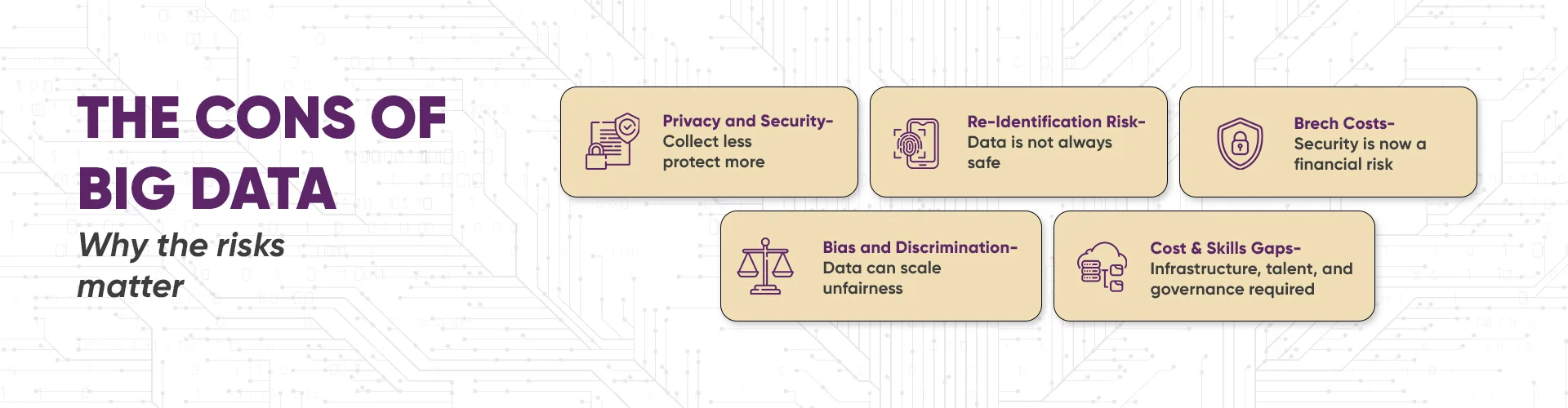
The biggest big-data risk is the “collect everything” culture. Strong privacy frameworks push the opposite: collect only what you need, use it only for clear purposes, and protect it end-to-end.
For example, GDPR principles emphasize:
- purpose limitation (collect for specific, explicit reasons),
- data minimization (only what’s necessary),
- and integrity/confidentiality (security safeguards).
Even if GDPR doesn’t legally bind your organization, these principles are a practical benchmark for trust.
2) Anonymous Data Isn’t Always Safe
Many teams assume that removing names makes data harmless. But de-identification can fail: researchers have shown that some de-identified datasets can be re-identified under certain conditions, especially when combined with other data sources. NIST’s work on de-identification discusses both the benefits and the re-identification risk.
3) Breaches are Expensive and Getting Costlier
Big data environments concentrate value. That attracts attackers. IBM’s Cost of a Data Breach Report 2024 estimates the average global breach cost at USD 4.88 million, underscoring how disruptive breaches have become.
For organizations, this turns security from “IT hygiene” into a core financial risk.
4) Bias and Discrimination
Big data can scale unfairness. If historical data reflects unequal access or structural discrimination, analytics can reproduce it, sometimes invisibly.
A landmark Science study showed racial bias in a widely used health prediction algorithm: at the same risk score, Black patients were significantly sicker than White patients, and correcting the issue would have dramatically increased the share of Black patients receiving extra care.
This is why more data does not automatically mean more truth.
5) Cost of Implementation and Skills Gaps
Big data programs require infrastructure (storage, compute), data engineering, governance, and ongoing maintenance. NIST notes that big data can overwhelm traditional technical approaches, which is why scalable architectures and clear roles matter.
Without the right talent and controls, big data initiatives can become expensive experiments with low ROI.
A Practical Playbook: How to Use Big Data Responsibly
If you want the benefits of big data without the downsides, this checklist helps:
- Start with the decision, not the dataset
Define the question, the outcome metric, and what would change if you learn X. - Practice data minimization
Collect the minimum fields required; prefer derived attributes when possible (e.g., “over 18?” instead of DOB). - Build privacy and consent into the workflow
Clear notices, retention limits, and access controls are not legal extras; they’re trust infrastructure. - Secure the pipeline end-to-end
Encrypt sensitive data, monitor access, and treat data governance like a living system. - Measure data quality and provenance
Track missingness, drift, and source reliability, especially if decisions affect people. - Audit for bias and unfair outcomes
Test model performance across groups; question proxies (like cost as a stand-in for need). - Document and make decisions explainable
Keep a record of data sources, transformations, assumptions, and limitations.
Where Habib University Students Fit In
Pakistan’s expanding open data ecosystem creates a powerful learning opportunity: students can work with real datasets and build skills in analytics, visualization, privacy-aware design, and public-interest technology.
Habib University’s BS Computer Science program includes streams and courses aligned with this future, such as Social Network Analysis and Graph Data Science, alongside AI and information security foundations that matter for responsible analytics.
If you’re interested in how data intersects with intelligent systems, robotics, and real-world decision-making, you’ll also enjoy: What Degree Do You Need to Become a Robotics Engineer?
Closing Thought
The pros and cons of big data aren’t a debate about whether we should use data; they’re about how we use it.
Used well, big data analytics can improve health outcomes, strengthen education, upgrade public services, and power climate resilience. Used carelessly, it can erode privacy, amplify bias, and create high-cost security failures.
The winners in the next decade, students, institutions, and organizations, won’t be the ones who collect the most data. They’ll be the ones who can extract value responsibly.