Who is Nergis Mavalvala? The Karachi Scientist who Heard the Universe
There was a bicycle repair shop just outside the apartment compound on McNeil Road, Karachi where Nergis Mavalvala grew up. She was ten. When she brought her bike in, the man who ran the shop did not fix it and handed it back. He showed her how to do the repairs herself, and after that she borrowed his tools.
A child taking a machine apart to work out why it stopped working sits fairly close to what she went on to do for a living.
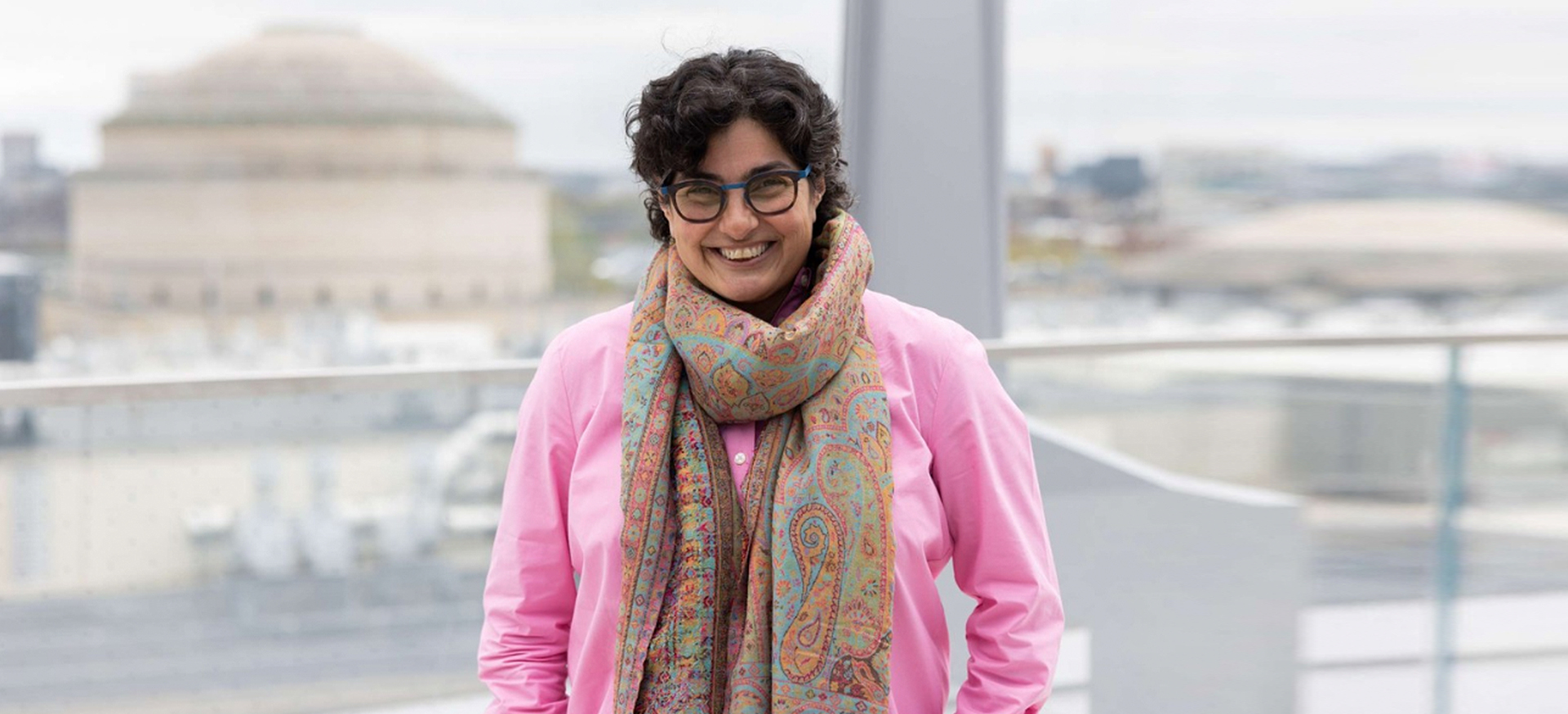
She now leads the School of Science at the Massachusetts Institute of Technology (MIT). On Friday 25 September 2026 she returns to Karachi, where Habib University has announced her as the tenth speaker in its flagship public lecture series. Dr. Nergis Mavalvala, Dean of MIT's School of Science
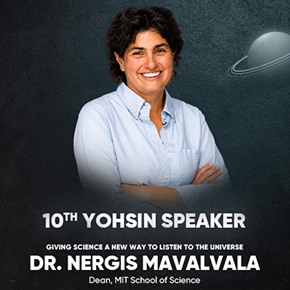
10th Yohsin Lecture
Register
Friday, September 25, 2026, 5:00 p.m.
Habib University, Karachi
Free and open to the public
Who is Nergis Mavalvala?
Dr Nergis Mavalvala is an astrophysicist and the Dean of the School of Science at the Massachusetts Institute of Technology, the first woman to hold the post. She is the Curtis and Kathleen Marble Professor of Astrophysics, a MacArthur Fellow and a member of the National Academy of Sciences.
She was born in Lahore in 1968 and raised in Karachi. She studied at the Convent of Jesus and Mary, then left for the United States in 1986, graduating with a degree in physics and astronomy at Wellesley College and her doctorate at MIT.
Her work runs along two connected lines: the detection of gravitational waves, and quantum measurement science. As a longtime member of the LIGO collaboration, she helped build the instruments behind one of the defining discoveries of this century.
Karachi First
She studied at the Convent of Jesus and Mary from pre-K through O-levels. The teacher comments on her report cards, she remembers, kept landing in the same place. “Smart kid, too talkative and hard to control.”
Her parents prioritised her education and her sister’s at times when it was not easy to do. She has said she grew up in a household where the usual gender roles were not really observed, and so grew up thinking women “can, must and should do anything and everything.”
Ask her what she misses about Karachi and the answer is not the skyline. It is her school friends, her family, the tight-knit Zoroastrian community she grew up inside, the hospitality, the food.
Then Wellesley in 1986, a physics degree in 1990, and MIT for the doctorate. She has described joining LIGO as something she more or less stumbled into. She was a first-year graduate student looking for a supervisor. She had a short conversation with a professor named Rainer Weiss, who had invented the concept the entire observatory was built on, and that was that.
What Nergis Mavalvala Helped Detect?
Einstein’s 1915 general theory of relativity described space and time as something that can stretch and compress, rather than a fixed stage on which everything else happens. If that is right, a violent enough event should send a disturbance rippling outward through space and time themselves. Einstein worked out the mathematics for those ripples. He also doubted any instrument on Earth would ever be sensitive enough to catch one.
He had reason to doubt it. Consider the scale of the problem.
LIGO works by bouncing laser light between mirrors set four kilometres apart and watching for any change in the distance between them. When the wave from two colliding black holes passed through the detectors on 14 September 2015, it changed that four-kilometre distance by roughly one thousandth the width of a proton.
That is the measurement she and her colleagues built an instrument to make.
The signal arrived at 09:51 UTC and lasted a fraction of a second. Its source was two black holes, each around thirty times the mass of the sun, spiralling into each other and merging. The collision happened more than a billion years ago and the ripple had been travelling outward ever since. The collaboration spent five months verifying it before announcing on 11 February 2016.
Einstein being right mattered. The larger consequence is that astronomy gained a second sense. Almost everything we know about distant objects reached us as light of one kind or another, gathered by instruments that look. LIGO does not look at anything. It registers the shape of space changing as the wave passes through. In the decade after that first detection, the international detector network recorded more than three hundred such signals from events no telescope could have seen.
About the 2017 Nobel Prize
Dr Mavalvala is not a Nobel laureate. The claim circulates widely, including in Pakistani coverage, and it is worth getting right.
The 2017 Nobel Prize in Physics went to Rainer Weiss, Barry Barish and Kip Thorne, for their contributions to the LIGO detector and the observation of gravitational waves. Weiss was Dr Mavalvala’s doctoral adviser at MIT. Together they helped develop the detector technologies at the heart of the instrument. He died in August 2025, aged 92.
When the prize was announced, Weiss said the discovery had been the work of a large number of people, and that he regarded the award as standing in for them. More than a thousand researchers from over twenty countries worked on LIGO. Dr Mavalvala is one of them.
What She Works on Now
She became Dean of MIT’s School of Science on 1 September 2020 and still holds the position.
Her research did not stop at the detection. A significant part of it concerns squeezed light, a technique for manipulating the quantum properties of a laser beam so that a measurement can be pushed past a limit quantum mechanics would otherwise impose. She has also worked on cooling and trapping objects large enough to see, in order to watch quantum behaviour at human scale.
Both halves of her work circle the same question from opposite ends. How precisely can you measure anything at all, and what turns out to be audible once you can. As she puts it, when scientists make a discovery they think they have answered a question, but almost always what they have done is pose a new one.
Why does she Defend Knowledge that has no Obvious Use?
Nobody needed gravitational waves detected. Einstein’s prediction sat unmeasured for a century, and the case for chasing it was that it was worth chasing.
That is the argument she has built out of her own career, and it is the title of her lecture. The Joy of Discovery: Curiosity, Science, and the Pivotal Role of Universities. The deepest discoveries, she contends, usually begin exactly there, as questions pursued because they are worth asking. The practical applications arrive decades later, often in forms nobody anticipated.
From that she draws a claim about universities. Their responsibility runs past training professionals. They exist to cultivate wonder, creativity, perseverance and intellectual freedom. The pursuit of knowledge for its own sake, on her account, is the engine of civilization.
That argument carries local weight. Habib University was founded in Karachi in 2014 as Pakistan’s premier liberal arts and sciences university, on a model that holds the sciences, engineering, arts and humanities inside one undergraduate education. A physicist arguing that curiosity without an immediate return deserves institutional protection is arguing for something this University was assembled around.
Dr Mavalvala is also one of several Pakistani women whose work has shaped contemporary science. We look at five Pakistani women scientists [link to women in STEM blog] separately.
Nergis Mavalvala’s lecture in Karachi: how to attend
She will deliver the tenth Yohsin Lecture at Habib University in Karachi on Friday 25 September 2026 at 5:00 pm. Admission is free and open to the public, as it has been across the Yohsin Lecture Series since Dr Munir Fasheh delivered the inaugural lecture in November 2011.
Full details are on the Yohsin Lecture 2026 page, and you can register for the 10th Yohsin Lecture online.