
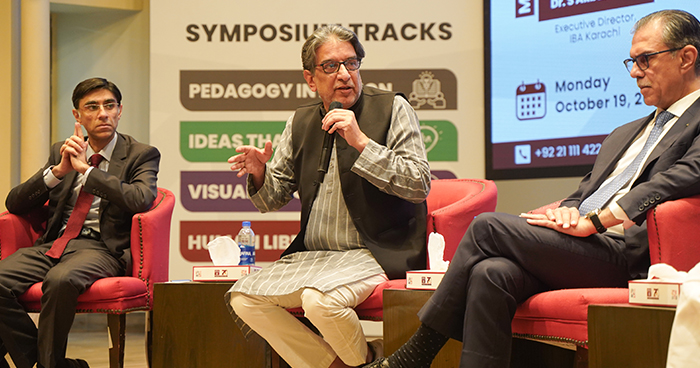
President Rizvi Calls for Reclaiming Human Judgement and Rethinking AI in Higher Education
Wasif Rizvi, Founding President of Habib University, joined presidents of leading universities in a panel titled Teaching for Today and Tomorrow: What should Universities Stop, Start, and Continue in the AI Era at the Teaching & Learning Symposium 2026 at the Institute of Business Administration, Karachi, on October 19th, 2026. The panel discussion was part of the Annual Teaching and Learning Symposium at IBA that reflects the shared commitment of Habib University, Aga Khan University, and IBA to advancing teaching excellence through collaboration for knowledge exchange, innovation, and continuous improvement in higher education.
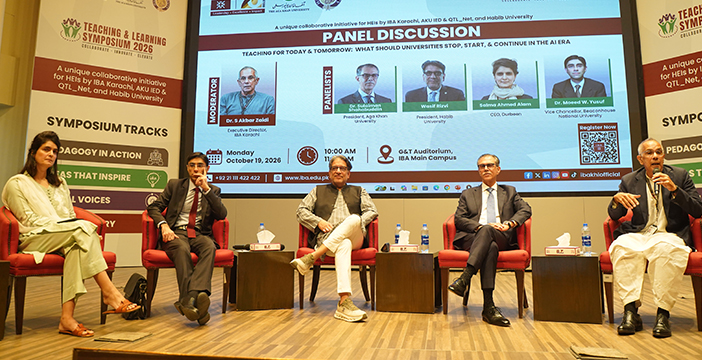
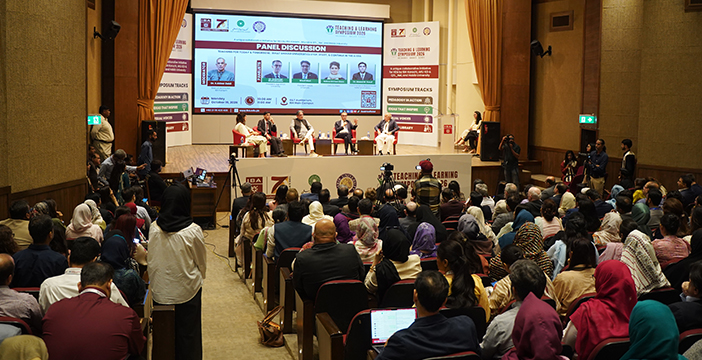
What is the future of higher education in the age of artificial intelligence? What will student learning look like in the years to come? How concerned should higher education administrators and faculty be about its growing dependence? With the theme centered on AI in Pedagogy, the symposium explored questions such as these and identified opportunities for cross-institutional collaboration to enhance teaching quality.
An Ethic Developed over Centuries
The welcome remarks were shared by Dr. Sana Tauseef, the Chair of the Symposium, followed by Dr. Farid Panjwani, Dean of AKU, IED, who emphasized on encouraging critical thought and study in the humanities so that students would have the capacity to ask the right questions. The Keynote Address, ‘Critical Thinking and Agency in the Age of AI: Time to Re-think Higher Education,’ was delivered by Dr. Fazilat Siddiq, Professor at the Faculty of Educational Sciences, University of Oslo, Norway.
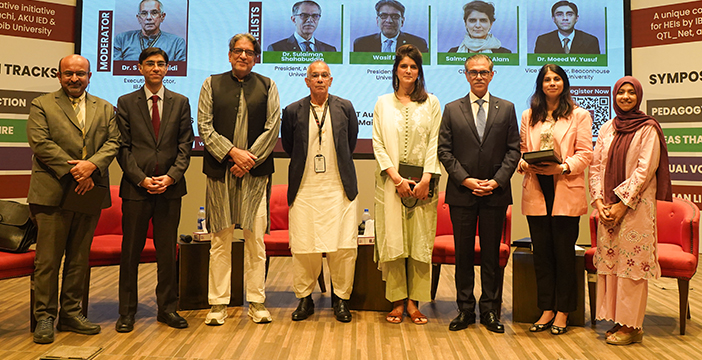
The panel discussion included Habib University President, Wasif Rizvi; Vice Chancellor, Beaconhouse National University, Dr. Moeed W. Yusuf; President Aga Khan University, Dr. Sulaiman Shahabuddin; Chief Executive Officer at Durbeen, Salma Ahmed Alam, moderated by Dr. S. Akbar Zaidi, Executive Director of the IBA.
Answering a question about what AI really is, President Rizvi began his discussion with the mention of a Murti-Pill, a fictional device from the 1930 Polish novel Insatiability by Stanisław Ignacy Witkiewicz, and how an MIT study used it as a metaphor to define what AI is. “We should be asking if what we’ve being doing for 3000 years is relevant now,” he said, highlighting an ethic that humans have developed over centuries.
He further pointed to how Princeton and other universities have abandoned self-governed learning, citing an example of Princeton returning to handwritten assignments as these are ‘crucial to cognition.’
“There is no such thing as AI literacy; you just don’t do it,” he further stated.
Dr. Moeed W. Yusuf highlighted how a panel like this has not happened before, and that this is the first time in decades that a moment like this has arrived for us to collaborate and offer the world a global solution. “What worries me is that teachers don’t see themselves as mentors.” He argued that faculty and students need to be brought together for mentorship to cultivate, and if teachers start seeing the use of AI ethically, so will the students.
“Transferring that information into knowledge will require mentorship. Teaching is going back to the old tutorial method. For that faculty must be ready and change,” he said.
“The train has left the station but it’s the time to put the brakes,” he said to a metaphor about AI, reflecting on his time working on strategy of nuclear weapons and seeing how people who make the weapons are playing with fire.
“The best way is to regulate it, live with it, and invest in faculty who will then invest in students” he said.
Salma Ahmed noted that a new chapter of the human revolution has opened. However, it is important to keep contextual realities in mind. “We should turn our constraints into opportunities,” she said.
The Error of Making Technology Ubiquitous
Pointing to the fault of educators and our age-old ethic, President Rizvi said, “we have committed an error in making technology ubiquitous. That’s coming back to haunt us.” Writing was the first technology itself, and it became ubiquitous just 200 or 300 years ago. This built the case for the ubiquitous use of technology, according to President Rizvi.
He went on to say that employers who complain about AI literacy think that people are using it thoughtlessly. What they actually want are people who can produce unedited, independent work, and use AI judiciously – that is, with good judgment. Therefore, the question for universities is rather, how can we create processes that let us judiciously use AI? This usage comes much later in the student’s life, specifically in their junior or senior year. Education, he said, has become extremely dependent on one kind of technology, which is writing. Universities have outsourced the written word, and AI can do it very easily.
President Rizvi highlighted that the question we should be pondering is what kind of learning system should exist when AI can perform the task that historically was able to measure learning. In making technology ubiquitous, we must challenge the educational tendency to take technology, make it universal, and create a system surrounding it without considering the consequences if it were to go out of control. The discussions around it would be never-ending, he said.
The Battle for Attention
To a question about teaching new students how to use AI responsibly, Rizvi spoke about how the challenge is ultimately about more than technology. Universities are now competing for students’ attention in an environment dominated by social media, labelling them as “attention-extracting technologies.”
Similar to oil that has been extracted and earned companies billions of dollars, attention is now becoming a profitable product. Universities and faculty must make sure they do not fall prey to this. “Because of the pressure of AI, we can revert to creating the right kind of community learning fabric that we used to cherish and bring back our [focus on] attention.”
“We shouldn’t sidestep the exposure to AI, but use it as a thought partner,” said Salma Ahmed Alam, when asked whether we should be engaging with it to the degree that we are.
Dr. Moeed W. Yusuf reiterated that AI is here to stay, and faculty should be involved more in shaping their teaching and learning methods.
Dr. Sulaiman Shahabuddin emphasized analysis and reasoning as we use AI tools to enhance efficiency.
During the question-and-answer session, attendees’ questions ranged from the extractive nature of AI, the environmental impact, and how to understand the extent of our AI usage.
A Landmark Collaboration Between Habib University, Aga Khan University, and IBA
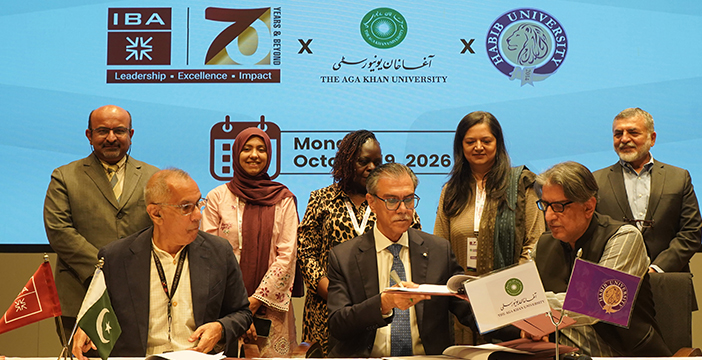
After the panel discussion, Dr. S. Akbar Zaidi (Executive Director of the IBA), Mr. Sulaiman Shahabuddin, (President of the Aga Khan University), and Wasif Rizvi signed an MoU under the agreement to advance teaching excellence, collaboration, knowledge exchange and innovation in higher education. The symposium gathered educators, students, higher education administrators, and researchers working on the forefront of AI in higher education in Pakistan.