Education
- Ph.D., Mechanical Engineering (Fulbright Scholar) — The University of Texas at Austin, USA, 2012
Thesis: Immunity-based Framework for Heterogeneous Mobile Robotic Systems - M.Sc., Mechatronics Engineering — University of Engineering & Technology, Lahore, Pakistan, 2003
- B.E., Mechanical Engineering (with Honors) — National University of Sciences & Technology (NUST), Rawalpindi, Pakistan, 1999
Biography
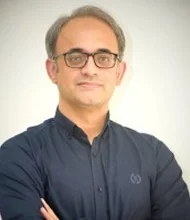
Dr. Ali Raza is an Associate Professor at the Dhanani School of Science and Engineering at Habib University. Earlier he served at the Department of Mechatronics & Control Engineering, UET Lahore. A Fulbright Ph.D. alumnus from The University of Texas at Austin (2012), he specializes in human-centered robotics, care-companion robots, bio-inspired artificial immune systems, and resuscitation technologies.
He has played a pioneering role in establishing Pakistan’s human-centered robotics ecosystem. He founded the Human-Centered Robotics Lab (HCR Lab) under the National Center of Robotics and Automation (USD 1.0M grant, 2018) and the Ihya Lab for Mechatronics and Resuscitation Research in collaboration with Hamad Medical Corporation, Qatar (2021). His labs have indigenously developed collaborative robots, industrial exoskeletons, active lower-limb prostheses, modern automated CPR devices, soft exoskeletons, haptic interfaces, and hyperbaric systems.
Dr. Raza has secured over USD 3.5 million in competitive national and international research funding, supervised several MS/PhD students, and authored more than 30 peer-reviewed journal and conference papers. He is a recognized leader in translating bio-inspired intelligence and mechatronic design into socially impactful robotic systems.
Research Interests
- Human-Centered and Care-Companion Robotics
- Bio-inspired Artificial Immune Systems for fault-tolerant robots
- Medical and resuscitation mechatronics (automated CPR, haptic feedback, bio-mimicking simulators, etc.)
- Industrial exoskeletons and powered prostheses
- Collaborative robots and human–robot interaction
Selected Publications
- Rehman, M. U., et al. (2025). A low-cost markerless motion-capture technique for early detection of illegal cricket bowling action. Measurement Science and Technology, 36(10), 105418.
- Raza, A., et al. (2025). Modeling and simulation of cardiovascular system under cardiac arrest for finding a more effective CPR technique. Computers in Biology and Medicine, 189, 109890.
- Mazhar, R., Raza, A., et al. (2024). A mechatronic bio-mimicking simulator platform for cardio-pulmonary resuscitation. IEEE/ASME Transactions on Mechatronics.
- Javed, T., Raza, A., et al. (2024). Multi-Class Classification of Human Activity and Gait Events Using Heterogeneous Sensors. Journal of Sensor and Actuator Networks, 13(6), 85.
- Bilal, M., et al. (2022). Design optimization of powered ankle prosthesis to reduce peak power requirement. Science Progress, 105(3), 00368504221117895.
- Raza, A., et al. (2019). Immunity-based dynamic reconfiguration of mobile robots in unstructured environments. Journal of Intelligent & Robotic Systems, 96(3), 501–515.
- Raza, A., & Fernandez, B. R. (2018). A multi-tier immuno-inspired framework for heterogeneous mobile robotic systems. Applied Soft Computing, 71, 333–352.
- Akram, M., & Raza, A. (2018). Towards the development of robot immune system: A combined approach involving innate immune cells and T-lymphocytes. Biosystems, 172, 52–67.
- Mahmood, I., & Raza, A. (2017). Therapeutic equipment for brain-hyperthermia using convective spray cooling. Journal of Medical Devices, 11(3), 031010.
- Raza, A., & Fernandez, B. R. (2015). Immuno-inspired robotic applications: A review. Applied Soft Computing, 37, 490–505.
Professional Experience
- Associate Professor — Dhanani School of Science and Engineering, Habib University (January 2026 – Present)
- Associate Professor — Department of Mechatronics & Control Engineering, UET Lahore (April 2021 – December 2025)
- Assistant Professor — UET Lahore (January 2004 – April 2021)
- Lecturer / Lab Engineer — UET Lahore (December 2001 – January 2004)
Leadership & Administrative Roles
- Chairperson, Department of Mechatronics & Control Engineering, UET Lahore — Led Washington Accord (OBE) accreditation, doubled undergraduate enrollment, launched B.S. Robotics & Intelligent Systems program
- Director, Human-Centered Robotics Lab, National Center of Robotics & Automation
- Director, Ihya Lab for Mechatronics and Resuscitation Research, UET Lahore
- Member, UET’s Senate, Academic Council, and Advanced Studies & Research Board
Selected Research Grants
- ERASMUS+ Building Resources for Innovation, Digital Growth and Empowerment (EU, 2025)
- ERASMUS+ Capacity Building in Biomedical Engineering Education (EU, 2023)
- NRPU — Modular Reconfigurable Soft-Exoskeleton for Industrial Workers (2022)
- Hamad Medical Corporation, Qatar — Mechatronic CPR Research Simulator (2020, 2021)
- National Center of Robotics & Automation — Human-Centered Robotics Lab (2018)
- NRPU — Probabilistic Marker-less Motion Capture System (2018)
Industrial Consultancy & Collaboration
- Xavor Corporation / Navigait (2020–2025): Robotics consultant for geriatric and dementia-care companion robots
- XiSYS Consulting Ltd (2022–2023): Lightweight autonomous winged-drone development
- Tetra Pak (2012–2017): Designed and delivered training programs in automation, pneumatics, and hydraulics across 28 countries (GMEA region)
- Interloop Ltd., Ibrahim Fibres Ltd., Stylers International Ltd.: Several industry projects on automation and worker-assistive robotics
Selected Awards
- Best Teacher of the Mechatronics Department at UET Lahore (2023)
- Fulbright Doctoral Scholarship (2007–2012)
- Multiple Better Incentive Awards, at UET Lahore (2013–2017)
- Best Final-Year Project Award (1999)