Computer Science or AI: Which is Better for Your Career in Pakistan?
If you’re trying to decide between computer science vs AI and keep wondering which is better for your career in Pakistan, the honest answer is: it depends on your goals, risk tolerance, and timing, not just on hype.
Below is a data-backed, Pakistan-focused breakdown to help you choose the right CS vs AI degree path.
Pakistan’s Tech Scene in 2025: Why this Decision Matters
Pakistan’s IT and services sector has been booming. In FY25, the country’s IT exports reached a historic high of US$3.8 billion, marking an 18% increase over the previous year.
This surge reflects growing global demand for software and tech-enabled services delivered by Pakistani talent. As companies expand, there’s a rising demand for developers, data engineers, system administrators, and increasingly, AI-capable professionals. Meanwhile, the national rollout of the National Artificial Intelligence Policy 2025 signals a major push to integrate AI across public services, agriculture, education, health, and technology sectors.
In this overall context, choosing between a CS or AI-specialized degree isn’t just an academic choice; it’s a strategic career decision that will influence your opportunities for the next 5–10 years.
What You Study: CS vs AI Degrees in Pakistani Universities
Students opting for a traditional CS degree typically learn core fundamentals: programming languages (Python, Java, C++), data structures and algorithms, databases, operating systems, networks, and software engineering. This broad base equips you to work anywhere from web and mobile development to backend systems, cybersecurity, cloud, and DevOps.
On the other hand, a specialized AI or Data Science degree, increasingly offered by Pakistani universities, adds deeper coursework in mathematics (statistics, probability, linear algebra), machine learning, neural networks, natural language processing (NLP), computer vision, and data modelling.
A CS degree builds a versatile foundation, giving you flexibility across many tech-related roles.
An AI degree (or CS with AI/data-science electives) trains you for specialized, advanced roles in machine learning, data analysis, and intelligent systems, but demands stronger mathematical and analytical skills.
Because many institutions now offer AI programs, such as COMSATS University Islamabad, Ghulam Ishaq Khan Institute of Engineering Sciences and Technology (GIKI), and SZABIST, students have a real choice when they enroll.
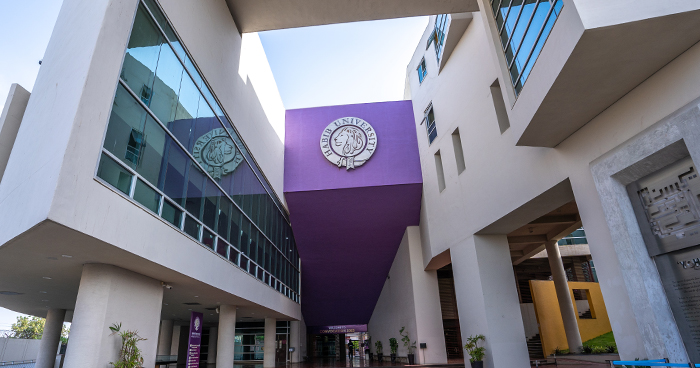
Some universities are also modernizing their CS degrees to include AI right inside the core curriculum. For example, Habib University’s BSCS program integrates advanced machine learning, deep learning, and even large-language-model coursework directly into its Computer Science track, giving students both the flexibility of a traditional CS foundation and early exposure to cutting-edge AI technologies. This blended approach allows students to remain versatile while still developing skills aligned with the future of intelligent systems and emerging tech careers.
Job Market: Which Degree Opens More Doors Today?
CS jobs: broad and mature
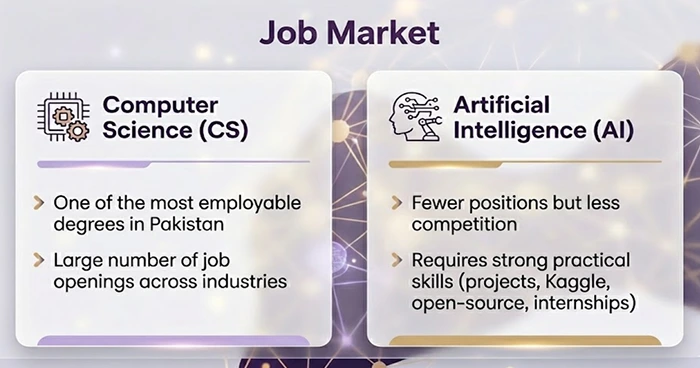
Pakistan’s job portals show hundreds to thousands of CS-relevant roles at any given time—software engineer, backend/frontend developer, QA, IT support, system administrator, etc.
Even if some reports point to 6–7% unemployment among fresh CS graduates, the key reason isn’t “no demand” but skill gaps, graduates lacking strong practical coding, problem-solving, and portfolio projects.
With solid skills, CS remains one of the most employable degrees in the country.
AI jobs: fewer in number, higher in value
On the AI side, you’ll see roles like:
- Machine Learning Engineer
- AI Engineer
- Data Scientist / Data Analyst with ML focus
- NLP Engineer, Computer Vision Engineer
Job postings for AI in Pakistan are rising, but they’re still far fewer than generic CS roles.
However, multiple recent reports highlight a serious shortage of AI-skilled professionals in Pakistan; universities are still catching up with industry needs.
The government’s National Artificial Intelligence Policy, which aims to make Pakistan a leader in AI readiness by 2035, signals strong long-term demand in this field.
If you want an AI career in Pakistan, the current situation is:
Less competition, but also fewer positions, and employers expect strong, practical skills (projects, Kaggle, open-source, internships).
AI vs CS Salary in Pakistan
Here’s where AI vs cs salary really gets interesting.
Recent data shows:
- An AI Specialist in Pakistan earns around PKR ~780,000 per year on average, with experienced professionals going much higher.
- An AI Engineer’s total compensation in Pakistan can cross PKR 2.3M+ annually at stronger companies and senior levels.
- Reports on high-paying tech jobs in Pakistan list AI engineers, data scientists, and advanced software engineers among the top earners, frequently above PKR 200k+/month in mid to senior roles.
In comparison, general software engineers (CS grads) often start lower and scale up more gradually, still very good pay relative to many other degrees, but on average a bit behind top AI roles at the same experience level.
Why AI Might be the High-Ceiling Path and Why CS Could Be the Safer Bet
Because of rising demand for data-driven decision-making and automation, professionals skilled in AI, ML, and data science are increasingly valued. According to local salary and job-market reports, AI engineers and data scientists in Pakistan can command substantially higher compensation compared to entry-level general developers, especially if they combine strong technical skills with project experience.
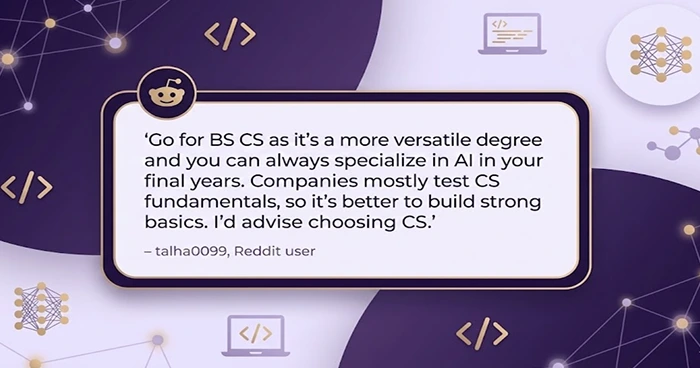
However, success in AI requires more than simply holding a degree. It often depends on proven competence in mathematics, experience with real-world data problems, familiarity with ML pipelines, and sometimes self-learning or continuous education (bootcamps, MOOCs, research, open-source). Many employers still test fundamental CS skills regardless of specialization. As one community member on Reddit put it:
“Go for BS CS as it’s a more versatile degree and you can always specialize in AI in your final years.”
In short, a degree in AI can offer a high ceiling — but the floor (entry-level stability and employability) is often stronger with a CS background.
Quick Comparison: When to Choose CS vs AI
Choose CS if you:
- Prefer flexibility, want to keep your options open across software, web, mobile, cloud, or system engineering.
- Are not yet sure whether you enjoy math-heavy, research-oriented work.
- Want a safer “in-demand” start to your career, with many possible paths.
- Might shift to AI/data later through electives, online courses, or a master’s.
Go for AI if you:
- Enjoy math, statistical reasoning, algorithms, and data-driven problem-solving.
- Are excited about ML, neural networks, AI/ML research, automation, data science, or machine-learning systems.
- Willing to put extra effort into practical projects, research, side studies, or continuous learning.
- Are aiming for higher long-term growth, competitive salaries, and (possibly) remote or global work.
The Verdict: Which One is Better for You
For students unsure about which direction to pursue, a Computer Science degree remains a reliable and flexible starting point. It builds strong computational foundations and opens pathways into software engineering, cloud computing, cybersecurity, data science, and, later, advanced AI work. If you enjoy programming, problem-solving, and broad exposure to multiple tech fields, CS gives you room to grow before deciding on a specialization.
Students who already know they are passionate about mathematics, data, and intelligent systems may find an AI-focused academic track more exciting. AI and machine learning skills are rapidly gaining importance across Pakistan’s tech ecosystem, making specialized study attractive for those committed to working in these domains early on.
However, the choice does not have to be binary. At Habib University, the BS Computer Science program intentionally blends CS fundamentals with advanced exposure to artificial intelligence, including courses in machine learning, deep learning, and modern AI architectures. This integrated approach allows students to build a strong generalist foundation while engaging with cutting-edge AI topics within the same degree.
Students exploring these fields can apply for admission through Habib University’s structured process, which welcomes applicants from national and international boards and offers generous financial aid to ensure access for deserving students.