
Overview Of the Program
Integrated Sciences and Mathematics (iSciM) at Habib University offers a diverse range of rigorous foundational and research-based courses that allow students from all disciplines to broaden their understanding of natural science and mathematics. Our interdisciplinary offerings profiting from various forms of design and community-based projects allow students to develop essential hard and soft skills required to understand and address complex problems. The program currently offers two academic minors in Physics and Mathematics.
Program Learning Outcomes
Through iSciM, based on their course selection, the graduating Habib students will:

Understand the foundations and the applications of the scientific method;
Understand the fundamentals of energy, environment, and global warming and learn key skills to address issues of present times;
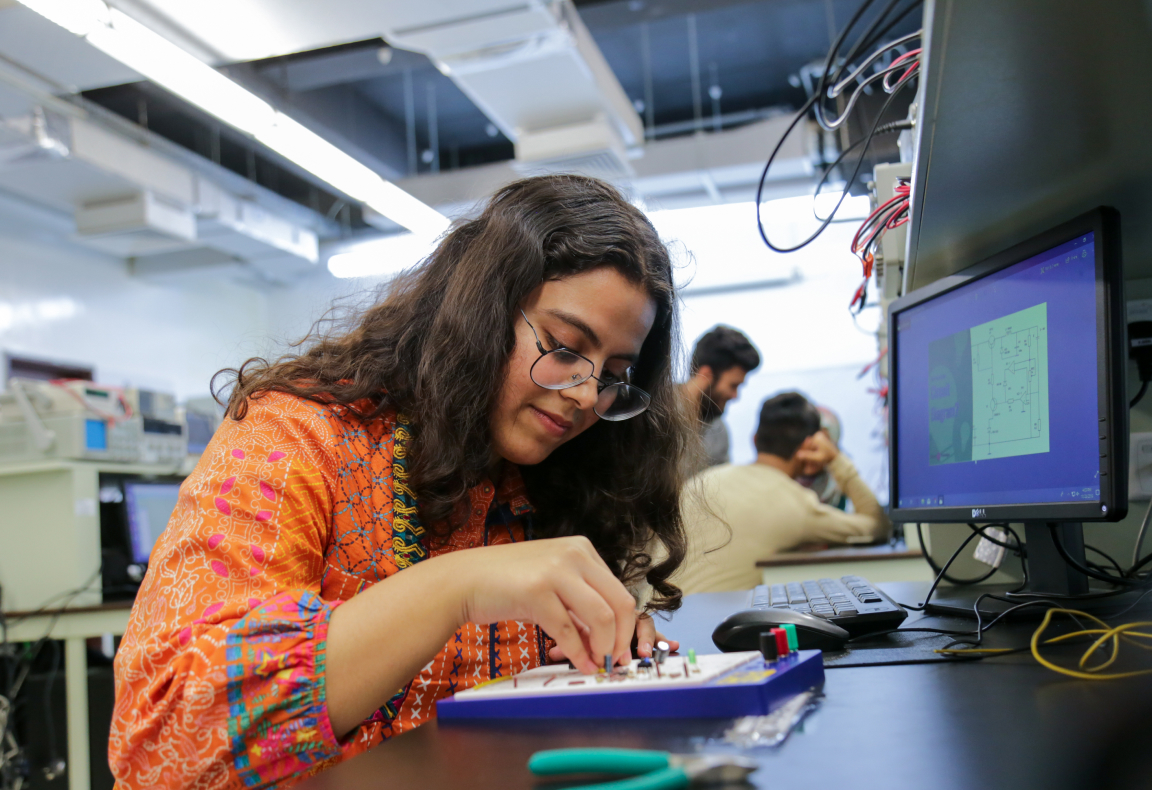
Develop experimental skills in physics, chemistry, and biology; develop a strong foundation in physics, chemistry, bio-sciences, environmental science, energy, and mathematics;
Understand the human body functions at cellular and molecular level and the effects of nutrition, microorganisms and environment on human health and society.
Develop strong skills in data analysis with an ability to use various software tools;
Develop a strong grasp on scientific writing;
Develop the ability to understand current research in various fields of science;


Curriculum Details
The Integrated Sciences and Mathematics (iSciM) program at Habib University focuses on several key areas that reflect some of the most pressing global challenges. These areas are not only academic but also encourage students to engage in real-world applications, preparing them to contribute to solving some of the world's most significant challenges. These areas include:
Courses:
Energy
Understanding and developing sustainable energy solutions is crucial in a world grappling with resource depletion and the environmental impacts of fossil fuels. The program explores various energy systems and technologies to promote innovation in clean and renewable energy.
Environment
Environmental sustainability is a central theme, with an emphasis on the preservation of ecosystems, natural resources, and biodiversity. Students are encouraged to think critically about human impact on the planet and solutions for mitigating environmental degradation.
Climate Change
The program delves into the science of climate change, its causes, and its global effects. Students learn to analyze climate data, model climate systems, and explore strategies to combat the ongoing environmental crisis.
Infectious Diseases
The study of infectious diseases is increasingly relevant in the context of global health. The program equips students with the knowledge to understand the spread, treatment, and prevention of diseases, while considering the socio-economic impacts of pandemics.
Global Health
iSciM addresses public health challenges from a global perspective, examining how social, economic, and environmental factors influence health outcomes. The program focuses on global health systems, health disparities, and strategies for improving public health worldwide.
Theoretical Physics
The program offers in-depth exploration of the fundamental principles of physics, from quantum mechanics to relativity. This area of study helps students grasp the laws governing the universe and prepares them for research and applications in advanced scientific fields.
Applied Mathematics
Applied Mathematics focuses on using mathematical concepts and methods to solve real-world problems, ranging from computational models to statistical analysis. Students learn to apply mathematical techniques to a variety of scientific and engineering disciplines, further enhancing their problem-solving abilities.
Our Faculty and Fellows
Our faculty is committed to fostering teaching excellence and shares the University's belief in the importance of an interdisciplinary undergraduate experience characterized by collaboration between faculty and students.