Nahj al-Balagha, Saying 80: al-ḥikma ḍāllat al-mu'min, fa-khudh al-ḥikma wa-law min ahl al-nifāq. Ḍālla in classical Arabic is a stray animal, and by extension any lost thing that still has an owner. Saying 79: "take wisdom wherever it may be." T. Qutbuddin (ed. and trans.), Nahj al-Balaghah: The Wisdom and Eloquence of Ali (Brill, 2024; open access); numbering per the Subhi al-Salih edition.
Sunan al-Tirmidhi 2687 (narrated by Abu Huraira): "The word of wisdom is the lost property of the believer; wherever he finds it, he has the greater right to it." Al-Tirmidhi himself described it as gharib (known through a single chain) and noted that one of its narrators, Ibrahim ibn al-Fadl, was weak; Darussalam grades it da'if, while al-Suyuti rated it hasan. For this reason the page leads with the Nahj al-Balagha and cites the hadith only as a parallel. Sahih al-Bukhari 91 (narrated by Zayd ibn Khalid al-Juhani): found property is to be announced for a year and returned to its owner if he comes; the stray camel (ḍāllat al-ibil, the same word Imam Ali uses for wisdom) is to be left, "as it has its water container and its feet, and it will reach water and eat of the trees till its owner finds it."
The tracker: paggi ("foot print tracker") in colonial Sindh, used in police investigations in 1942: Aftab Nabi, Policing Insurgency: The Hurs of Sindh (reproduced by Sani H. Panhwar). In the Thar–Kutch borderland, a pagi ("the person who shows the way in the desert") could read from a print the number of riders, weight, age and distance travelled: Wikipedia, "Ranchordas Pagi," a tracker born at Pithapur, now in Pakistan. Khoji is the Urdu and Punjabi word for a tracker (UrduPoint Urdu–English Dictionary).
T. B. Macaulay, Minute on Indian Education, 2 February 1835, in H. Sharp (ed.), Selections from Educational Records, Part I (Calcutta, 1920), §10; Governor-General's Resolution, 7 March 1835. See also P. V. Rao, Beyond Macaulay (2020).
Act No. XXIX of 1837 (Language of Judicial and Revenue Proceedings), Government of India; N. Green (ed.), The Persianate World (University of California Press, 2019).
Qatar Digital Library, "Prize Agents, 1857 and the Acquisition of the Delhi Collection"; British Library, Delhi Collection.
T. Qutbuddin (ed. and trans.), Nahj al-Balaghah (Brill, 2024). The page presents the sayings as the tradition has received them.
Global Wellness Institute, Global Wellness Economy Monitor 2025: US$6.8 trillion in 2024. An industry source.
P. K. J. Park, Africa, Asia, and the History of Philosophy: Racism in the Formation of the Philosophical Canon, 1780–1830 (SUNY Press, 2013); Stanford Encyclopedia of Philosophy, "al-Kindi" (P. Adamson).
Colonial surveys of indigenous education (Munro 1822–25; Adam 1835–38; Leitner 1882), in Dharampal, The Beautiful Tree (1983); B. Metcalf, Islamic Revival in British India (Princeton, 1982).
Tipu Sultan's library: British Library Asian and African Studies blog (2016); J. Ehrlich, South Asia 43:3 (2020). Granada 1499: D. Eisenberg (1992). Maní 1562: D. de Landa. Sarajevo 1992: A. Riedlmayer (1995). Timbuktu 2012–13: UNESCO World Heritage Centre, 21 January 2015; Hill Museum & Manuscript Library. Punjab University Library: HMML repository record (digitisation from 2025).
R. Ali, The New Yorker, 5 January 2017; F. Lewis, Rumi: Past and Present, East and West (2000); UNESCO, Representative List, "Mevlevi Sema Ceremony"; C. Ernst, Sufism (2011). Coleman Barks (1937–2026), and Rumi as a best-selling poet in the United States: Wikipedia, "Coleman Barks" and "Rumi."
S. Malook, The Friday Times, 21 November 2025, on the Pakistan Philosophical Congress.
E. Kohlberg, "Ali b. Abi Taleb ii," Encyclopaedia Iranica; R. Shah-Kazemi, Justice and Remembrance (I.B. Tauris, 2006/2007); Habib University motto: Nahj al-Balagha, Saying 81. G. Böwering, "Hojviri," Encyclopaedia Iranica, for Hujwiri in Lahore; Stanford Encyclopedia of Philosophy, "Ibn Sina."
M. Fricker, Epistemic Injustice (Oxford, 2007); B. de Sousa Santos, Epistemologies of the South (2014); S. Rizvi, inaugural Imam Ali Lecture, 3 March 2023; Habib University, "The Habib Liberal Core" (2024).
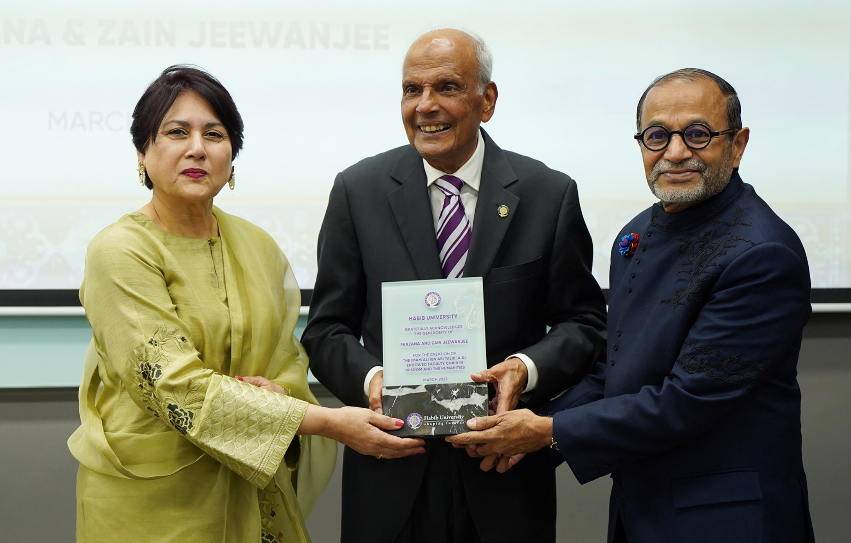
Donor biography and quotations: Habib University, Imam Ali Chair page (habib.edu.pk/imam-ali-chair), "Honoring the Generous Foresight of the Jeewanjees"; Habib University news, 4 March 2023 and 17 February 2025; Dawn and Business Recorder, 5 March 2023.
Chair remit and lecture series: Habib University news, 4 March 2023 and 17 February 2025; Liberal Core and Comparative Humanities programme pages. Yohsin Wall: Habib University news, "Enshrining the Dawood Habib Legacy," 8 January 2019.
Images: H. Woodrow (ed.), Macaulay’s Minutes on Education in India, Written in the Years 1835, 1836 and 1837 (Calcutta, 1862), School Books Archive, Azim Premji University. U. Sims-Williams, “Collections Within Collections: An Analysis of Tipu Sultan’s Library,” Iran 59:2 (2021), 287–307 (open access, CC BY 4.0); on the Kīmiyā-yi saʿādat, Wikipedia, “The Alchemy of Happiness.” Lecture photograph: Habib University news, 17 February 2025.
- Updated
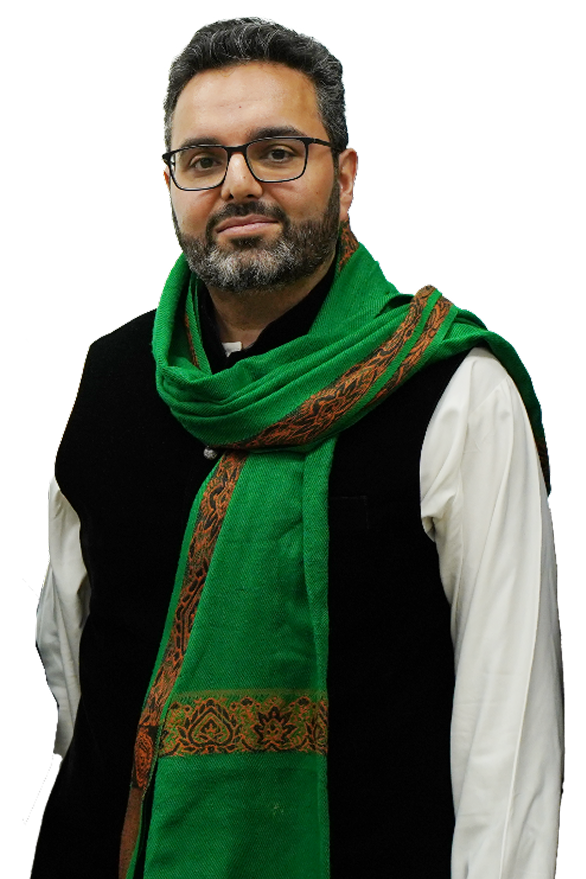
Habib University news, "Renowned Sajjad Rizvi Joins as Inaugural Imam Ali (AS) Faculty Chair in Wisdom & the Humanities, a Joint Chair with the University of Exeter," 15 October 2026; University of Exeter, profile of Sajjad Rizvi (experts.exeter.ac.uk/1253-sajjad-rizvi).