
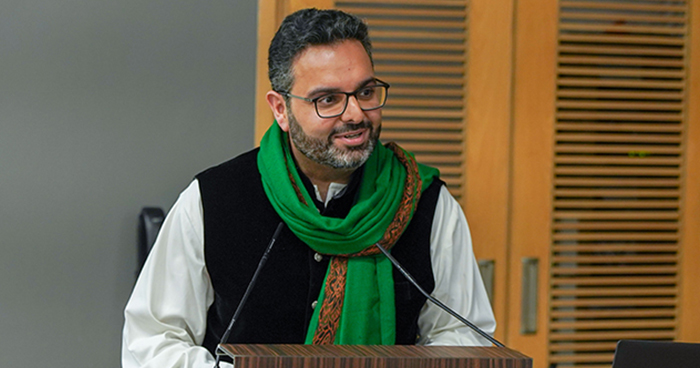
Renowned Scholar Sajjad Rizvi Joins Habib as Imam Ali (AS) Chair in Wisdom & the Humanities
Habib University is proud to announce the appointment of Sajjad Rizvi to the Imam Ali Ibn Abi Talib (A.S.) Faculty Chair in Wisdom and the Humanities, a pioneering academic initiative that in unique globally, dedicated to the study of wisdom traditions within the humanities.
A globally renowned intellectual historian and Professor of Islamic Intellectual History at the University of Exeter, Sajjad Rizvi is a scholar whose work explores the course of philosophy in the Islamic world, past and present, and especially in the Persianate world. He has taken part in numerous platforms and public conversations hosted by Habib University, and brings a well-established engagement with the university community to this transformative role. He joins Habib through a joint appointment with the University of Exeter, deepening the university’s institutional connection with a globally renowned institution.
The Chair is endowed through the visionary philanthropy of Silicon Valley entrepreneur Zain Jeewanjee and Farzana Jeewanjee, and the appointment marks an extraordinary milestone for higher education in the region. An endowed faculty chair is among the highest academic honors an institution can bestow. It is an enduring tribute to the benefactors who make it possible and a catalyst that draws global academic leadership into the university’s scholarly fabric.
Rooted in the Legacy of Imam Ali (AS)
The Chair takes its name and philosophical foundation from Imam Ali Ibn Abi Talib (AS), one of history’s most profound exemplars of intellect, justice, and spiritual wisdom. Celebrated across centuries through the declaration of the Prophet Muhammad (PBUH), “I am the city of knowledge, and ‘Ali is its gate,” Imam Ali’s life embodied the union of theoretical reflection and ethical action. His discourses, letters, and sermons, preserved in the Nahj al-Balagha (The Peak of Eloquence), remain vital touchstones of rhetorical brilliance, moral governance, metaphysics, and hikma.
By naming this pioneering Chair after Imam Ali (AS), the initiative anchors the pursuit of wisdom in a figure whose legacy champions universal human dignity, critical reflection, and the relentless quest for truth. It establishes an intellectual home where scholarship transcends technical competence, training minds to pursue knowledge as an instrument of service, justice, and societal renewal. At the same time, while being rooted in a tradition and figure of profound significance within Islamic intellectual history, the Chair is openly non-denominational and embraces all wisdom traditions, including Islamic, Indic, Greek, African, East Asian, and Western philosophical and spiritual traditions. Its vision is to create a pluralistic and dialogic space where diverse epistemologies, positionalities, and ontologies engage meaningfully with contemporary human challenges.
Repairing Sapiential Inquiry and Reviving Wisdom Traditions
The modern university inherited a narrowing idea of what counted as knowledge. Enlightenment ideals, carried across much of the world under colonial rule, defined legitimate knowledge as that which could be measured, verified, and separated from questions of ethics and meaning. Longer-standing traditions of wisdom and conceptions of pedagogy were pushed to the margins of the academy, dismissed as folklore, mythology, theology, or relics of the past to be curated and shelved, rather than recognized as serious ways of knowing and being.
The end of colonial rule did not simply undo this. Where these traditions have been recovered, they are often engaged only at the surface, as heritage to be celebrated or material to be catalogued, rather than as bodies of thought with their own rigor, methods, and claims on the present. Many in formerly colonized societies have also absorbed the same narrow view, and so measure their own intellectual inheritance by standards that were never designed to recognize it; their disdain often for their own intellectual tradition and their alienation from it reflects the continuous hold of colonialist epistemology.
It is this rupture from tradition that the Chair has been established to address, not merely to re-valorize tradition but to recover its intellectual life and vigor critically. Inspired by the intellectual and ethical legacy of Imam Ali (AS), it seeks to revive, institutionalize, and advance the study of sapiential knowledge: wisdom that integrates ethical reflection, philosophical inquiry, and lived human experience. It will bring rigorous scholarly attention to the world’s sapiential lineages, including the study of wisdom, logic, knowledge, and hikma, treating them as living, critical resources capable of guiding modern society through pressing systemic dilemmas rather than as passive historical artifacts.
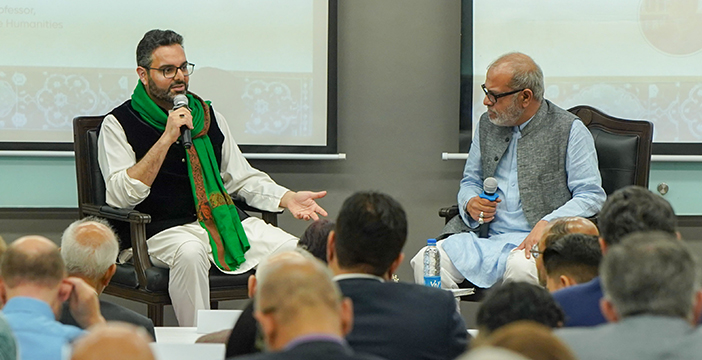
Sajjad Rizvi spoke to this imperative when he delivered the address at the inaugural Imam Ali Endowed Faculty Chair in Wisdom and Humanities Lecture in 2023:
“The concept of Hikma, or wisdom, is particularly relevant in today’s world, which is characterized by an over-reliance on technology and a tendency towards superficial understanding. Hikma provides us with a means to delve deeper, to cultivate a more nuanced understanding of ourselves and our relationship with the world around us and, develop a more profound sense of empathy and insight, which is essential for cognitive reparation.”
This purpose lies at the heart of Habib University’s mission. Founded in 2014, the university was established with a reparative mission: to address the ruptures in knowledge, language, and culture left by colonial modernity, and to re-anchor higher education in the realities and intellectual traditions of our own society. The Chair gives that mission a scholarly home, and a place where the work of repair is carried out with depth rather than gesture.
A Multi-Faceted Intellectual Platform at Habib University
The Chair is housed in the Comparative Humanities program, within the School of Arts, Humanities and Social Sciences, and the placement is deliberate. Comparative Humanities teaches philosophy, literature, history, and religion comparatively and critically, treating the Islamic and South Asian traditions as living interlocutors rather than case studies. The Chair anchors that work with a scholar of international standing and a mandate that reaches across five flagship initiatives.
The first is curricular innovation. The Chair will further infuse the Habib Liberal Core, particularly foundational courses such as Hikma (Wisdom), and the Comparative Humanities major with philosophical rigor and sapiential scholarship. The Liberal Core is an interdisciplinary curriculum required of every undergraduate regardless of major, and the Chair’s emphasis on sapiential lineages aligns with its flagship courses, where students critically examine inherited traditions of knowledge, ethics, and history.
Beyond the classroom, an annual lecture series will convene prominent global scholars and thinkers to foster public discourse on wisdom, the humanities, and contemporary society. A biennial international Conference on Wisdom and Humanities, the first of its scale in South Asia, where dedicated platforms for these discussions have historically been sparse, will bring regional and international scholars together. Finally, scholarly collaborations and community outreach will bring visiting scholars to co-teach, conduct joint research, and lead initiatives that carry philosophical inquiry into the broader public square.
Through this sustained investment, the Imam Ali Ibn Abi Talib (AS) Faculty Chair positions Habib University at the forefront of global reparative scholarship, bridging historical wisdom and contemporary education to help reshape the future of the humanities.