
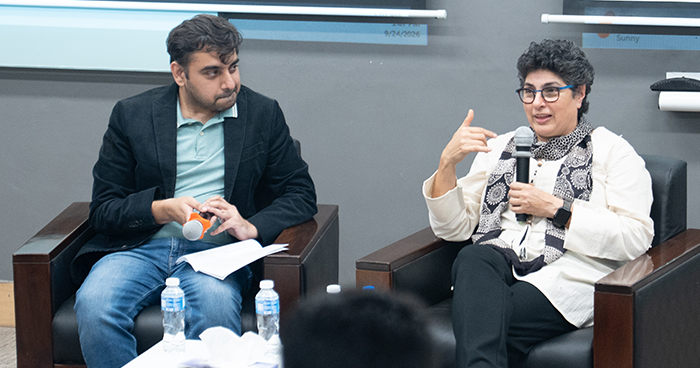
The Questions Only You Can Ask: Habib Students in Conversation with Dr. Nergis Mavalvala
What does it take to pursue a question for decades before knowing whether the answer exists?
For Dr. Nergis Mavalvala, the answer was not a single breakthrough, but a succession of smaller advances: intermediate goals, new technologies, and the patience to keep going.
During “The Questions Only You Can Ask,” a session with Habib University students during her visit for the 10th Yohsin Lecture, Dr. Mavalvala, Dean of MIT’s School of Science, reflected on the long road to the first detection of gravitational waves and the many steps that made that moment possible.
“To get to the ultimate goal, you have to set many intermediate goals,” said Dr. Mavalvala. “Supporters do not fund you for 25 years without any progress.”
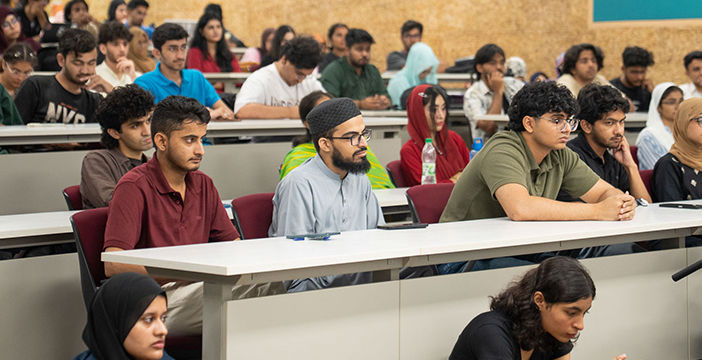
In the years leading up to the discovery, her team kept moving forward by inventing, patenting, and publishing the technologies needed for the eventual detection. Even an instrument that was not sensitive enough to detect a signal could still advance the work by placing limits on what the universe could contain.
Asked whether this meant that the journey mattered more than the result, she answered: “Yes, that’s really well put.”
When the gravitational waves were finally detected in 2016, her first thought was not of the discovery itself, but of her PhD advisor, Rainer Weiss, who had spent decades working toward it.
“The first thing I thought of was, ‘this was for you, Ray’,” she recalled.
A career is rarely as linear as it looks
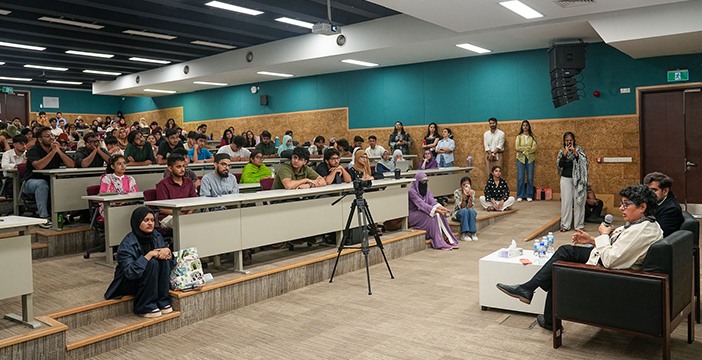
The students’ questions moved naturally beyond gravitational waves to the choices, uncertainties, and setbacks that shape a scientific career.
Asked whether she had always known what she wanted to do, Dr. Mavalvala described a trajectory that was broadly linear on paper but marked by several deviations along the way.
“My career has been pretty linear in the sense that I went to undergrad and did this and went to grad school and did this. But it wasn’t without some deviations,” she said.
She recalled failing her graduate exams before eventually passing them, and credited a supportive advisor who quietly gave her new problems whenever she faltered.
There were other detours, too. She briefly pursued professional squash and spent a year taking classes at Harvard Law School after living among law students during her graduate years. Neither path became a career. Both, however, led her back to physics with renewed enthusiasm.
Looking back, she was candid about the role of circumstance and luck.
“I had the privilege of those circumstances. I had these moments of breakdowns. And I had the ability to pop out and pop in,” she said.
Knowing when a question is ready
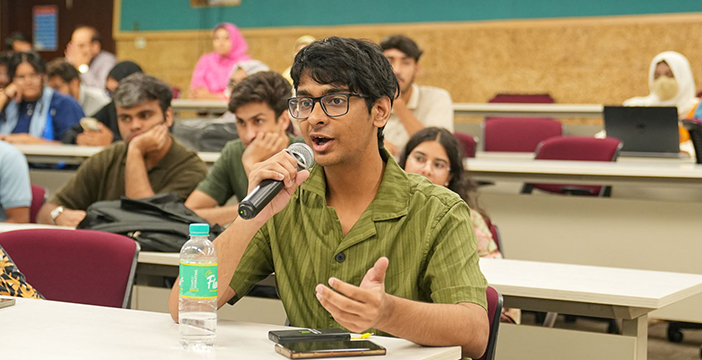
Another student asked how scientists decide which predictions or theories are worth pursuing.
Dr. Mavalvala’s answer offered a broader lesson about discovery: breakthroughs rarely emerge in isolation. Einstein predicted gravitational waves in 1916, but the possibility of detecting them became more tangible only after subsequent findings and technological advances, including the discovery of black holes and neutron stars and the invention of the laser.
“So, that’s what I meant by having sort of good taste in choosing the problems, knowing when the moment is right, because some other discovery or some other technology hasn’t enabled it [yet],” she stated.
The conversation eventually moved from the universe to something more personal: what Dr. Mavalvala reads. She said she mostly reads history and mentioned 1177 B.C.: The Year Civilization Collapsed, which she had recently read.
The range of questions was perhaps the most fitting reflection of the session itself. Students did not encounter Dr. Mavalvala simply as a physicist who had helped detect gravitational waves. They engaged with her as a scientist, mentor, educator, and individual whose career had been shaped by persistence, curiosity, failure, and opportunity.
Where Community Meets Global Scholars
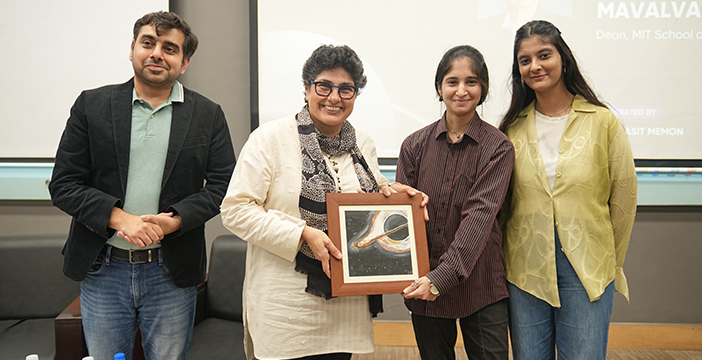
Dr. Mavalvala’s conversation with Habib students was part of her visit to Habib University for the 10th Yohsin Lecture, a lecture series that brings leading scholars and thinkers into direct access with the University and the wider community.
Over the years, the series has featured scholars including philosopher and linguist Noam Chomsky, author Dr. Reza Aslan, and oncologist Dr. Azra Raza.
The value of the Yohsin Lecture Series lies not only in bringing distinguished thinkers to Karachi, but in creating opportunities for students and the wider community to engage with them directly.
For students, that access can mean asking questions that extend beyond a scholar’s field — from the nature of discovery and the pursuit of difficult problems to failure, career choices, and the role of chance in shaping a life.