From Karachi to the Cosmos: An Afternoon of Curiosity with Dr. Nergis Mavalvala
On Thursday, 24 September 2026, Habib University welcomed the members of the Entrepreneurs’ Organization (EO) Karachi and their families to campus for the first time, for an afternoon with Dr. Nergis Mavalvala, Dean of the School of Science at the Massachusetts Institute of Technology (MIT), the first woman to hold that position, and a member of the LIGO team that made the first direct detection of gravitational waves in 2015. The gathering came on the eve of Dr. Mavalvala’s 10th Yohsin Lecture. It had a character of its own: entrepreneurs and industrial leaders sat alongside their spouses and children, and by the end of the afternoon the children were asking the questions.
The premise was simple, and very much Habib’s own. A university has a responsibility to the intellectual life of its city, and the most useful thing a scientist of Dr. Mavalvala’s standing can offer a room full of entrepreneurs and families is not a list of honors but an honest account of how curiosity is formed, protected, and sustained.
A University’s Responsibility to Its City
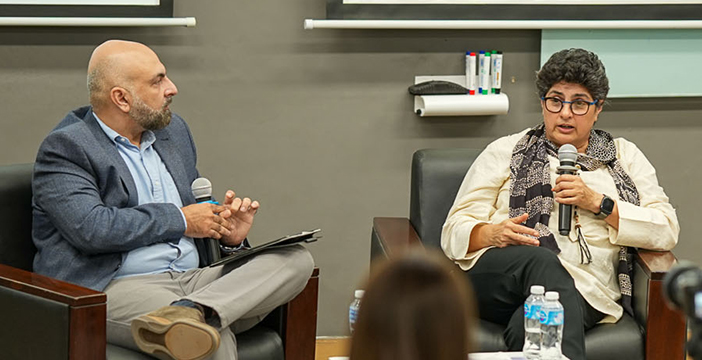
The series takes its name from Yohsin, the idea at the heart of Habib’s educational philosophy, which asks not only what we learn but what kind of person we become through learning. The afternoon was not about the accomplishments at the end of Dr. Mavalvala’s journey but “about the journey itself, where curiosity began, what kept her following it, and how it carried her to where she stands today.” Mr. Khurram Merchant, EO’s Global Learning Chair, who moderated the conversation, put it in Karachi terms: Dr. Mavalvala had proved that “with quiet endurance, relentless focus, and a bit of Karachi stubbornness, you can literally redefine our knowledge.”
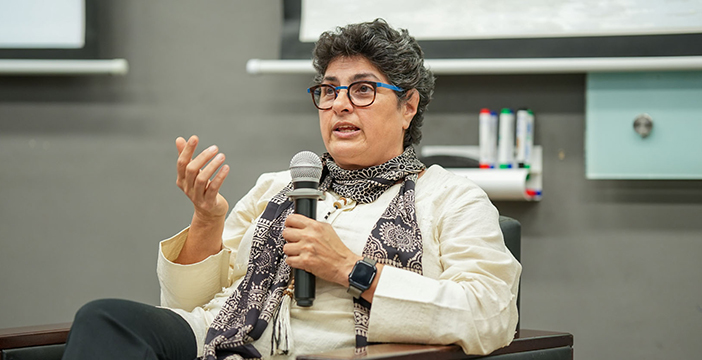
Dr. Mavalvala addresses the audience.
Why a Physicist Chose the Liberal Arts
For a liberal arts university in Pakistan, the most consequential part of Dr. Mavalvala’s story may be the part that had nothing to do with physics. She applied to MIT as an undergraduate and was turned down, and she is candid that this suited her. “I wanted to go to a liberal arts school,” she said. She went to Wellesley College instead; MIT “was right down the street.”
“Every single day I use the things that I learned in college that aren’t physics.”
The physics she studied as an undergraduate, she said, was in some ways “expendable,” because she learned it again in graduate school. “The rest of the things I learned as an undergraduate, I’ve never done again, and they’re still good for me.” As a dean she now oversees fields far outside her own, “everything from neuroscience to geoscience and mathematics.” “For good decisions, you should know a lot of things,” she said. “But you still have to know your trade the best.” It is a view Habib University has built its curriculum around: that a person trained in one discipline serves it better, and serves society better, for having been educated across several.
The Safety Net
If there was a single idea the conversation kept returning to, it was the safety net. Dr. Mavalvala’s parents did not attend college. “But they were very clear that their daughters were going to go to among the best schools in the city.” Her mother, she added, “really hates it when I say this, but I think she was a feminist.”
What her parents gave her was not academic guidance but something more fundamental.
“The safety net of knowing that they supported you, that they were going to be there for you, is all a kid needs.”
“Part of the reason I could be as adventurous as I was, was that I had a safety net,” she said. “Initially the safety net was my own family, and after that it was my academic family.”
Failure is a Gift
She failed her PhD qualifying examinations twice and passed on the third and final attempt. Disenchanted with physics for a time, she spent three months on the professional squash tour and a year at Harvard Law School. Neither took, and she returned to physics counting the detours among her gifts.
“Every failure was actually a gift. And so I don’t want to give away the gifts, even though they were painful at the time.”
Her advice to the young people in the room was correspondingly measured: “Risk is really good, but calculate it well.”
The Room Asks Back
A recent graduate of the University of California, Berkeley, asked how one sustains curiosity over so uncertain a horizon. “I was quite prepared that there may not be a detection in my lifetime,” Dr. Mavalvala said. When the signal (gravitational wave signal) came, her second thought was for the mentor who had started it all and who passed away last year: “This is for you, Rai.” To the head of a primary school asking how to draw more girls into STEM, she was direct: “It’s not on the girls. It’s on the rest of the system around them to fix itself.” To parents anxious about admissions, she offered relief rather than strategy.
“Life goes on beautifully well if you don’t go to an Ivy League.”
Then she paused the proceedings herself: “Can I just ask, do the kids have any questions?” A thirteen-year-old asked what she would tell her younger self. “Keep a more open mind, and say thank you more often.” Another asked how she became a dean. “Becoming a dean was my punishment,” she joked, before the real answer: “All the science I was able to achieve was because someone enabled it, and so it was time for me to enable others.”
Looking Ahead
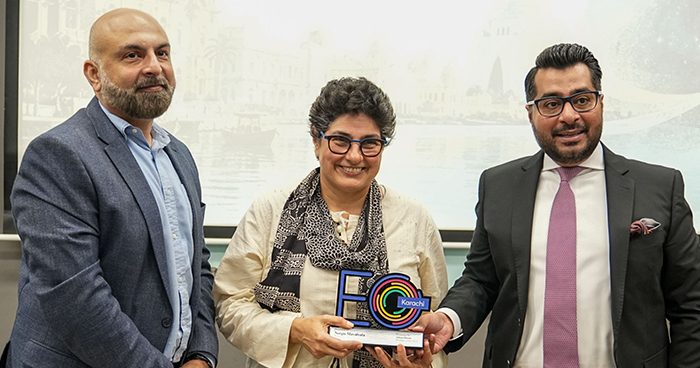
Closing the conversation, Mr. Merchant thanked Habib University for the openness with which it had taken on the event and expressed EO Karachi’s hope to be “a strategic partner for long-term learning” with the University. “I don’t know about you guys,” he said. “I don’t want this to end.” Mr. Adnan Hirani, President of EO Karachi, presented a shield of appreciation to Dr. Mavalvala, and a second to Habib University and its team, before the conversation continued over tea and a guided tour of the campus.
Mr. Adnan Hirani, President of EO Karachi, presents a shield of appreciation to Dr. Mavalvala, with Mr. Khurram Merchant.
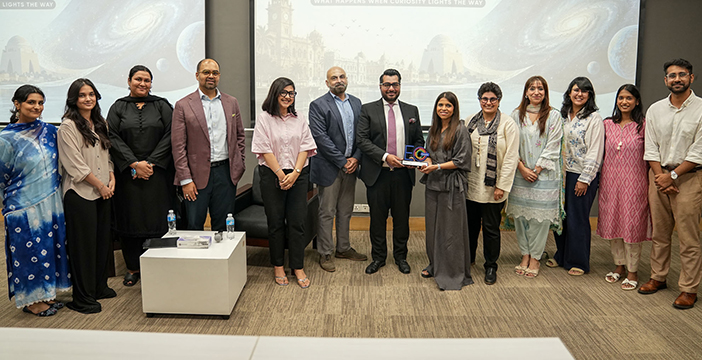
The Habib University and EO Karachi teams with Dr. Mavalvala after the presentations.
Dr. Mavalvala’s visit continued the following day with the 10th Yohsin Lecture, “The Joy of Discovery: Curiosity, Science, and the Pivotal Role of Universities.” The afternoon with EO Karachi was, in its own way, a preface to it. A scientist who helped open a new window on the universe told a room full of Karachi families that what made the difference was a bicycle, a few good teachers, a family that stood behind her, and a liberal arts college that let her study widely before she studied deeply.