

 Share Profile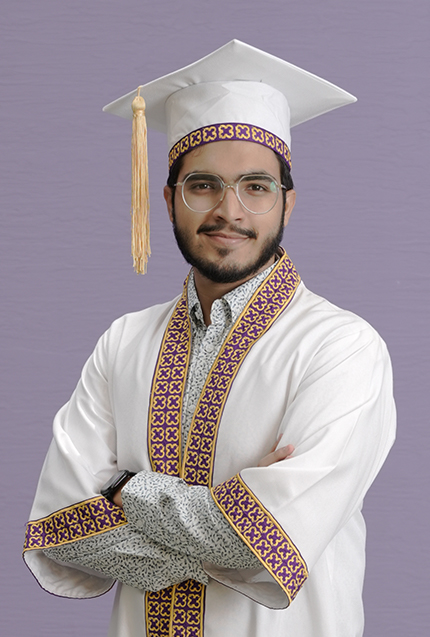
Meesum Abbas

Aspiration Statement
Driven by deep learning and real-time systems, my primary focus is engineering high-impact AI solutions. Ultimately, I aim to bridge complex technical architecture with user needs through product management.
Core Skills
- C++ & Algorithm Optimization
- Flutter, Dart & Firebase
- Machine Learning & NLP (PyTorch, Transformers, LLMs)
- Microservices & Threat Modeling
- OpenCV
Core Demonstrated Competencies
- Agility
- Collaborates Openly
- Drive for Results
- Strategic Thinking
Preferred Career Paths
First priority: AI/ML Engineer
Second priority: Product Management
Third priority: Backend/Full Stack Engineer
Academic Awards / Achievements
- Dean's List 2023, 2024, 2025
- President's List 2023, 2024
Experience
Leadership / Meta-curricular
- General Secretary, Araish - E - Khayal
- Volunteer At Nasa Space App Challenge, Natural Science Club, 2025
- 2nd Position Faculty Vs Students, Brain.Hack() - Computer Science and Engineering Club (CSEC), 2025
Internship / Volunteer Work
- SWE Intern, Motive (June 2025 – March 2026)
- Teaching Assistant, Introduction to Deep Learning, Habib University (August – December 2025)
- Teaching Assistant, Generative AI - Practices, Habib University (January – April 2025)
Publications / Creative Projects
- Research Paper – Research paper on "Food Hazard Detection (SemEval Task-9)" published in the Association for Computational Linguistics (ACL) Anthology in 2025.
- Research Paper – Research paper on "Early Detection of Depression (eRisk-2025 Task-2)" published in the Conference and Labs of the Evaluation Forum (CLEF) CEUR Workshop Proceedings in 2025.
- Competition – International competition participation at the International Collegiate Programming Contest (ICPC) Asia West Finals for Competitive Programming - Ranked 2nd in Pakistan in Round 2
- Competition – International competition participation at the International Collegiate Programming Contest (ICPC) Asia West Finals for Competitive Programming - Ranked Top in Pakistan in Round 3
Final Year Project
Project Title
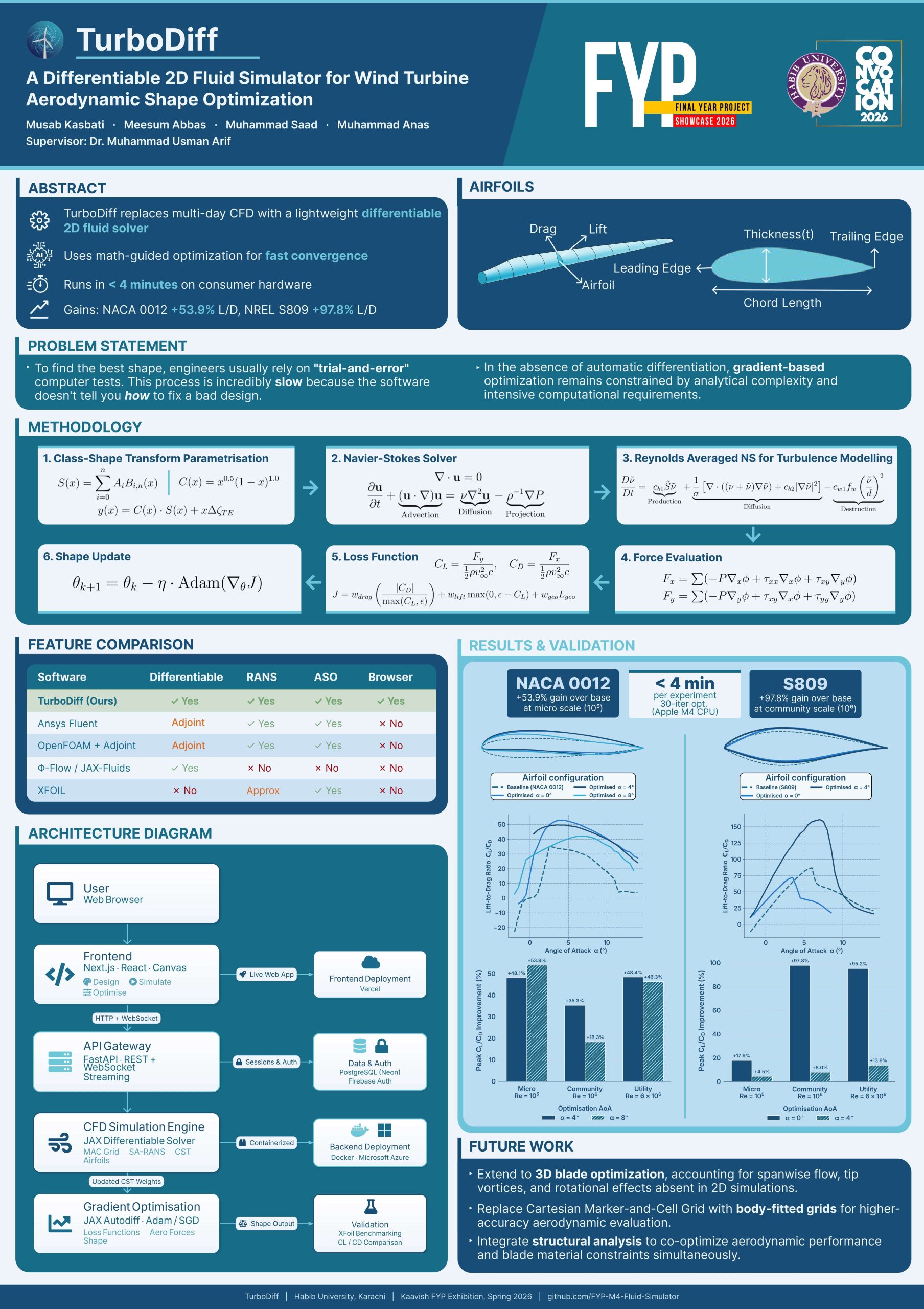
Turbodiff: Differentiable Fluid Dynamics Simulator for Airfoil Shape Optimization
Description
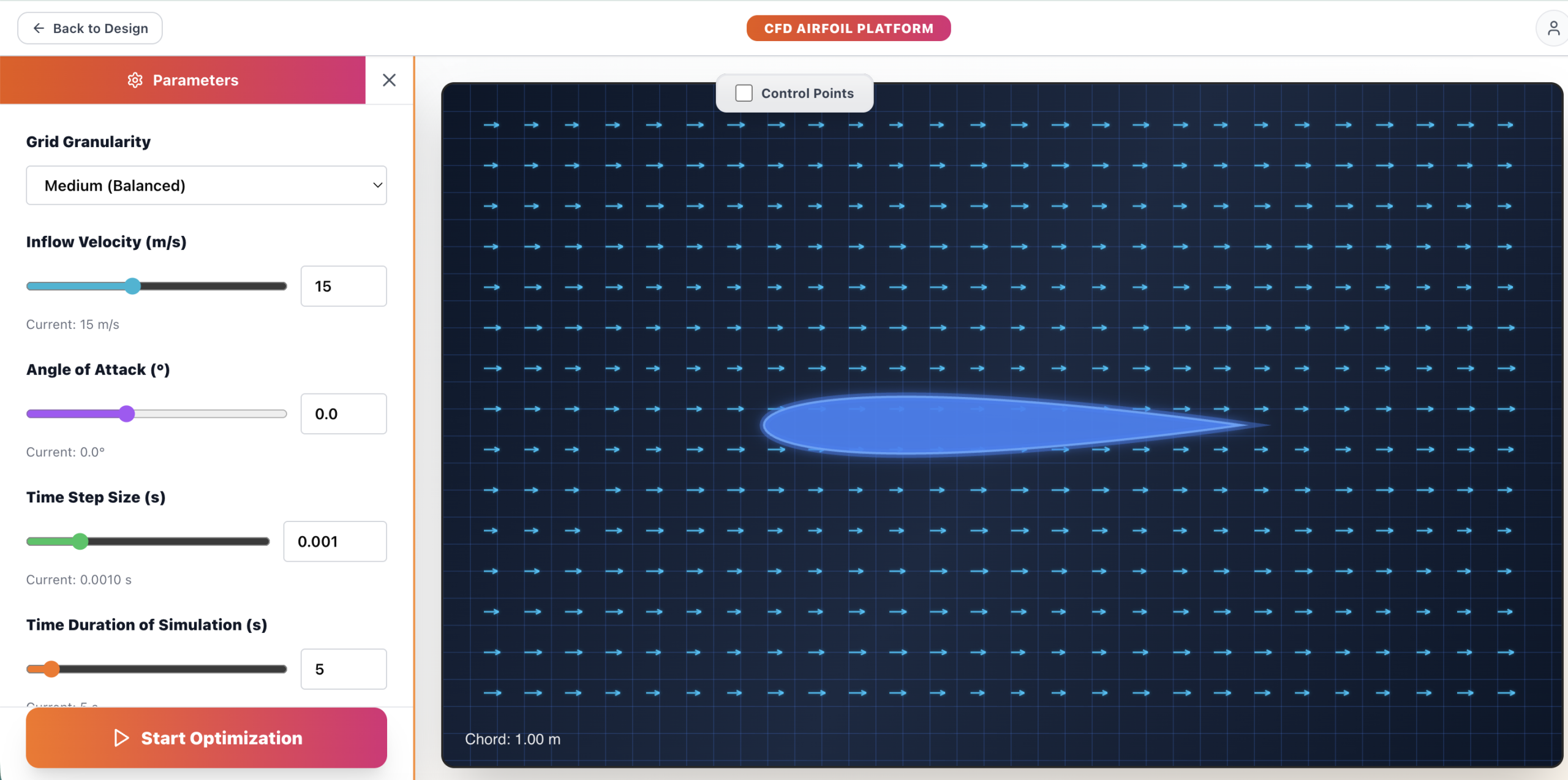
In this project, we engineered a custom Computational Fluid Dynamics (CFD) simulator with a novel shape optimization pipeline leveraging differentiable fluid dynamics to maximize airfoil efficiency. Traditionally, aerodynamic optimization requires computationally expensive iterative testing. Turbodiff solves this by applying deep learning-inspired back-propagation directly through the fluid simulation to perform gradient-based optimization of the airfoil geometry. The core simulator is built using JAX for fluid dynamics and incorporates Reynolds-Averaged Navier-Stokes (RANS) equations to efficiently model complex turbulent flows. Additionally, a secure web application enables users to simulate and optimize airfoils over the web and store/retrieve simulation outputs. Primarily, we aimed to provide an efficient, AI-integrated computational approach to aerodynamic design, allowing rapid optimization of airfoils for specific local atmospheric conditions.
Project Pictures