

 Share Profile
Maham Baqir

Aspiration Statement
I have majored in Comparative Humanities with a minor in Social Development and Policy, focusing on philosophy, history, South Asian, and global studies to explore pathways toward peace worldwide today.
Core Skills
- Academic Writing and Editing
- Canva
- Citation and Bibliography Formatting (APA, Chicago, MLA)
- Microsoft Excel
- Public Speaking and Moderation
- Qualitative Analysis
- Textual Analysis
- Event Planning and Execution
Core Demonstrated Competencies
- Adaptability
- Collaborates Openly
- Planning
- Takes Initiative
Preferred Career Paths
First priority: Academia/Writer/Researcher
Second priority: Advocate/Activist
Third priority: Film
Academic Awards / Achievements
- Dean's List 2023
Experience
Leadership / Meta-curricular
- NECHE Accreditation Intern for Habib University
- Vice President - Academic Affairs Cabinet, Habib University Student Government
- President, Philosophy Club
- President, Araish - E - Khayal
- Associate Editor, Pride Press
Internship / Volunteer Work
- NECHE Accreditation Intern, Habib University (March – May 2024)
- Orientation Leader (OL) For The Incoming Freshman Batch, Habib University (July – August 2023)
Publications / Creative Projects
- Exchange Program – Stanford Summer International Honors Program
Final Year Project
Project Title
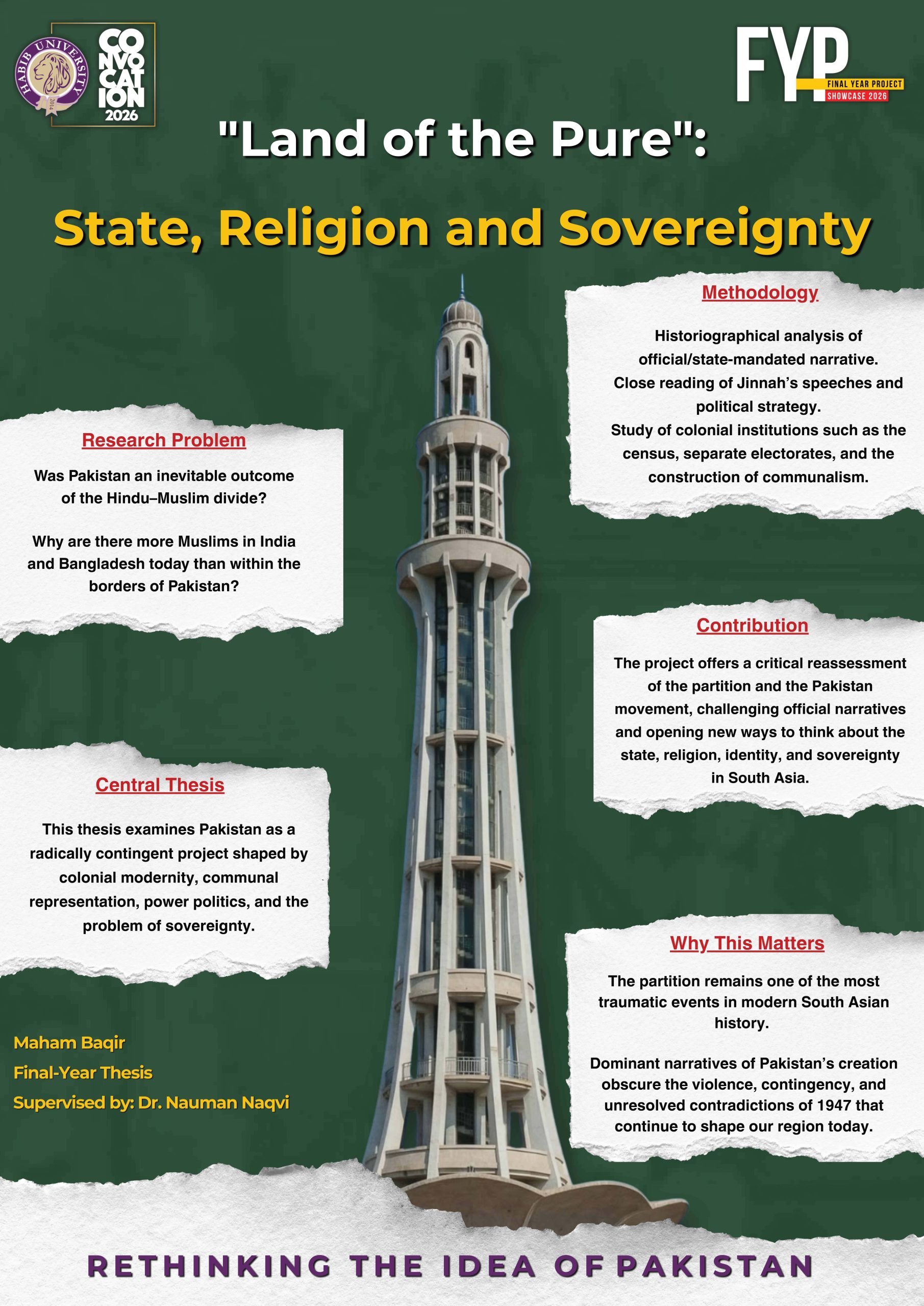
"Land of the Pure": State, Religion, and Sovereignty
Description
The dominant narrative within nationalist historiography reads the event of partition as an inevitable outcome of a religious divide between Hindus and Muslims. Even today, partition continues to be celebrated as the ultimate victory of Islam in the subcontinent. This thesis pinpoints key moments in the emergence of the idea of Pakistan. It explores how notions of religious and nationalist belonging have been forged. Particular attention is given to the political strategies of Muhammad Ali Jinnah in mobilizing the demand for Pakistan as a 'bargaining chip.' In doing so, it situates the Pakistan movement within the broader discourse on nationalism and the region's colonial modernity within the larger framework of modern history.
Project Pictures