

 Share Profile
Eeshal Khalidnadeem Qureshi
Hilton Pharma HU TOPS Scholar

Aspiration Statement
Curiosity drives my journey in tech. With front-end development experience and a trainee developer role, I’m passionate about learning, building impactful digital experiences, and exploring software development and UI/UX design.
Core Skills
- Git Version Control
- Html/Css Front-End Development
- Java/Springboot
- Python (Machine Learning)
- Rest Api Development
Core Demonstrated Competencies
- Collaborates Openly
- Drive for Results
Preferred Career Paths
First priority: Software Development
Second priority: UI UX Designer
Third priority: ML Engineer
Academic Awards / Achievements
- Dean's List 2023, 2024
- High Academic Leap Scholarship 2023
- High Achievement Scholarship 2024
- President's List 2023, 2024
Experience
Leadership / Meta-curricular
- Events Cabinet Team Member, Habib University Student Government
Internship / Volunteer Work
- Trainee Software Engineer, Folio3 (November 2025 – May 2026)
- Web Development Intern, Martechsol (May – August 2025)
Publications / Creative Projects
- Research Paper – Research paper titled “Classifying Pakistan’s Diverse Languages Through Speech Using Deep Neural Networks” published at the 4th International Conference on Communication, Computing and Digital Systems (C-CODE 2025)
- Research Paper – Proposing a CNN-based model for classifying regional languages with 85% accuracy
Final Year Project
Project Title
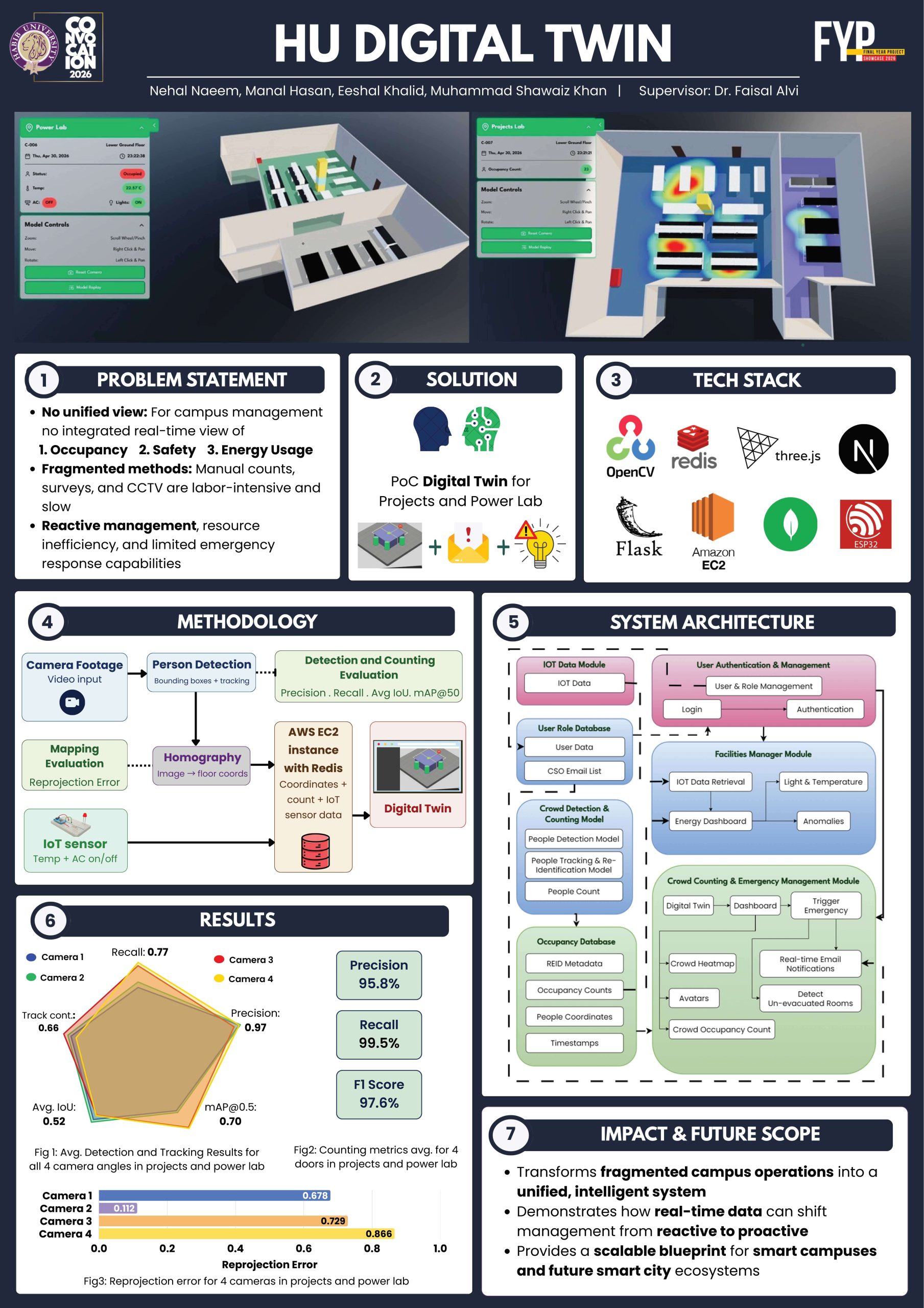
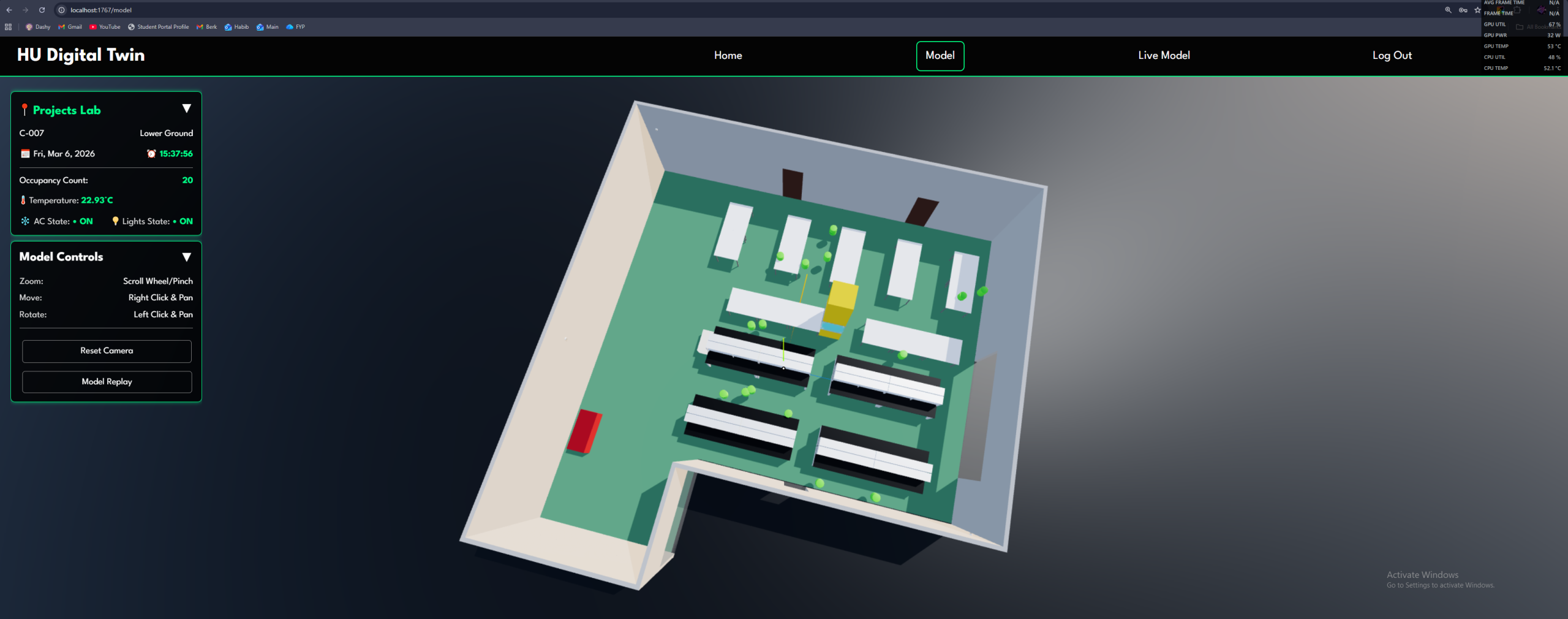
HU Digital Twin
Description
This project focuses on developing an AI-based system for real-time people detection, tracking, and counting using overhead cameras and deep learning techniques. The aim is to accurately estimate occupancy patterns in indoor environments and integrate this information into a digital twin framework. The system utilizes computer vision models for crowd monitoring and applies tracking methods to handle occlusions and movement across camera views. The purpose of the research is to support smart building management, improve safety monitoring, and enable data-driven decision-making for space utilization and emergency planning. The findings highlight that AI-based vision systems can provide reliable occupancy data, which can enhance digital twin models for better facility management, energy optimization, and efficient crowd management in smart environments.
Project Pictures