

 Share Profile
Aina Shakeel
Hilton Pharma HU TOPS Scholar

Aspiration Statement
Data science and machine learning enthusiast interested in building intelligent systems from real-world data. I aim to work on AI-driven solutions that improve decision-making, automation, and scalable technology applications.
Core Skills
- Data Analysis (Pandas, NumPy)
- Python
- Research Methods
- SQL
- Machine Learning (Scikit-Learn, PyTorch, TensorFlow)
Core Demonstrated Competencies
- Adaptability
- Collaborates Openly
- Planning
- Takes Initiative
Preferred Career Paths
First priority: Machine Learning Engineer
Second priority: Data Scientist
Third priority: Software Engineer
Experience
Leadership / Meta-curricular
- Speridian AIHackathon - 2nd Runner Up
- Vice President, Sports & Recreational Club
- General Secretary, Sports & Recreational Club
- Habib University Sports Olympiad Organizer - Vice President, Sports & Recreational Club
- Participant Basketball, Rowing, Powerlifting Competitions, Sports & Recreational Club
Internship / Volunteer Work
- Project Intern, Gerry’s DNATA (February – May 2026)
- Lead Instructor, Code School (August 2025 – May 2026)
- Undergraduate Researcher, Habib University (May – July 2025)
- Teaching Assistant - Database Systems, Linear Algebra and Object-Oriented Programming, Habib University (August 2024 – December 2025)
Publications / Creative Projects
- Publication – Classifying Pakistan’s Diverse Languages Through Speech Using Deep Neural Networks
- Conference Presentation – Published in the 2025 International Conference on Communication, Computing and Digital Systems (C-CODE), Islamabad
Final Year Project
Project Title
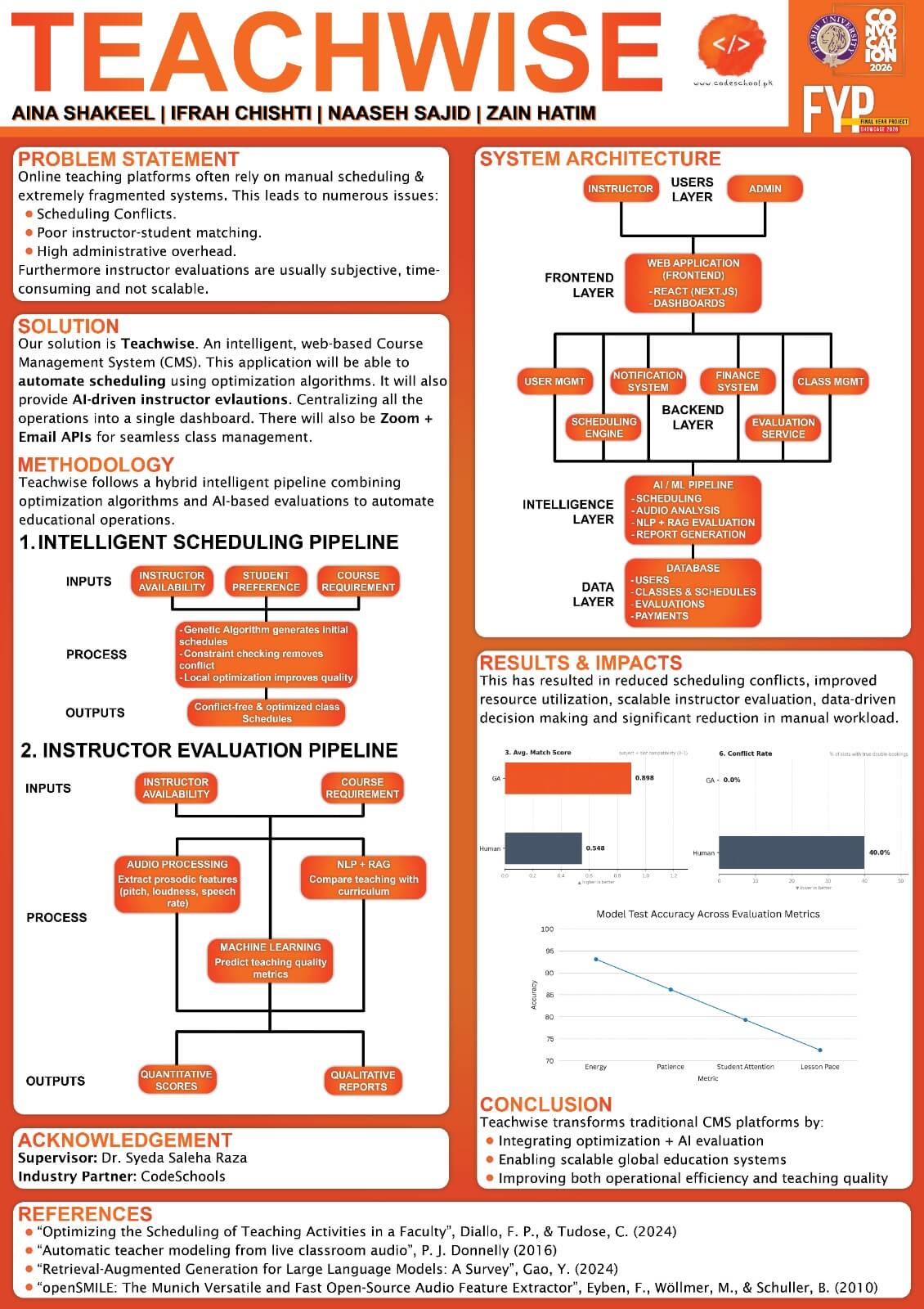
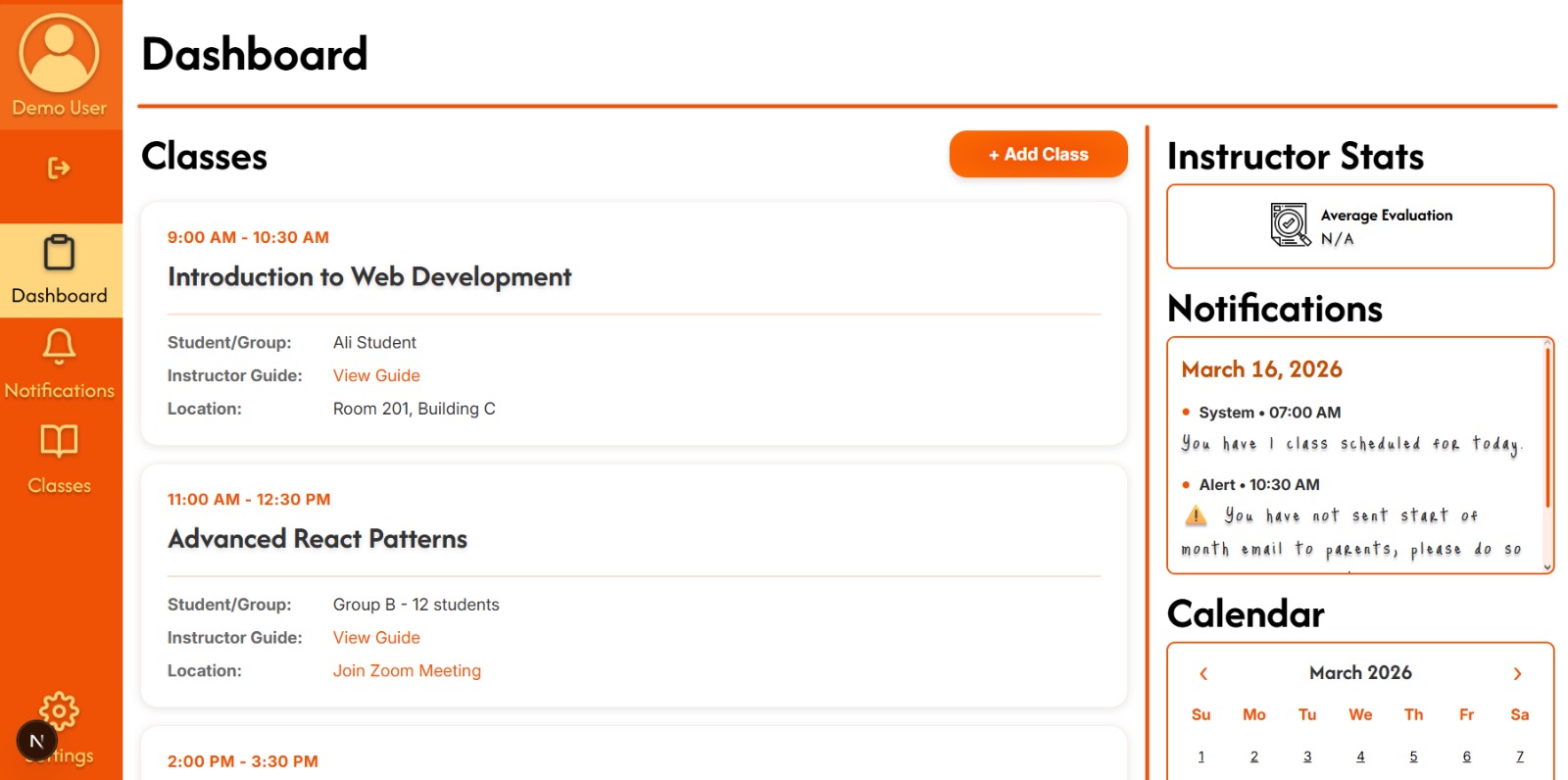
TeachWise: Automated Teaching Evaluation and Classroom Management
Description
This project develops an AI-powered system to automate classroom evaluation and academic management. The system analyzes lecture recordings by extracting prosodic audio features such as pitch variation, loudness, and speech rate, and uses machine learning models to assess teaching quality indicators including energy, patience, student attention, and lesson pace. In parallel, a retrieval-augmented generation (RAG) approach compares lecture transcripts with lesson plans to evaluate curriculum adherence. The platform also integrates scheduling automation and a content management system (CMS) for managing classes, recordings, and evaluation reports. By combining acoustic analysis and semantic evaluation, the system generates objective teaching assessments and structured feedback, enabling scalable and consistent evaluation of instructional quality.
Project Pictures