
Reshaping the Ethic of Giving: Wasif Rizvi’s Vision for Higher Education on Shan-e-Ramzan
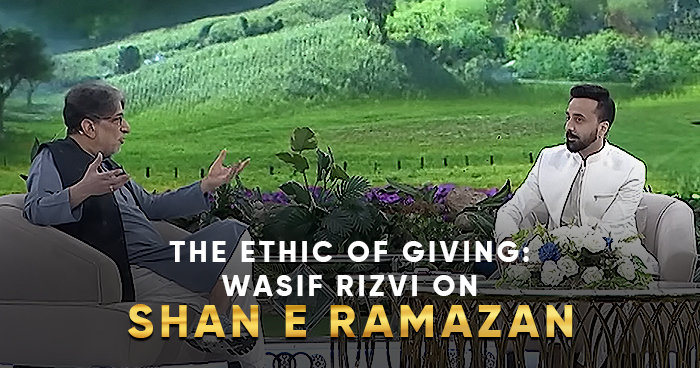
On March 20th, in a powerful segment on ARY Digital’s Shan-e-Ramzan’s closing episode for this year’s transmission, Wasif Rizvi, President of Habib University, joined host Wasim Badami to deliver a message that transcends traditional charity. As the holy month drew to a close, the conversation on the segment titled “naiki” that is centred on traditional charity for immediate relief causes, a critical but often overlooked theme was brought to light: the role of Zakat and philanthropy in building sustainable institutions of higher learning.
The Missing Link in Muslim Generosity
The segment opened with a reflection on the “lost heritage” of the Muslim world. Rizvi pointed out a startling paradox: while Muslims globally are among the most generous people, contributing hundreds of billions of dollars in Zakat and Sadaqah annually, less than 2% of this immense philanthropy is directed toward institutions of knowledge.
Rizvi traced this back to the “Golden Age” of Islam, where the ethic of generosity was the bedrock of civilization and social upheaval. Figures like Al-Khwarizmi, Ibn Sina, and Imam Al-Ghazali were not just individual scholars; they were the products of a system supported by communal giving. Today, however, that focus has shifted toward immediate, short-term relief, such as food and water, leaving the intellectual and developmental future of the community underfunded.
Why Higher Education?
During the segment, the host Wasim Badami, raised a poignant point: while feeding the hungry is essential, educating a student creates a multiplier effect. A single educated individual can go on to provide for hundreds of families, effectively reducing the overall number of people in need.
Rizvi expanded on this point, noting that in Pakistan, only about 11% of the eligible population (ages 17-25) is enrolled in tertiary education. The primary barrier to their access is cost. Here, he highlighted a “structural problem” where elite educational streams (like Cambridge and IB systems) dominate top university seats, while 98% of the student body coming from the Intermediate stream often finds itself priced out of quality higher education in the private sector.
Read: Benefits of Giving Zakat for Higher Education
Habib University: A Model of Institutional Zakat
Habib University was presented as a direct response to this crisis of higher education in Pakistan. Since its inception in 2014, the university has disbursed over $42 million in scholarships and financial aid. Remarkably, 87% of its students receive some form of financial support, making it one of the most generous institutions in the country and outside of North America. Additionally, a landmark achievement of the university’s mission has been zero dropouts since then, due to financial constraints.
Rizvi emphasized that Habib University does not follow a “conventional” scholarship model. Instead, it has built a structure where roughly 75% of the university’s operating costs are covered by philanthropy and community support, rather than student fees. This ensures that even students from the most humble backgrounds, those Rizvi calls “the potential Al-Khwarizmis of today”, can study alongside their peers with full dignity and zero financial burden.
A Call to Action for “Mohsineen”
The segment concluded with a stirring call to action. Rizvi invited viewers to “readjust” a portion of their generosity. He suggested that if even 10% of individual Zakat was redirected toward higher education, it could fundamentally transform the nation’s intellectual fabric.
Referring to donors as Mohsineen, a term from the Quran for those who do good with excellence, Rizvi argued that supporting a student is not a favour to them, but a duty toward the future of the civilization. As the video played in the background, depicting the “Tale of a Trillion” and the legacy of Muslim scholarship, the message was clear: to renew a nation, one must invest in the minds that will build it.
By positioning Zakat as a tool for institution-building, Wasif Rizvi and Habib University are not just funding degrees; they are reviving a civilizational ethic that seeks to solve poverty at its root, through the power of knowledge.
Watch the full video here