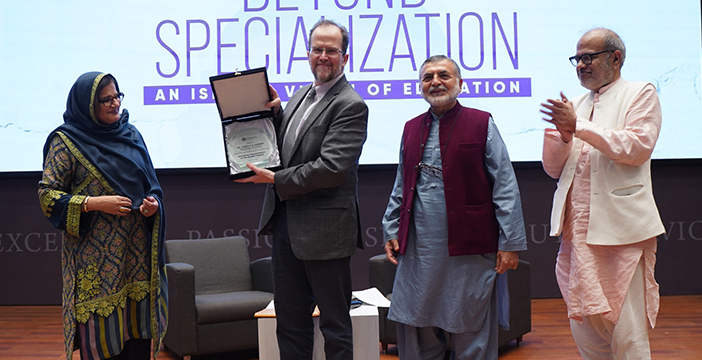
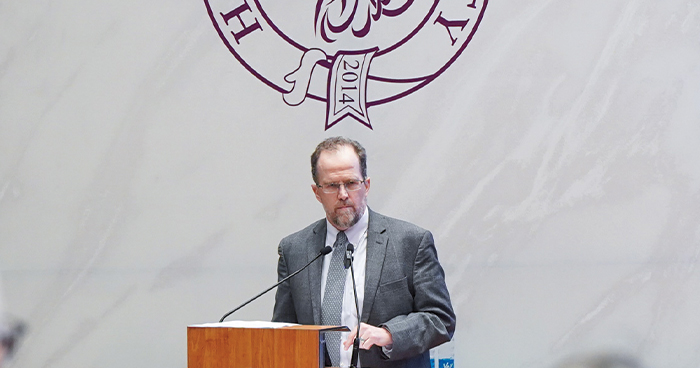
Dr. Joseph Lumbard Explores an Islamic Vision of Education at Habib University’s Reshaping Philanthropy in the Islamic World Lecture Series
“Nowhere in the Islamic tradition is knowledge understood as a human production. In fact, we can say quite the opposite. That dedication to knowledge produces us as regards both individuals and societies. We do not, as is too often assumed in modern parlance, produce knowledge. Rather, we transmit knowledge through knowledge. We cultivate knowledge through tarbiyah. We discover truth through kashf. We verify truth through tahqeeq. And we recognize truth through ma’rifah.”
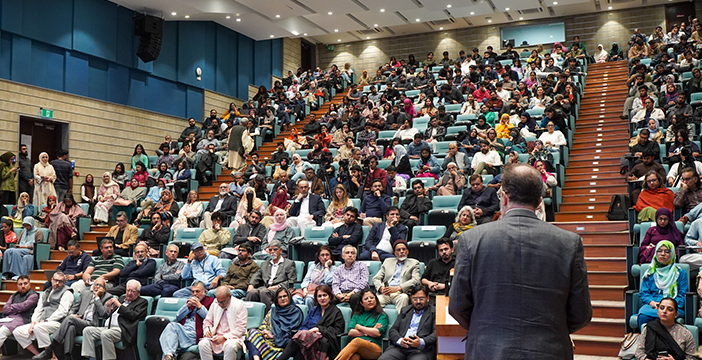
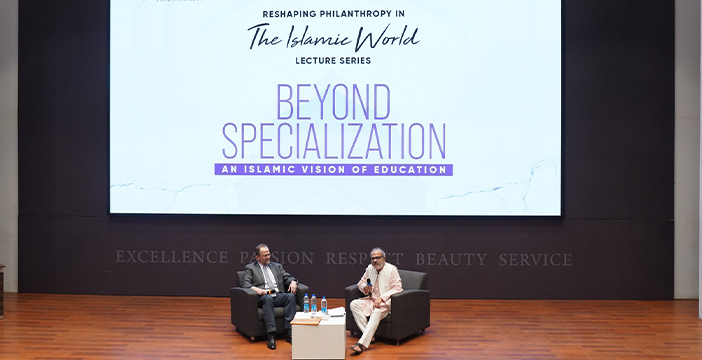 Dr. Joseph E. B. Lumbard delivered “Beyond Specialization: An Islamic Vision of Education,” the third public lecture in Habib University’s flagship Reshaping Philanthropy in the Islamic World Lecture Series, on Friday, January 16, 2026. The lecture brought together a wide cross-section of Karachi’s intellectuals, civil society, and thought leaders, alongside members of the Habib University community, including students and faculty, for a wide-ranging discussion on how Islamic knowledge traditions can address some of the fundamental challenges facing modern higher education.
Dr. Lumbard is an American Muslim scholar and Associate Professor of Qur’anic Studies at the Hamad Bin Khalifa University in Qatar. His scholarship spans Qur’anic studies, Sufism, and Islamic philosophy. His academic career has included appointments in Cairo, Boston, and Sharjah, and he has also served as Advisor for Interfaith Affairs to the Jordanian Royal Court under King Abdullah II.
 In his lecture, Dr. Lumbard focused on what he described as an intellectual crisis in contemporary higher education. He argued that modern academia has increasingly fragmented knowledge into isolated disciplines, often divorced from ethical purpose and spiritual meaning. Drawing on Islamic intellectual history, he presented a vision of education that seeks not merely to produce technical specialists, but to cultivate intellectually and morally integrated human beings.
He spoke about the effect of technology on humans that has resulted in cognitive decline and subsequently reduced knowledge and wisdom to information, “Increasing reliance upon technology creates a world where the very tools many now use to access information ensure that the human faculties required for knowledge act ever more rapidly. Study upon study has shown the cognitive declines associated with excessive social media immersion and now with the cognitive offloading through regular use of artificial intelligence. Once heralded as great tools of enlightenment, the computer, the internet, the cell phone, and now artificial intelligence drift further from these vaunted objectives as we humans succumb ever more to our basest desires.”
By linking knowledge with philanthropic institution-building, the lecture invited participants to reconsider how higher education might serve society in a more holistic and responsible manner.
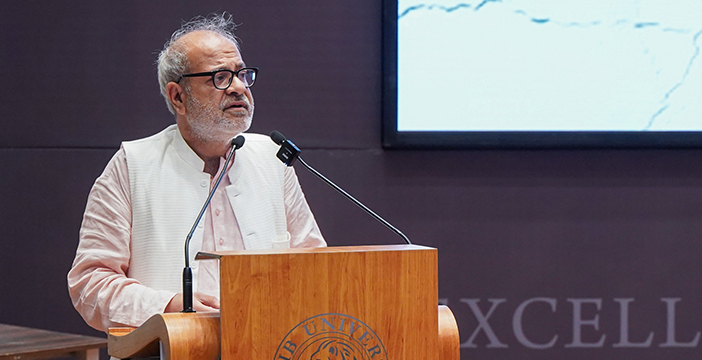
The lecture series was introduced by Dr. Nauman Naqvi, Associate Professor in the Comparative Humanities Program at Habib University, who highlighted the urgency of rethinking philanthropy as a long-term investment in knowledge, institutions, and ethical leadership rather than short-term charitable relief, “Habib University’s Reshaping Philanthropy in the Islamic World initiative is grounded in a critical intellectual and moral concern. While generosity in Muslim societies remain, charity and philanthropy can always be better. The direction of that generosity has increasingly drifted away from long term institution building, particularly in higher education, where sustained social transformation is made possible. Historically, Islamic philanthropy was not conceived as episodic or reactive charity alone.”
“Habib is reviving an Islamic tradition of philanthropy rooted in institution-building, intellectual growth, and lasting public good; reshaping giving beyond charity toward aspiration, and placing higher education at the heart of Pakistan’s future,” he shared.
The session concluded with a spirited Q&A segment, during which audience members engaged Dr. Lumbard on topics including the role of ethics in the pursuit of knowledge, the relevance of Islamic intellectual traditions today, and the institutional challenges facing higher education in Muslim societies. The event reflected Habib University’s ongoing commitment to fostering thoughtful dialogue on education, ethics, and social responsibility.
 Habib University’s Reshaping Philanthropy in the Islamic World Lecture Series addresses a critical gap by examining how Islamic traditions of giving can be reoriented toward building enduring institutions of knowledge. The series seeks to move philanthropy beyond short-term relief toward long-term transformation, positioning education as a moral and social investment for our time.