
The Gravity of Giving: An Evening with Dr. Nergis Mavalvala and Mohsineen
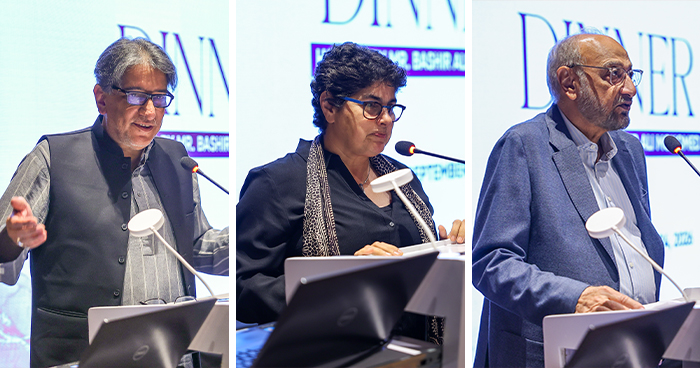
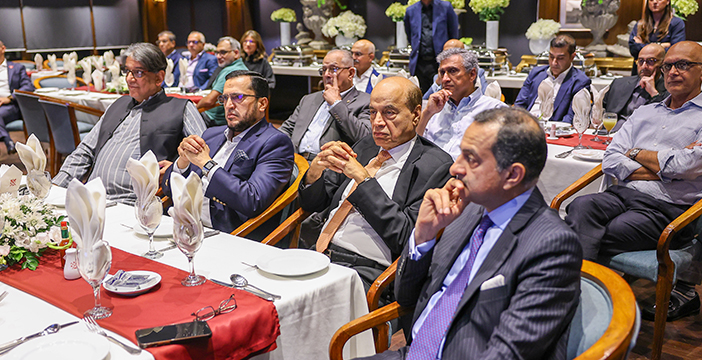
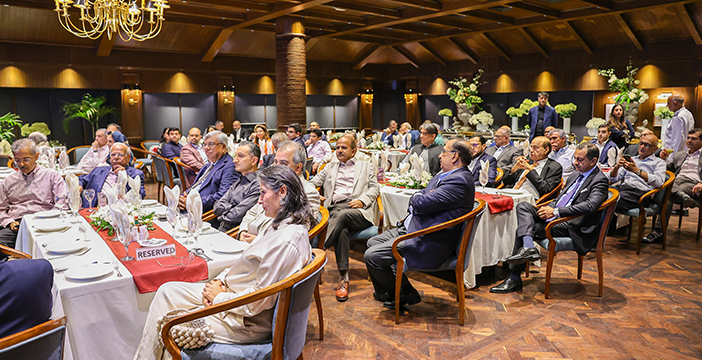
On Thursday, 24 September 2026, the night before the 10th Yohsin Lecture, Habib University’s community of Mohsineen came together for a dinner hosted by Mr. Bashir Ali Mohomed, Chairman of the University’s Board of Governors, in honour of Dr. Nergis Mavalvala, Dean of the School of Science at the Massachusetts Institute of Technology. The Yohsin Lecture brings a thinker of global distinction to Pakistan each year. The dinner, as the evening’s master of ceremonies Ms. Aqsa Junejo, Director of University Advancement, Marketing and Communications, put it, offered “something a little more personal”: the chance to hear Dr. Mavalvala “in a most intimate setting,” among the people whose generosity has built the University she was about to address.
“Not simply a visit, it is a homecoming”
Mr. Bashir opened the evening by recalling the Habib family’s founding vision of a world-class institution in Pakistan, “one that would provide an exceptional education while ensuring that talented young people are not excluded because of their financial circumstances.” That vision, he said, “has since been embraced by a remarkable community of Mohsineen, many of whom are with us this evening and have truly taken this cause as their own.” Today close to 90% of Habib’s students receive some form of scholarship or financial assistance, and in just over a decade, its graduates have gone on to advanced study at MIT, Harvard, Oxford, Cambridge, and the likes.
About the guest of honor, Dr. Mavalvala, raised in Karachi before leaving to study in the United States, he expressed: “This is not simply a visit of an eminent scientist, it is a homecoming.”
The joy of a root canal
President Wasif Rizvi followed with a special note of gratitude for all the attendees, including members of the Habib family, members of the Board of Directors and thought leaders and supporters from different sectors. His presentation, titled, The Joy of a Root Canal, piqued the audience’s curiosity from the opening slide. Building an institution of higher learning in Pakistan, he argued, meant choosing a painful repair over a cosmetic one. It was five slides, he warned the room, but true to his signature style, “it contains seven Ashaar from Ghalib, though. So, there’s no compromise there.”
He began with mentioning the celebrated economist Daron Acemoglu, Dr. Mavalvala’s colleague at MIT, whose work shows that nations that prosper are those that invest in institutions. “It’s one thing to write about it,” Mr. Rizvi observed, “and the other thing is to build it.” Pakistan has certainly built: the number of universities rose from 161 in 2014 to 248 in 2024. Its standing in tertiary education barely moved over the same decade, and the country sits 168th of 193 on the Human Development Index.
Habib’s answer took the form of three drills. The first was a coherent undergraduate education rooted in a Liberal Core, of which Stanford’s Dr. Alexander Key has said that “Stanford University can learn from Habib’s Liberal Arts model, and especially the Liberal Core.” The second was access. A university that recovered its costs from students, Mr. Rizvi said, “would price out 98% of the students. We thought, no. We will build the most radically generous private university model that exists anywhere.”
The third drill went, as his slide put it, “straight into the aching molar”: persuading a community for whom “the idea of building an institution and that too of higher learning is not something that people are familiar with.” Less than one per cent of Pakistani philanthropy reaches higher education. Habib’s response was to reshape philanthropy itself, reimagining Zakat as a means of opening access and building pathways for enduring legacies.
The X-ray came last. Habib University has been granted Candidate for Accreditation status by the New England Commission of Higher Education (NECHE), the body that accredits Harvard, MIT and Yale, on a timeline of four years rather than the usual seven. The signs of recovery, President Rizvi said, are in the students: 3,099 students and alumni since inception, and 97% of graduates from 2018 to 2025 in employment, entrepreneurship, freelance work or graduate study.
He closed by turning to the room. “We didn’t want to cut paste whatever was happening in higher education. We didn’t want to have the same financial model. And we took the challenge of coming and talking to all of you. Rafiq sahab and I are fortunate that all of you resonated.” Then the last of the seven couplets, which he offered as the community’s own:
رگوں میں دوڑتے پھرنے کے ہم نہیں قائل
جب آنکھ ہی سے نہ ٹپکا تو پھر لہو کیا ہے
Ordinary blood, he glossed, merely circulates. “The real one is the drop of passion that comes out of your eyes.”
“I am one of those”
Dr. Mavalvala began where the evening had placed her: at home. “I grew up in Karachi. I grew up in a family that really valued education.” At the Convent of Jesus and Mary, she discovered she liked working with her hands, a story she told through the bicycle she could not afford to have repaired. She took it to a shop, “and the man there, without ever telling me what he was doing, taught me how to repair a bicycle.” The lesson, she said, is the one Habib is built on: “if you teach a person to fish, they will eat every day as opposed to if you catch a fish for them, they’ll eat that one time.”
She wanted a liberal arts education, because the A-level system “is a narrowing funnel” and she knew she was missing “some greater body of knowledge.” But she recalled: “when I finished high school here, there was no Habib Universities at the time,” and her family “could hardly afford a local education, leave alone an international one.” What changed everything was a letter. “One of the most, if not the most consequential events of my life, was opening a letter that contained a very generous financial aid package from American colleges.” She went to Wellesley College, then to a PhD at MIT.
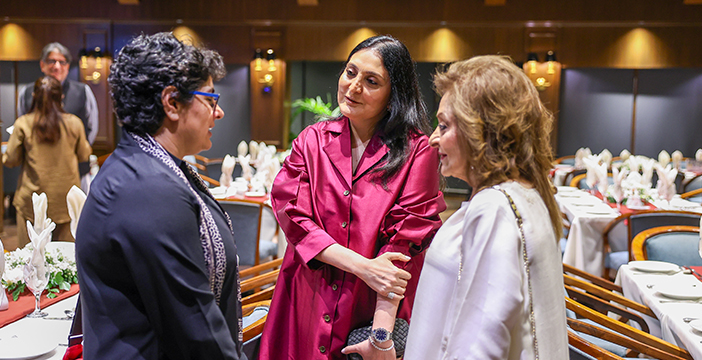
“All of our successes, for every one of us, is built on the generosity and mentorship of those who came before us,” she told all the Mohsineen in the room. Then, looking at the figures President Rizvi had just shown: “So the statistics you showed for the students, your students here at Habib University- I am one of those.”
At MIT, Dr. Mavalvala walked through an open office door and met Rainer Weiss, who described a quest to detect gravitational waves, which would require measuring changes in spacetime “smaller than a thousandth of a proton.” When he asked what she could do, she told him she could fix bicycles. “So it came full circle.” She joined “not because it was easy, and in fact, it seemed impossibly hard,” and stayed for the pleasure of inventing every instrument they would need. LIGO’s first detection came a quarter of a century later; one of the most joyous moments of her life, she said, was watching Weiss receive the Nobel Prize in 2017. To her own students she now says: “if you’re not breaking things every now and then, you’re not pushing the envelope.”
As Dean of MIT’s School of Science, she added, her liberal arts degree “is coming to use every time we’re talking about something that is outside of the things that I specialized in.” Asked often what gives her hope, her answer is her students: “knowing that I’m doing an ever so slight little piece to change their lives and, therefore, to change all of our collective futures.”
What came before us
The two speeches were, in the end, one argument. Dr. Mavalvala put it plainly: “all of us are made from what came before us. And that the drive to do something that’s hard has to be supported and amplified in people and resources.”The following evening, on the campus in Karachi, Dr. Mavalvala delivered the 10th Yohsin Lecture, The Joy of Discovery: Curiosity, Science, and the Pivotal Role of Universities. The dinner that preceded it had already made the case for the second half of that title. A girl from Karachi who could fix bicycles helped humanity hear the universe because someone, somewhere, opened a door. In this city, a community of Mohsineen is holding one open.