
Pedagogical Development Week 2026: Orienting Oneself in a Disorienting World
At Habib University, high-quality education is not only delivered through classroom lectures but also shaped by faculty members’ pedagogical innovations. These innovations encourage faculty to see themselves as more than teachers: mentors, facilitators, and co-learners. Likewise, students assimilate the outcomes of these approaches, developing skills such as critical thinking, appreciation of diverse perspectives and experiences, and a problem-solving mindset that they bring into the classroom. Pedagogy, whether through technological or non-technological interventions, brings interdisciplinary practices, fosters inclusive environments, and serves to deepen the relationship between students and faculty.
The Office of Teaching & Learning (OTL) serves as a prime mover in shaping and formulating academic programs that foster innovation, collaboration, and meaningful student engagement. Apart from supporting faculty members in curriculum design and pedagogical development, OTL creates an environment where faculty feel a sense of belonging and shared purpose. OTL leads the planning and implementation of Pedagogical Development Week, an annual initiative that brings faculty and fellows together to reflect on teaching practices, share experiences, and explore new educational strategies. By prioritizing contextually relevant course content and inclusive teaching practices, the office, together with faculty, ensures that learning resonates with students’ lived experiences while equipping them to engage critically with global challenges.
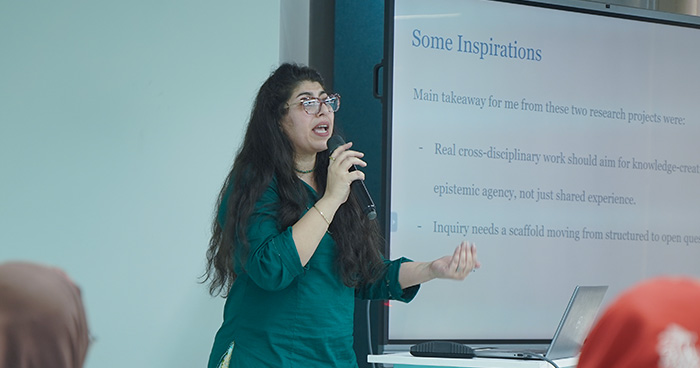
This year, Pedagogical Development Week invited faculty to reflect on a question that is increasingly difficult to avoid: how do we teach in a world that itself appears increasingly disoriented? Under the theme “Orienting Oneself in a Disorienting World,” PDW’26 brought together faculty and fellows to examine teaching in relation to Habib University’s evolving strategic priorities and the changing realities confronting higher education. The week created a space not only to discuss what happens inside classrooms, but also to reconsider the purposes behind everyday teaching decisions. Through workshops, panels, peer-learning sessions, and discussions, faculty explored the changing relationship between content, pedagogy, assessment, and community- the four dimensions of Habib University’s CPAC model. The conversations addressed some of the most pressing developments shaping education today, including artificial intelligence, assessment design, interdisciplinary and project-based learning, complex social challenges, inclusive learning environments, and the increasingly tangled relationship between theory and practice.
At the heart of these conversations was an understanding that education cannot remain static while the world around it changes. The question, therefore, is not simply how educators can respond to change, but how they can help students develop the intellectual and ethical orientation needed to navigate it.
Reorienting to the Centre
The week kicked off with a return to the heart of the university: the student learning experience and undergraduate education. In “Reorienting to the Centre: Faculty/Fellows and the Year Ahead,” faculty considered how all of these institutional, program, and day-to-day decisions in the classroom actually connect in their students’ lives. It emphasized the importance of the role of Boards of Studies in the evolution of an academic course, and all full-time faculty members were involved in this process. Habib’s course design is based on the CPAC approach (Content, Pedagogy, Assessment, and Community), which means that learning in the classroom is a purposeful and connected process.
One session in particular centered on Habib’s liberal arts identity. The Liberal Core is more than a university requirement; it is a part of students’ learning; it does not only focus on a specific major, but it is important for contextual and historical awareness for all students regardless of their major. The Liberal Core and the students’ majors need to communicate with each other, the session argued. In addition to being knowledgeable about a particular discipline, students must also be educated on the overarching questions, perspectives, and ways of thinking that characterize a liberal arts education, while their study of the discipline is deepened and enhanced.
The discussion also recognized the challenges of faculty and institutions. Teachers are experiencing a lot of change, whether it’s pressure from artificial intelligence, concerns about teacher well-being, or constant changes in course content. However, as the session highlighted, the identification of institutional “holes” is a crucial first step in addressing these. Purposeful teaching starts with the premise that institutions are not perfect; it starts with the commitment to discover what needs attention and commit to improving together.
Teaching in the Age of Polycrises
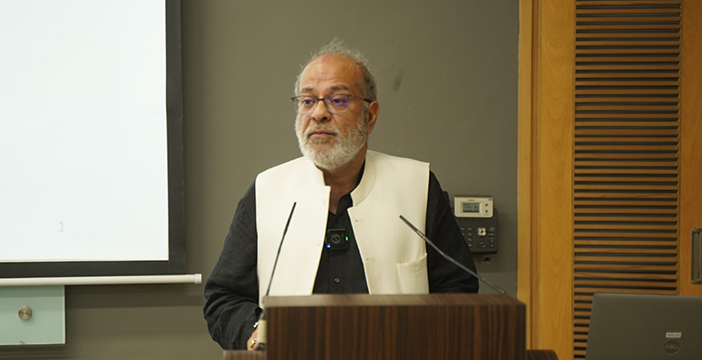
To prepare students for a world they will enter, the University must recognize the nature of that world. Dr. Nauman Naqvi’s “Polycrises & Pedagogies” explored a period in which climate change, economic instability, political unrest, public health issues, technological disruptions, and artificial intelligence cannot happen independently. They complement, reinforce, and impact everyday life at the same time. The session encouraged the teachers to reconsider how students were being situated in this reality. The notion of the “infantilization” of the learner, as an infant who needs to be shielded from challenging situations, was challenged by the discussion; one that rejected the notion that the learner is a child who should be protected from challenge.
“It is a generous thing to save a person from suffering: it is a theft to deny him adulthood,” said Dr. Nauman Naqvi.
This notion was carried over to the pedagogy itself. Education cannot proceed in the same way if the problems of the world come at the same time, in separate disciplinary compartments. According to Dr. Naqvi, “The world does not come departmental.” These challenges that students face outside of the university are interrelated, and students need to be provided opportunities for learning about the interdependence of these challenges. This conversation also brought the motive of Habib back to its postcolonial liberal arts approach and a point he made, that “postcolonial is not just an issue for the Global South and extends beyond it”. In this sense, education is an opportunity to reflect on the underlying principles of concepts like progress, modernity and development, and to question whose histories and knowledge have been privileged.
Visualizing Theory, Making Learning Visible
Dr. Behroze Mirza discussed how to make complex ideas meaningful to students in the session, “Visualizing the Course Design: The Quad-A Perspective!” Four pedagogical strategies were introduced in the session – Archetypal, Artistic, Analogical, and Atangent – as methods to incorporate simplicity and sophistication in course design. The second, archetypal, is a means of addressing a common student question: “Why do we need to study this old or seemingly outmoded theory? Instead of “retrofitting” older concepts out of fashion, faculty members can show how the older theories are still relevant and how newer concepts can be traced back to older theories.
This approach was well exemplified with the perceptron. The perceptron was developed in 1958, and it can be considered an early form of the machine-learning systems that underlie many of today’s AI systems. The same idea that seems to students to be an antiquated idea can then become a way of gaining understanding of the technological world surrounding them. The artistic element of the framework inspires faculty to think in pictures, to make abstract ideas concrete through paintings and other visual art forms. The analogical approach, on the other hand, makes links between theories and known cultural elements such as movies like The Matrix and Dune. These relationships help in making complex scientific and philosophical concepts more accessible, memorable, and engaging.
The session finally illustrated that the presentation of complexity doesn’t have to be complicated. For some students, the key to seeing relevance in a difficult idea is to make it visible.
From Solving Problems to Working with Complexity
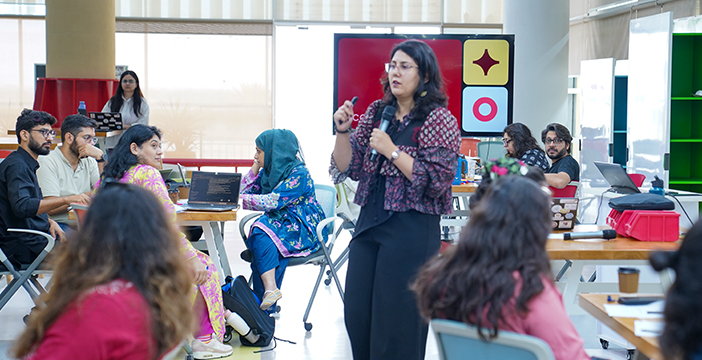
Manahil Huda (Lecturer in the Communication and Design program, and Assistant Director, Design Thinking in IDEAL) led “Systems Thinking and Systemic Design: Teaching for Complexity,” which was followed by further discussion of complexity. Instead of a traditional presentation, the session started with the faculty physically moving throughout the room and interacting in activities that illustrated how relationships between people can create complex systems.
Faculty were invited to select people in the room and to create relationships among them, without telling anyone who they are. In another task, they were required to stand between two people, thus “sheltering” one individual from another. The activity quickly showed the complexity of relationships and systems where the cause-and-effect interpretation is not always present. The session was an introduction to faculty to the concept of “wicked problems,” which are problems that may have no clear answer and are so closely linked that cannot be solved with a single solution. Students should be able to develop knowledge of the bigger systems that influence the issues they face, in an age of interdependent systems and polycrises.
A key difference that emerged was that we address small problems, while we create interventions to address ‘wicked problems.’ Here, a wicked problem means something that is more than complex. System thinking thus involves a shift in thinking for educators and students to see the whole system rather than the individual parts. It is important to map relationships, identify interdependencies, and to think about the implications of interventions. This is not the same as teaching complexity and providing students with problems that get increasingly harder to solve. It’s about teaching them to see complexity.
Creating Inclusive Classrooms
Some sessions were about learning environments outside the classroom, but with “Inclusive Learning Environments: Recognizing Bias and Liberating Classrooms,” the focus was on the faculty and what they observed in their classroom experiences with regards to inclusion/exclusion.
The first exercise was very basic, easy to see, and understand. Faculty were invited to share a place, time, or professor when they felt included. The answers were then picked up, mixed, reshuffled, and read out loud. Through the exercise, individual memory became a collective memory, and participants got to understand that there are different memories that define how people see a learning environment. Faculty were then asked to identify areas of bias in these experiences and reflect on the subtle ways in which classroom practices can foster a sense of welcome or exclusion for students. Those moments are just some examples of how inclusive pedagogy is not just confined to formal policy. It may be present in what appears to be mundane for classroom decisions, interactions, expectations, and assumptions.
The session invited faculty to think of the classroom as a place where students carry with them their different histories, identities, expectations and experiences. To step towards an inclusive environment, it is necessary to constantly reflect on the way teaching is experienced by the other side of the classroom.
Making Online Learning Work
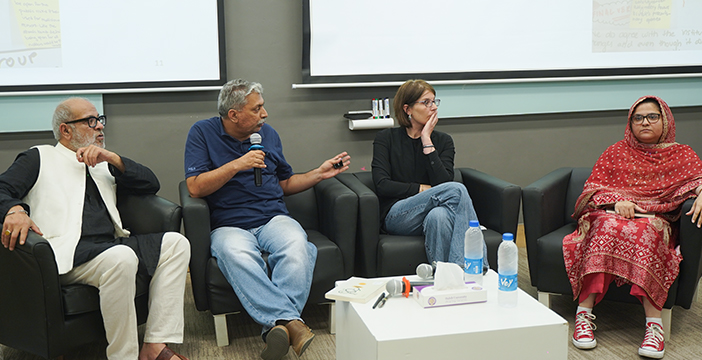
The changing nature of learning spaces was also discussed in “Making Online Learning Work,” led by Rehana Kazmi from LUMS’s Learning Institute. The session commenced with an interactive poll of the faculty to draw out their queries on online learning and the challenges they face in a virtual classroom.
The issue of engagement became prominent. Why is it that attention tends to vanish when a class goes online? Some of the factors discussed were anonymity and spatial separation, and it was emphasized that the technology itself is not a pedagogy. All tools must have a teaching function. There are different technologies and different pedagogical goals that can be supported, such as live sessions via Zoom, Teams, or Meet, structured learning via Canvas or other learning management systems, collaborative Google Docs, live polls, or gamified checks. The numbers are not an important part of the story; rather, it’s what we’re doing with the tools.
Minimal communication activities can make a big difference. Use a session plan, record sessions, call students by name, and include polls as shared moments can help structure and make sessions present in virtual spaces. For example, a 50-minute online lecture doesn’t have to be 50 minutes of lecture time. A lecture, activity, lecture, activity approach can maintain interest and provide for participation. It was a good reminder that technology should not be used for its own sake in education, but rather for its educational value.
A Culture of Purposeful Experimentation
Across its varied sessions, Pedagogical Development Week 2026 consistently returned to a common idea: teaching is an intentional practice. Whether faculty were discussing the Liberal Core, the polycrises, systems thinking, inclusive classrooms, online learning, multi-section courses, or artificial intelligence, the underlying question remained the same: why are we teaching this, and how should we teach it in this context?
It is possible that education may not be about giving students certainty in a world that can sometimes seem as bewildering as a changing landscape. Rather, it can enable them to orient themselves; ask more questions, see complexity, engage across differences, question assumptions, and make thoughtful interventions in the world around them.
Pedagogical Development Week is a week at Habib University where faculty learn not just about new pedagogical approaches but also from each other. The week reinforces a culture of experimentation, peer learning, and purposeful teaching, which means intentional teaching is a shared process.
In the end, if you can navigate a world that is not orienting, you don’t just find a fixed direction to go in; you also stop to ask questions. It is to foster intellectual curiosity and humility, criticality, and a sense of purpose, to continually self-examine where we are, where we are going, and why. At Habib University, PDW continues to be an integral part of teaching and learning.