
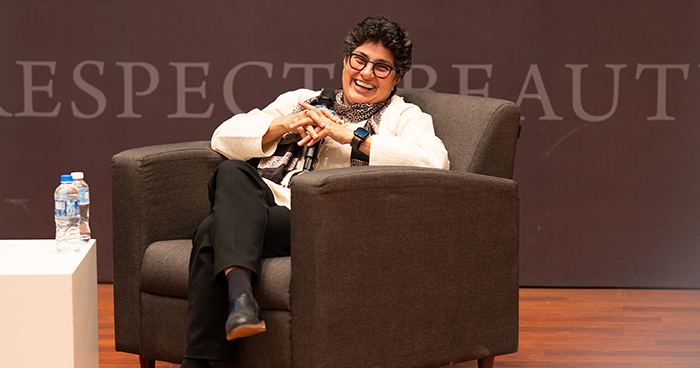
The Audacity to Ask: Dr Nargis Mavalvala Talks Curiosity and Setbacks with Karachi’s High Schoolers
On the 24th of September 2026, ahead of the 10th YOHSIN Lecture, Habib University’s flagship lecture series, the university opened its doors to high school students from various colleges throughout the city for an exclusive talk with Dr Nergis Mavalvala, reiterating its commitment to accessible education.
Dr Nergis Mavalvala is the first woman to serve as Dean of Massachusetts Institute of Technology’s School of Science and the first Pakistani-American astrophysicist to play a leading role in developing the technology that enabled the first direct detection of gravitational waves. The technology confirmed a prediction Albert Einstein made a century earlier, changing the way humanity understands the universe. Her work later fed into the LIGO collaboration, whose founding scientists went on to win the 2017 Nobel Prize in Physics.
During her brief talk with the students, she emphasised the importance of failure, calling it a gift. She maintained that most of the time things don’t work. Her work, for instance, in detecting gravitational waves previously considered impossible was, specifically, uncharted territory, even for her. And yet, for all the experiments that worked out, most of them didn’t, Dr Mavalvala argued.
On the topic of failure and learning from one’s mistakes, Dr Mavalvala recalled an instance during her undergraduate years when she started working in a lab. After cleaning a laser that was not working at full capacity, her curiosity led her to take it apart. It took three weeks to put it back together, but it worked. “Sometimes it’s okay to break it, to make it better”, she said.
Answering a question during the Questions and Answers session, Dr Nergis Mavalvala said that she had gotten into astrophysics accidentally, because she was inquisitive by nature. She had no burning passion, but what she did have was the audacity to ask.
A professor had told her about the instrument he was building, her first reaction was that he was insane. But the more she thought about it, the more she couldn’t stop thinking about it. The level of precision the work demanded excited the engineer in her. She hadn’t gone looking for it, but it found her.
When a student asked whether it’s ever too late to pursue a passion, her answer was simple: “never, not in terms of passion itself”, though the world puts up its own constraints. “If you have enough breadth, you have the building blocks to build”. She urged the students to stay broad in what they study rather than narrowing too soon.
Sulaiman Ali, a high school student, lauded Habib University’s effort to bring this once-in-a-lifetime opportunity to high schoolers and not just Habib Students.
“I had never imagined I would ever be in a room where I’d get to ask Dr Nergis Mavalvala questions. In my mind, I had always idolised her, thinking things worked out for her so well, so when she spoke about her setbacks, it changed my perspective”, said Sakina Wasi, another high school student from Karachi.