
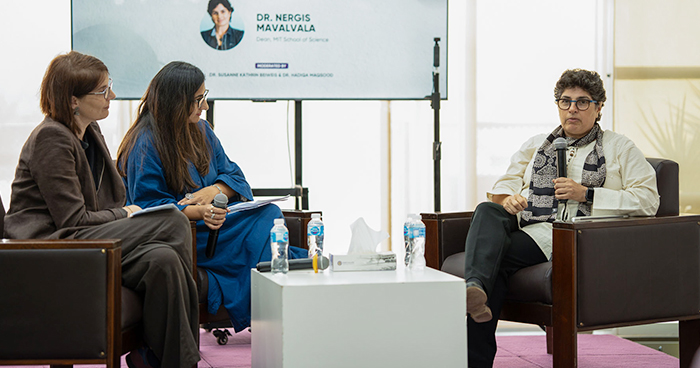
Dr. Nergis Mavalvala on the Power of Faculty Mentorship
Before she helped uncover ripples in space-time caused by collisions billions of light-years away, Dr. Nergis Mavalvala was a high school student running unauthorized chemistry experiments after hours in Karachi. Her teacher set only one ground rule: explain the setup beforehand. Even when he warned her a reaction would shatter a flask, and it inevitably did, he never barred her from trying.
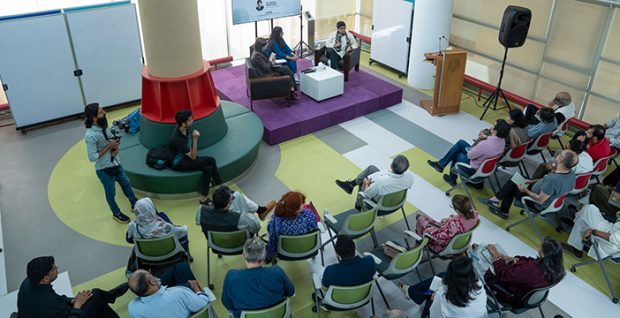
Speaking to faculty and educators, the MacArthur Fellow, renowned astrophysicist, and Dean of MIT’s School of Science returned to her hometown to address the subtle, formative role professors play in guiding the undergraduate journey. Moderated by Dr. Hadiqa Maqsood (Assistant Professor, Integrated Sciences and Mathematics) and Dr. Susanne Beiweis (Assistant Professor, Computer Engineering), the discussion examined how academic environments can foster independent thinkers who embrace failure as a prerequisite for discovery.
The Power Rush of Unsolved Problems
Coming from a traditional South Asian family, Dr. Mavalvala initially assumed her future lay in conventional professional paths, medicine or engineering. Seeking a broad foundation, she enrolled at Wellesley College, a liberal arts institution. A work-study placement altered her trajectory: instead of working in the campus dining hall, she secured a position inside an undergraduate research laboratory.
“I was working on a problem that nobody knew the answer to,” she recalled. “And that is the kind of power rush that an 18, 19-year-old just can’t get over… you’re working on something right at the frontier.”
The laboratory showed her that she did not have to choose between technical experimentation and fundamental discovery. She could be an experimental physicist, applying engineering principles directly to the cosmos.
Early on, that work involved breaking things. After she disassembled an expensive laboratory laser for cleaning and could not reassemble it, her mentor turned the setback into an intensive three-week lesson on how lasers function. When she miswired and blew up duplicate integrated circuits, the professor encouraged her to call the supplier directly; the sales engineer responded by sketching the wiring diagram by hand and shipping two replacements.
These experiences highlighted a core pedagogical philosophy: prescriptive lab work must leave room for open exploration. Standard instructional laboratory exercises often resemble rigid recipes, assembling components, logging data, and plotting charts. Real learning begins when the recipe ends and students are asked to take risks, whether by engineering an unscripted modification or discovering why an apparatus fails.
De-stigmatizing Failure in an Anxious Generation
Addressing student self-discovery, Dr. Mavalvala cautioned faculty against labeling an undergraduate’s gifts prematurely. Mentors should avoid defining what a student has not yet named for themselves; the goal is to provide positive reinforcement and let the student uncover their own identity. For struggling students, instructors must offer honest feedback while redirecting them toward their latent strengths.
She also noted a distinct cultural shift in how students perceive mistakes. Where past cohorts joked about blown equipment and missteps, modern students frequently experience academic stumbling as an acute source of anxiety:
Acknowledge the Discomfort of Learning: Real education creates vulnerability because students must confront what they do not yet know.
Model Faculty Fallibility: Professors must normalize error by demonstrating their own mistakes in real-time and feeling comfortable saying, “I don’t know, I’ll give you a chance tomorrow after I look it up.”
Serve as an Active Safety Net: Faculty should deploy their own professional networks to connect students across subfields, encouraging them to initiate outreach while standing by to support them.
Institutional Courage: Opening Doors for Women in STEM
Reflecting on her career path, often as one of only a handful of women in lecture halls and laboratories during the 1990s, Dr. Mavalvala emphasized that equity in STEM requires systematic institutional change rather than passive reliance on individual persistence.
She recounted a faculty meeting at MIT where women professors were asked whether they had applied for their jobs cold or had been specifically recruited. Without exception, every woman present had applied only after a department leader reached out directly to urge her candidacy, a pattern not shared by their male peers.
“It is never ever a matter of talent,” she stressed. “Because none of these places ever hires you without the talent. You have to just get yourself on the radar.”
Addressing retention requires structural accommodations rather than symbolic gestures. When departments shifted their standard weekly colloquiums from 5:00 PM to 3:00 PM to accommodate family commitments, attendance among women faculty jumped to 100%. The shift proved equally beneficial for young male faculty seeking active parenting roles.
Dissolving Departmental Silos
Turning to institutional strategy, Dr. Mavalvala outlined a vision for higher education where academic departments serve logistical rather than intellectual functions.
“I dream of the time when departments, the physics department, the math department, are merely administrative structures. They are not intellectual structures.”
Because humanity’s most complex challenges refuse to conform to single disciplines, curricula must compel students to bridge boundaries. While MIT maintains a rigorous first-year core, the General Institute Requirements covering physics, chemistry, mathematics, biology, computation, and communication, meaningful interdisciplinary exchange occurs when students cross borders. When an optics physicist needs to keep an imaged biological cell alive, the collaboration succeeds because students from both laboratories share techniques on the bench.
By requiring students to master disciplines adjacent to their major, institutions equip future researchers not merely with vocational training, but with a flexible cognitive toolkit.
For university educators, the takeaway remains clear: long before students achieve major breakthroughs, their trajectories are shaped by mentors who make room for curiosity, absorb the shock of broken equipment, and create spaces where intellectual exploration can flourish.
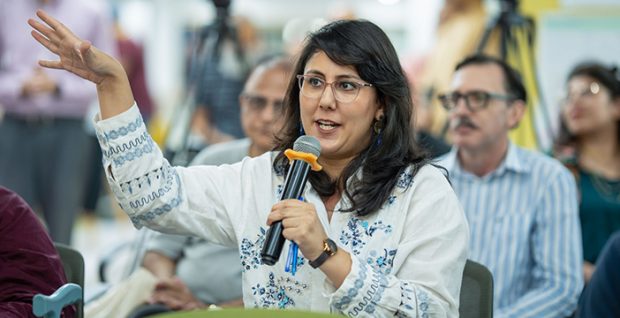
This session was part of Habib University’s efforts to convene global minds in engagement with academics. Each year, the Yohsin Lecture brings a thinker of global distinction to Pakistan, and this year’s visit reached beyond the public lecture, with conversations for faculty and students in sessions of their own. For a liberal arts and sciences university in Karachi, these encounters matter as much as the lecture itself, because they put the questions we ask in our classrooms in direct conversation with the wider world of ideas.