
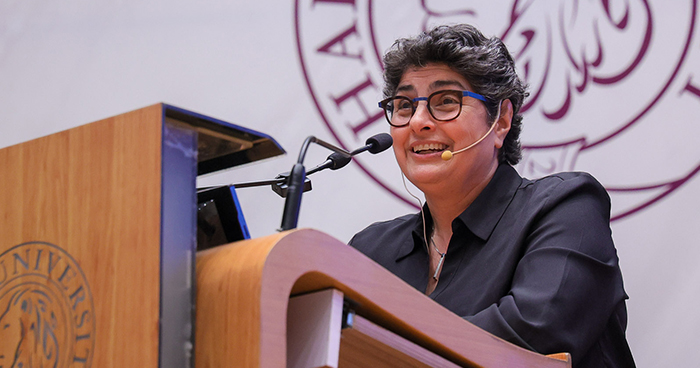
10th Yohsin Lecture: Dr. Nergis Mavalvala on Gravitational Waves, Discovery, and Why It Still Matters
In the evening of 25th September 2026, Dr Nergis Mavalva, the first woman to serve as Dean of Massachusetts Institute of Technology’s School of Science, delivered a rich and insightful lecture titled, “The Joy of Discovery, Curiosity, Science, and the Pivotal Role of Universities,” gracing as the 10th Yohsin Lecture speaker. The Pakistani-American astrophysicist played a leading role in developing the technology that enabled the first direct detection of gravitational waves, confirming a prediction Einstein made a century earlier, and changing the way humanity understands the universe, or rather ‘listens’ to the universe. Her work fed into the LIGO collaboration, whose founding scientists went on to win the Nobel Prize in Physics in 2017.
The Yohsin Lecture Series is an intellectual platform at Habib University that invites global thinkers into public discussions, centering on the questions shaping our perspectives about the world. Dr Elham Golpush Nezhad (Program Director and Assistant Professor, Communication and Design), the MC of the evening, said “the measure of learning is not achievement alone, but the character it brings into the world. The Yohsin Lecture extends this philosophy beyond the classroom, inviting exceptional thinkers to ask who we must become to shape our shared future.”
‘Nergis, Welcome Home’
Founding President, Wasif Rizvi, welcomed the Chancellor Mohammad H. Habib, members of Habib University’s Board of Directors, the Habib University foundation, the Mohsineen, distinguished guests, students, and the eminent Dr. Nergis Mavalvala. “Nergis, welcome home,” he said.
“The morning in 2016 when the world learned that you and your colleagues had pleased the spirit of Einstein, by finding that elusive gravitational signal. A few years ago, when MIT asked you to lead its School of Science as the first woman dean in its history, Habib has followed all of it. Our students actually most closely evolved.”
This particular lecture was hosted by the Dhanani School of Science and Engineering, thanks to Mr. Shoukat Dhanani and his family’s generous endowment because of which this school continues to produce progenies. “They gave from conviction alone, and that is the beautiful story of our university. I look around this hall, and see a galaxy of our most elite, who gave in a similar way, with the same conviction, and with their trust in our great founding Chancellor, Rafiq M. Habib, and his family. Thank you.”
He went on to say, “because of all of you, our students pay a fraction of what their education costs. A young woman from Lyari or Gilgit sits in the same seminar as anyone else in this country. Access of this kind had not been attempted in Pakistan before. It exists because the community in this room and outside decided it should.”
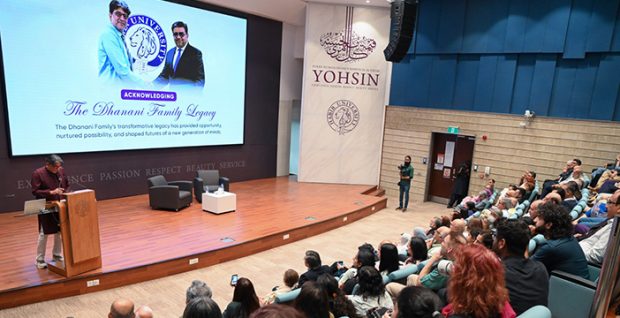
“The students in this hall are the answer to anyone who asks,” Mr Rizvi elaborated on the powerful motive of the students, as what they do in their lives are reflective of the institution’s philosophy of Yohsin, what they do with excellence, grace, beauty, respect, and service for others.
Following Mr Rizvi’s address, Dr Golpush Nezhad introduced Dr Mavalvala’s scientific breakthroughs as reimagining a way for humanity to encounter the universe, coining a metaphor to understanding culture and knowledge as well. “What scientists hear is produced through a relationship among the phenomenon, the instrument, the computer algorithm, and the trained human senses…it becomes meaningful through the tools, languages, and practices we use to interpret it.”
“LIGO, too,” Dr Golpush Nezhad explained, “unsettles the familiar story of discovery as the triumph of a simple genius. Its achievement emerged from decades of collective labor across disciplines, institutions, nations, and generations from people learning one another’s intellectual languages and keeping alive without knowing where it might lead. Our guest’s journey, therefore, brings together the central concerns of this evening, curiosity as an intellectual discipline, discovery as a collective practice, and the university as a place where different ways of knowing can meet, question, and enlarge one another.”
Taking the stage, Dr Mavalvala appreciated the tremendous welcome that her hometown had given her, and to have received the opportunity to share her science which is “one the greatest passions of my life.”
She went on to thank the President, colleagues at Habib University, the board and Mohsineen, “who made this place possible.” “Everything I’ve done here has told me that your vision and your generosity was every bit worth it. I’ve met with a number of students and alumni and I’ve just been wowed.”
‘A Paradigm Shift’
As the lights turned down and her presentation pulled up on the screen, Dr. Mavalvala began, “I’m going to take you on a journey. I’m going to tell you a story of a scientific discovery. Along the way, I’ll also tell you a little bit of science, but always with an eye towards the story.”
Laying the history of the breakthrough discoveries that she and her colleagues, as well as thousands of other scientists that she acknowledged had made, Dr Mavalvala said “It turns out that humans have been staring at the sky forever, longer than you think, because we have evidence. Three Homo Sapiens, on bones, have carvings of the sky in a constellation. So even pre-human cultures were looking up at the sky, in part because it was assumed to be the place where divine beings lived, in part because it was just mysterious.”
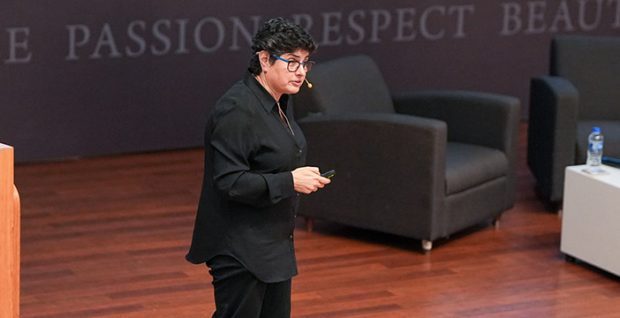
“These humans looked at stars at night, and so it was light from the shiny stars that brought us all of the little twinkles we see in the sky.”
A paradigm shift, she went on to say, in the 1600s, happened when we believed Galileo was the first person to point a telescope at the sky. This allowed humans, for the first time, not just see things with the naked eye, but to use instrumentation. In the 400 years since then, more sophisticated telescopes have been built, from the ones Galileo used, to giant telescopes and observatories.
“Neutron stars and black holes are cousins,” Dr Mavalvala shared in her lecture. “Black holes have a very special place in astrophysics because they’re the objects that made black holes because they pack so much gravity that even light cannot escape, and that’s why they are called black holes.”
So, how do we measure black holes?
“They give off no light, no light escapes from them, and that leads us to the reason we went on a quest like this. If we want to see objects in the sky that are dark, but they have gravity, then wouldn’t it be nice if we could measure a messenger of gravity instead of a messenger of light? To do that, the person who gave us the ability to think and dream about that is Einstein,” she explained.
400 years after Newton’s theory of gravity, Einstein turned our understanding of gravity ‘on its head.’ He said that all of the empty space-time dips like a massive bowling ball on a trampoline. This was how he pictured it.
‘Gravitational Waves Are Too Faint’
Dr Mavalvala went on to explain how Einstein was unsure of whether gravitational waves existed or if he made a mistake in the math he wrote. In his paper in 1916, he claimed that gravitational waves are too faint and this set the central focus of Mavalvala and her team’s work, where it took 100 years after he said this to detect them. This was now a supercomputer simulation that was completed in 2005.
Dr Mavalvala became LISA’s graduate student in 1991 when the observatories were built. During her postdoctoral at Caltech, she started working on the first instruments. In 2015, somewhere in the universe, two black holes collided and their gravitational waves set out like ripples on a pond, on a journey of 1.2 billion years. The waves were detected on earth through the detectors in North America. The waves slightly shook the mirrors of LIGO, and Dr. Mavalvala and her team detected the first gravitational wave.
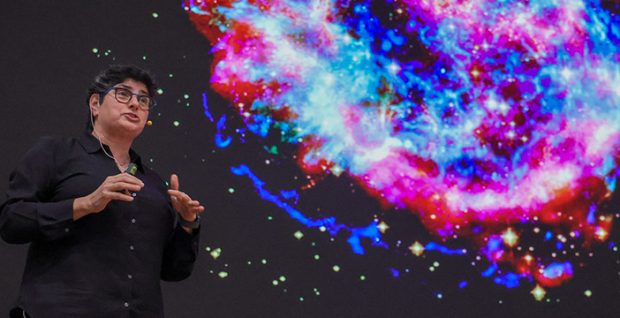
‘The Cousins Of Black Holes: The Neutron Stars’
Dr Mavalvala shared that the story didn’t end here and she and the team set out to build an observatory. “We wanted to see new things in the universe we hadn’t seen before. One of the most spectacular things that came next was the discovery of the collision of the cousins of black holes: neutron stars that are amazing in a completely different way.”
‘Why Do We Do Science?’
Dr. Mavalvala talked about one of her favourite things in science to be the ‘law of unintended consequences’ which means finding things that scientists didn’t set out to do, whether it was developing a new technology or making a new discovery. One of these was Einstein’s theory of general relativity itself, the LIGO laser that needed to be the brightest and of the purest color, and discovering that the same technology can be used for quantum computing, quantum communications and even cryptography.
She and the team of scientists were now able to answer the question, not just whether black holes orbit each other but if they also spin about their own axes. This would tell how the black hole pair was formed, and this precision was reached by Dr. Mavalvala and the team.
Einstein’s paradigm shift showed that humans can use instrumentation to look at the sky, and not the naked eye. These instruments were infrared telescopes, gamma ray telescopes, x-ray telescopes and radio telescopes. “It took 400 years to do that, and we put together a more complete picture of our universe because of that one paradigm shift, by today’s standards, an unaggressive telescope did.
‘Launching a New Field’
Dr. Mavalvala stated that this was the moment when a new field came into being: a new field of gravitational astrophysics with the signals they detected: the first direct detection of gravitational waves. “We’ve seen these binary black holes and neutron star collisions in real-time.”
“Because we could see them in real life, we could go back and look at the light from the neutron star and see the gold mine being formed. I’ve worked my entire career on the precision of the instrument, and it’s nice that the instrument works as well as it does.”
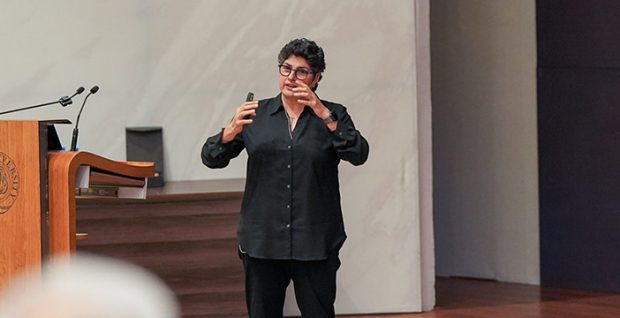
“For the first time,” Dr. Mavalvala said, “we don’t need light. We can use gravitation to observe the universe. And that is the change we need.”
In the process of opening this new window into the universe after Einstein, Dr. Mavalvala shared that they spawned dozens of new technologies. They’ve trained thousands of scientists and engineers, and sparked the imagination of numerous people.
“It all began,” she said, “because Einstein asked, what is gravity? Is it force? Why is it not working?” Following Weiss and Thorne’s original ideas in 1975, this was done by a collaboration of over 2,000 members, in which one-third of them were students”, Dr Mavalvala revealed. “Over 400 universities worldwide from 22 countries.”
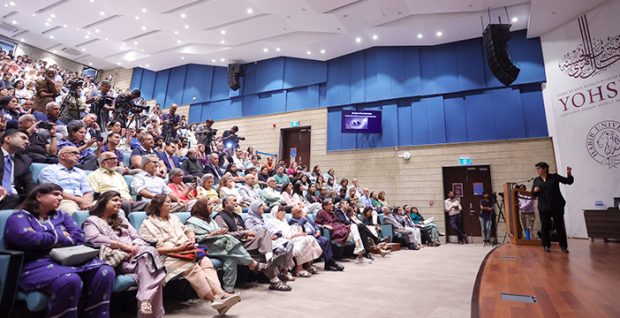
‘Universities as Engines For Discovery’
Dr Mavalva concluded her lecture, underscoring the role of universities, even in the scale and collaboration for the scientific discoveries. “Universities are absolute engines of discovery, generating fundamental knowledge, cultivating scientific talent, and of course, providing societal resilience that we need when it comes to bigger problems than detecting gravitational waves.”
She went on to highlight that science funding is an essential investment in the structural resilience of a society with long-term gains in education, environmental preservation, income stability, and resilience against global climate crises, pandemics, and climate change.
“When science is under attack,” she urged, “Legitimacy of knowledge is under attack, and all of us in this room have to be the ones to stand up and say no.” Ending with a quote by Margaret Theodore Parker a 100 years earlier, she shared her version by saying, “The arc of science, if discovery is long, bends towards nature’s truth and ensures society’s well-being.”
After a magnanimous applause and standing ovation from the audience, Dr. Mavalva interacted with the guests in a question-and-answer session after the lecture. To an audience member, she said, “Every single person at birth is research-minded. The reason some of us get to do it in adulthood is [access to] opportunity. Research has shown there is no investment that any government does that has greater return than investment in research and science.”
‘Living Embodiments of the Ethos of Yohsin’
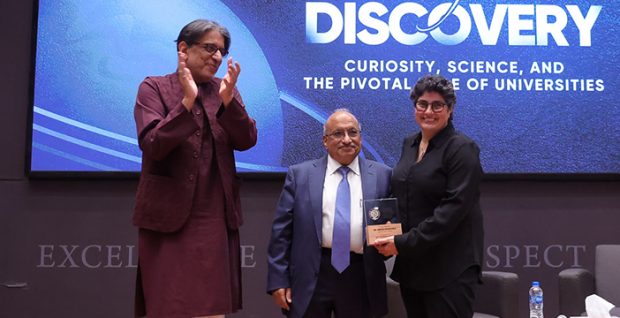
The University’s Chancellor Mr. Muhammad H. Habib addressed the attendees as the 10th Yohsin Lecture concluded, by saying, “Habib University was founded upon Yohsin, and this lecture series exists to place living embodiments of that ethos before our students each year. This evening has done exactly that.” Dr. Mavalvala was also presented a memento of appreciation by Mr. Muhammad H. Habib.