
Course Spotlight: Bridging Computing and Digital Humanities
Before the first class even walked onto campus in 2014, Habib University was already charting a bold vision for its undergraduate curriculum. The university’s inaugural catalog, developed over years of planning and consultation with international partners, reflected a commitment to interdisciplinary education that has endured from the outset. Notably, even in the initial Computer Science curriculum, students were required to engage with Digital Humanities and Social Sciences courses. This was a signal that the university envisioned technical students gaining a broader understanding of humanistic and social inquiry alongside their computational training.
By 2013, the catalog formally mandated that Computer Science students take two courses in Digital Humanities and Social Sciences. These courses were defined flexibly: any course cross-listed between the School of Arts, Humanities, and Social Sciences and the Dhanani School of Science and Engineering qualified. The goal was clear: equip technically trained students with a lens to understand society, culture, and human behavior while developing their computing skills. From the very beginning, this cross-disciplinary ethos became a cornerstone of the university’s educational philosophy. Moreover, the critical foundation of the comparative humanities standpoint in this course was to show that even a statistical data point is an interpretive act, given that information is never simply “given” (data) but is always “taken” or constructed (capta) according to the standards defined.
Designing Cross-Listed Courses
At the time, no Computer Science program yet existed. Yet the planners imagined a graduating class of 2018 who would be versatile, well-rounded computer scientists, capable not only of coding but of thinking critically about society and culture. This led to the design of cross-listed courses co-taught across departments, bridging traditional disciplinary boundaries. Over the years, the initiative expanded, with multiple cross-listed courses connecting Computer Science, Electrical and Computer Engineering, and other departments to the humanities, social sciences, and design fields. Programs such as Communication and Design (CND) and Social Development and Policy (SDP) similarly adopted co-designed Digital Humanities courses, ensuring students could blend technical and humanistic approaches.
The rationale was forward-looking: as humanities increasingly became digital, computational techniques were emerging as essential tools for research. By integrating these methods early in undergraduate education, the university aimed to prepare students for a world in which disciplinary boundaries are fluid and collaboration is essential.
Digital Humanities and Interdisciplinary Pedagogy
By 2025, this vision had evolved into a comprehensive strategic framework. University leadership emphasized engagement with emerging technologies such as AI, large language models, big data, virtual and augmented reality, while maintaining strong connections to the humanities, ethics, and policy. The Digital Humanities elective, initially a modest requirement, had grown into a deliberate experiment in interdisciplinary pedagogy.
The course Digital Humanities: Tools and Evaluation (DH 101) exemplifies this evolution. Co-taught by faculty from the School of Arts, Humanities, and Social Sciences and the Dhanani School of Science and Engineering, the course fuses traditional humanities analysis with computational methods.
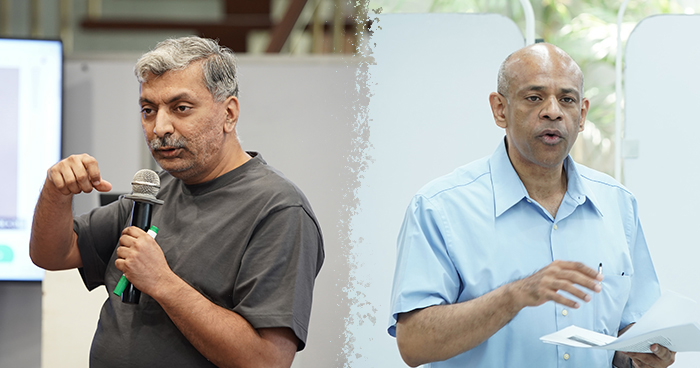
Dr Muhammad Haris, Assistant Professor in the Comparative Humanities program, taught this course alongside Dr Shah Jamal Alam, Professor of Computer Science.
“Digital Humanities is a dynamic “milieu” where disciplines converge to produce new knowledge. By moving between the “how” and the “why,” we create a classroom trading zone between technical logic and humanistic inquiry,” he said.
Students learn to analyze texts, build corpora, process large datasets, and navigate digital content from social media platforms, online archives, and historical repositories. The course combines practical skill-building with critical evaluation, ensuring that students understand the limitations of the tools they use and can apply them thoughtfully rather than blindly following technological trends. Interestingly, students were taught to move beyond what the tools do, to how to pick them apart. The Reverse Engineering Pedagogy (REP) was key, which treats the tool as a “black box” to be disassembled to deduce its underlying logic and biases.
“To balance technical skill with reflection, we employ Reverse Engineering Pedagogy (REP). We often start with a “black box,” a completed digital project or tool, and guide students to “pick it apart.” By forcing them to document their thinking process and confront moments where a tool “breaks,” we teach them that errors are not failures but the exact moments where the boundaries of a tool become visible,” Dr Haris went on to say.
Bridging Historical Context and Modern Computation
DH 101 also emphasizes the intellectual roots of modern computational tools. What begins as abstract, historical theory gradually connects to the technologies students encounter today, from large language models to conversational AI. This historical grounding allows students to critically engage with tools that might otherwise seem purely technical, fostering both understanding and discernment. It also inculcates a sense of responsibility in them for meaning-making, as this is where a machine differs from human abilities.
Co-Teaching and Epistemic Integration
A defining feature of the course is its co-teaching model, where instructors from different disciplines teach simultaneously in a seminar-style environment. Students witness active intellectual dialogue across perspectives, replacing traditional lectures with a dynamic exchange of ideas. This approach reflects Habib University’s broader educational philosophy: knowledge should be holistic and interconnected, addressing the fragmentation of expertise that characterized much of the 20th century. External partnerships, including workshops with international experts, helped shape the curriculum and strengthen its global relevance.
Cultivating Fully Functioning Human Beings
Ultimately, the university sees the liberal arts model not merely as an academic framework but as a tool to cultivate fully functioning human beings. By blending breadth and depth, technical skill and critical analysis, historical perspective and contemporary application, students develop the cognitive flexibility to navigate complex realities. Whether processing large datasets, analyzing historical texts, or interpreting social media trends, they learn to synthesize information across disciplines, think critically, and engage meaningfully with the world. The concept of ‘Humanistic Data Science’ becomes important as it explains that it’s not just about using “AI for the humanities” but bringing “Humanities for AI” where we use our expertise in character, style, and ethics to intervene in the development of these systems.
“Teaching Digital Humanities in this moment of epistemic uncertainty means acknowledging that our tools are “already broken,” unpredictable and prone to error. But that brokenness is our greatest opportunity. It forces us to “stay with the trouble,” to cultivate a “literacy of repair,” and to ensure that as we build digital futures, the human voice remains the measure of all things,” recalled Dr Haris.
For Habib University, the promise of liberal arts education is as much about shaping minds as it is about shaping futures. By integrating Digital Humanities and fostering interdisciplinary dialogue, the institution aims to produce graduates who are not only technically capable but socially and ethically aware, ready to meet the challenges of a rapidly evolving, interconnected world.
Dr Shah Jamal Alam, Professor of Computer Science, and Dr Muhammad Haris, Assistant Professor, Comparative Humanities, co-taught Digital Humanities: Tools and Evaluation (DH 101).