
Building the Future Through the Past: The Sammer Sultan Endowed Chair at Habib University
The endowment establishes Pakistan’s first academic chair dedicated to history, heritage, and archival studies.
Sammer Sultan, Co-Chairwoman of Shan Foods, has established the Sammer Sultan Endowed Chair in History, Heritage & Archives at Habib University, the first endowed academic chair of its kind in Pakistan. Housed within the University’s Comparative Humanities program, the Chair will fund a distinguished faculty position dedicated to original scholarship, teaching, and policy-oriented engagement focused on the preservation, interpretation, and revitalization of Pakistan’s historical, cultural, and archival inheritance. The commitment represents one of the most consequential acts of intellectual philanthropy directed at Pakistan’s higher education landscape in recent years.
Rooted in Epistemic Repair
Pakistan’s relationship with its own history remains contested and incomplete. Decades of selective historical narration, institutional neglect, and the erosion of archival infrastructure have left significant portions of the country’s historical, linguistic, and cultural record either undocumented or interpreted largely through external scholarly frameworks that position Pakistan as a peripheral subject rather than a primary source of knowledge about itself.
The consequences extend beyond missing archives or neglected manuscripts. They constitute an epistemic gap: a diminished capacity for a society to understand, interpret, and narrate itself on its own terms. The Sammer Sultan Endowed Chair is a direct institutional response to this challenge. It transforms philanthropic commitment into a lasting scholarly platform dedicated to researching, preserving, and reanimating Pakistan’s intellectual and cultural inheritance.
A Philanthropic Commitment to Historical Memory
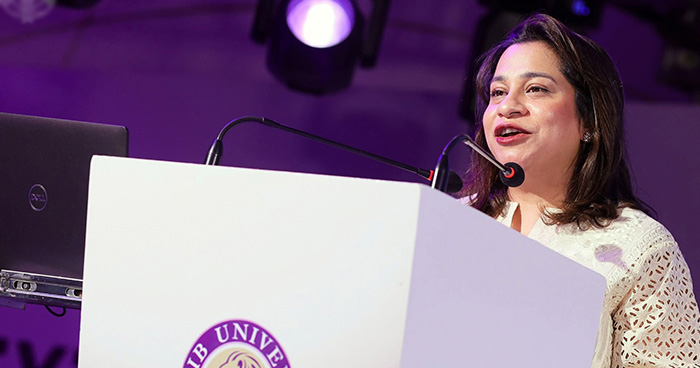
For Ms Sultan, the commitment to history and heritage is not an abstract act of philanthropy but a considered intellectual position, grounded in the belief that societies endure only when they preserve an honest understanding of themselves. Delivering the keynote address at Habib University’s President’s Dinner for the Class of 2026, she articulated the relationship between memory, identity, and the capacity of nations to shape their future:
“Societies decline not only economically or politically. They decline because sometimes they lose memory. They lose the ability to narrate themselves accurately. And perhaps the most radical thing a society can do is remember itself truthfully. Not romantically, not selectively, truthfully. Because countries that cannot remember themselves eventually begin seeing themselves through the eyes of others.”
The endowed Chair institutionalizes that conviction. By establishing a faculty position within Habib University’s Comparative Humanities program, Ms Sultan is ensuring that the rigorous study and recovery of Pakistan’s historical and cultural record becomes a sustained academic enterprise rather than one dependent upon temporary funding or individual initiative.
The broader intellectual philosophy underpinning her gift was evident throughout her address. She spoke of conviction as the primary currency of meaningful work, the importance of building institutions rather than merely criticizing them, and usefulness as a more enduring measure of achievement than recognition or status. These are the very principles embodied by an academic endowment, a gift that privileges permanence over visibility and structural contribution over episodic intervention. As she told the graduating class:
“Determination and conviction are the only real currencies in the world; not talent, not intelligence, not credentials alone. The universe responds to conviction. To people who continue to show up with seriousness, discipline, endurance, and belief, especially when there is no proof or immediate reward for doing so.”
From Preservation to Intellectual Leadership
The Chair is envisioned as a catalyst for intellectual leadership, a platform through which Habib University positions itself as a center for scholarship that places Pakistan’s heritage within worldwide academic discourse rather than at its periphery.
It will be held by a scholar of global stature: a researcher capable of leading original inquiry, generating new knowledge, and advancing the field of history, heritage, and archival studies through publications that both preserve critical knowledge and contribute pioneering work from Pakistan to the global academy.
Beyond producing research, the Chair will serve as a convening platform. Habib University will use it to host conversations that bring together leading international and Pakistani scholars, policymakers, and thought leaders alongside the wider public on questions of heritage preservation, cultural memory, and archival practice. These exchanges, across disciplines, sectors, and geographies, will be designed to shape the terms of public and policy discourse on what it means to recover and protect a society’s intellectual inheritance.
The Chair holder will also enrich the undergraduate experience at Habib University by introducing specialized courses within the Comparative Humanities program, focused on archives and historical preservation, and aimed at training the next generation of scholars and cultural stewards with both the analytical tools and the ethical orientation the field demands.
Advancing Habib University’s Intellectual Mission
Habib University’s academic philosophy is grounded in the idea of reparation and the restoration of connections severed by modernity: language, tradition, poetry, music, sacred geographies, and collective memory. The University seeks to reclaim indigenous knowledge systems while situating Pakistan’s history within broader comparative and global frameworks, rather than allowing it to be defined exclusively through external perspectives.
The Sammer Sultan Endowed Chair is closely aligned with that mission. President Wasif Rizvi acknowledged the significance of the endowment, noting the importance of Mohsineen whose commitment extends beyond expanding educational access to strengthening the University’s intellectual mission.
“We are fortunate that there is an increasing number of Mohsineen who believe in that intellectual experience. It’s not easy, or very cheap, to invest in something which is a lifetime legacy,”
he reflected during the President’s Dinner for the Class of 2026. At Habib University’s Ninth Convocation, President Rizvi also acknowledged the establishment of the Chair, stating,
“I’m very happy to acknowledge and celebrate the Sammer Sultan Endowed Faculty Chair in History, Heritage and Archives,”
describing it as an investment that will strengthen the University’s academic mission for generations to come.
Building a Lasting Intellectual Legacy
Endowed chairs are among the most consequential investments a benefactor can make in a university. Unlike project-based grants, they are insulated from annual fundraising cycles and designed to attract and retain scholars whose work requires sustained institutional support. They create enduring academic infrastructure capable of generating scholarship, mentorship, and public engagement across generations.
The Sammer Sultan Endowed Chair transforms philanthropic conviction into lasting institutional capacity, ensuring that the scholarly recovery of Pakistan’s historical and cultural memory is pursued with intellectual rigor and permanence rather than left to circumstance. Ms Sultan concluded her address to Habib University’s graduating class with words that capture the spirit of this commitment:
“The future is not something that simply arrives. It is imagined first, built internally first, and then externally.”
The Sammer Sultan Endowed Chair in History, Heritage & Archives is precisely such an act of imagination made permanent. It is a long-term investment in scholarship, historical understanding, and institutional excellence. One that will enable future generations of Pakistani scholars, students, and cultural stewards to engage with their past in ways that are rigorous, independent, and consequential.