
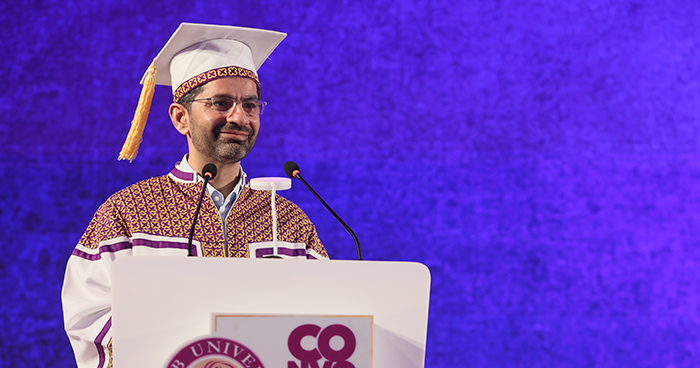
Mudassir Sheikha Reminds Graduates That They are “Made for Something Larger”
Mudassir Sheikha, co-founder and CEO of Careem, and member of Habib University’s generous community of donors (Mohsineen), looked out at the graduates and offered them an ambition far greater than the one the world typically hands its brightest young minds. It is a philosophy he knows well. Under his leadership, Careem grew from a regional ride-hailing service into an indispensable digital ecosystem operating in over 70 cities across 10 countries, from Morocco to Pakistan. Driven by a vision to simplify everyday life, he steered the platform beyond transportation into delivery, payments, and micro-mobility, culminating in a landmark $3.1 billion acquisition by Uber in 2020, a breakthrough moment for the regional tech landscape. Today, he furthers this deep commitment to transformative change and youth empowerment by establishing the Sekha Scholarships for Computer Science students, investing in the next generation of pioneers destined to redraw the region’s future.
He told Habib University’s Class of 2026 that an education like theirs was built for more than a comfortable life: it was built for impact. Addressing the University’s 9th Convocation on June 6, he encouraged the graduates to see themselves as the people who go on to build, to solve real problems, and to lift others as they rise.
He was warm and candid about how far the class had already come. Hard work had carried them here, he said, and so had the good fortune of where they were born and the families who raised them. That blessing, he told them, was also an invitation: with so much given to them, they were beautifully placed to give back. Their life’s work, he said, could be the greater and more rewarding game of realizing their full potential and solving the problems around them.
“Brilliance is common. The capacity to take body blows and stay at the crease is what is rare.”
Mudassir Sheikha
He distilled his message into three pieces of advice, each one practical and hard-won.
Master the trade
The first was to master the trade. Sheikha encouraged the graduates to seek out the most demanding, high-performing environment they could find, and to embrace the early, intense years as the fastest way to learn. “The more hours per day they make you work, the better,” he said. He spoke fondly of his own early career in San Francisco, where he and his colleagues would work late into the night, energized by how much there was to absorb. His mother, he recalled with a smile, often urged him to ease up; looking back, he said, those demanding years were the best investment he ever made. He had a gentle word for the parents in the hall, too: this was their children’s season to be hungry, and the most valuable gift they could offer was encouragement to keep learning.
Build something of your own
The second was to step out, in time, and build something of their own. “Every problem is an opportunity,” he said. “The bigger the problem, the bigger the opportunity.” He pointed to the many challenges in the society beyond the hall and recast them as openings waiting for someone with vision: “If not you, who will?” Quoting Steve Jobs, he reminded the class that everything around them was built by people no smarter than they are, and that the real difference-makers are simply those with the initiative to begin. Then he offered a formula they could carry with them: start small and aim high. Careem, he noted, did not begin as a grand mission to change the world. It began as a simple fix for an everyday frustration he and his co-founders felt as consultants in Dubai, a plain web-based car service with no app and no on-demand magic. Start with something real, he said, and then keep aiming higher.
Stay at the crease
The third piece of advice was about endurance. Building something from scratch, he said, is one of the most rewarding things a person can do, and it asks for resilience above all. Borrowing a line from the founder of Nvidia, he said that character is forged through challenge, and he told the graduates that growing up in Karachi had already given them a real advantage: a lifetime of practice in perseverance. Building anything worthwhile, especially in Pakistan, is less like a fast T20 match and more like a five-day test, he said, where the reward goes to those who stay in. He spoke openly about Careem’s own journey, including the hard decision to pause its ride-hailing service in Pakistan, and drew from it a generous lesson: resilience is not about avoiding every setback, but about staying at the crease, and, when an innings ends, having the grace to pass the baton to the next builder. More often than not, he said, those who stay at the crease long enough watch a bright path open up ahead.
He closed on a note of confidence in the Class of 2026. The world will always offer the comfortable path, he said, but they were made for something larger: to endure, to build, and to lift others as they rise. “We need your endurance,” he told them. Then, after warm congratulations and a heartfelt nod to the parents and faculty who filled the hall, he sent the graduates out with two words: “Pakistan Zindabad.”