

 Share Profile
Mehlab Kashani
Hilton Pharma Merit Scholar

Aspiration Statement
Aspiring to work at the intersection of climate change and economics, I aim to pursue roles focusing on climate finance through research, consultancy, and data analysis.
Core Skills
- Google Earth Pro
- QGIS
- Statar
- Studio Max
Core Demonstrated Competencies
- Acts with Ownership
- Adaptability
- Collaborates Openly
- Effective Presentation Skills
- Encourages Innovation
Preferred Career Paths
First priority: Consultant, Research Analyst
Second priority: Research Associate/Project Manager
Third priority: Human Resources Associate
Academic Awards / Achievements
- Dean's List 2023, 2025
Experience
Leadership / Meta-curricular
- Chair - Yohsin Committee
- Vice President, Pride Press
- Managerial Editor, Tehzeeb
- General Secretary, Habib University Student Government
Internship / Volunteer Work
- Research Assistant, World Bank Funded Project (via Zarb-E-Tehqiq) (May – September 2025)
- Research Intern, Climate Action Center (June – August 2025)
- Research Assistant, Habib University (May 2024 – March 2025)
- Research Intern, Balochistan Board of Investment and Trade (July 2023)
Final Year Project
Project Title
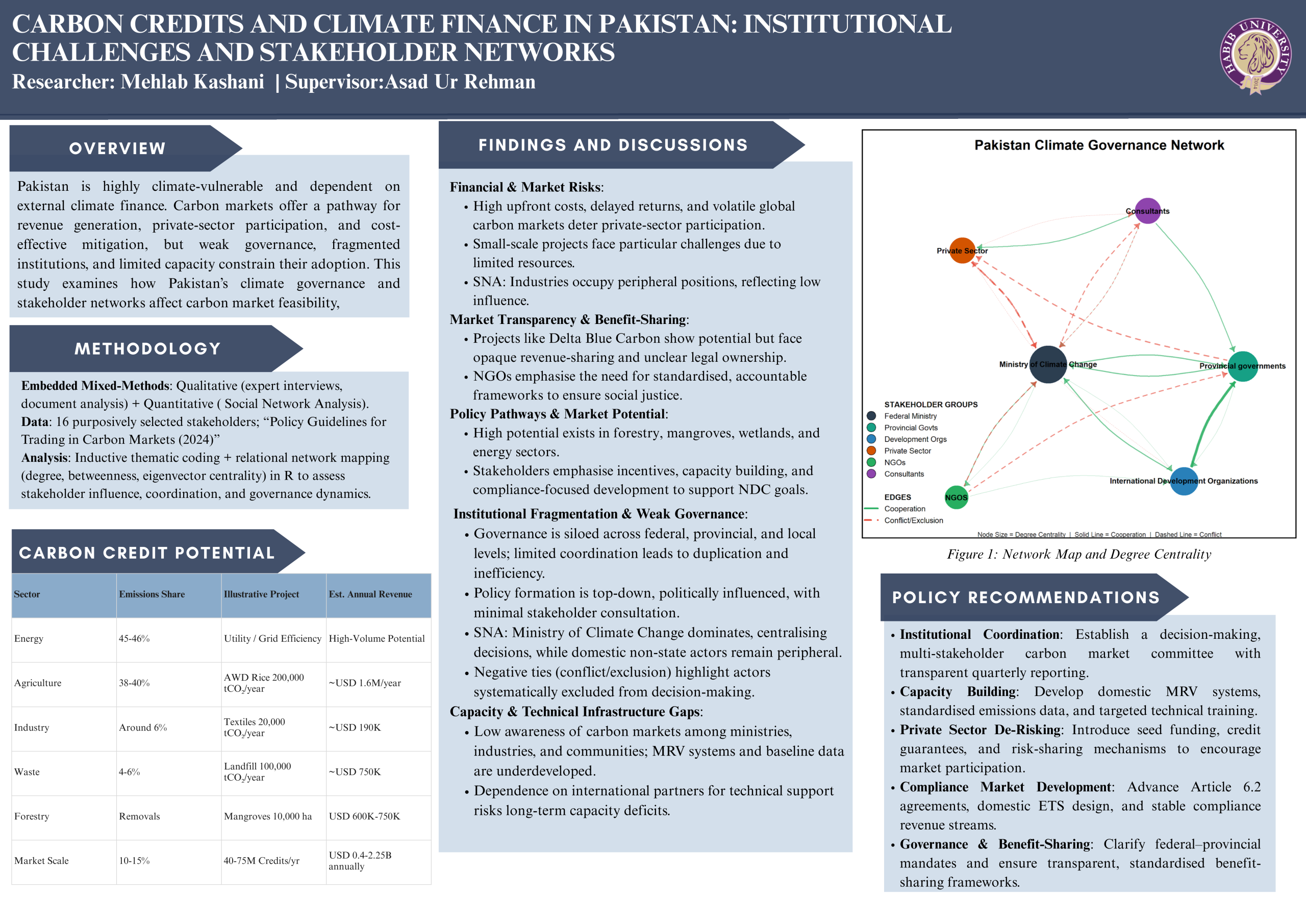
Carbon Credits and Climate Finance in Pakistan: Institutional Challenges and Stakeholder Networks
Description
Pakistan is among the world’s most climate-vulnerable countries and faces a significant gap between climate risks and climate financing. This study examines the potential and barriers to carbon market development in Pakistan using Ecological Modernization Theory and Environmental Governance Theory. Using an embedded mixed-methods design, it draws on sixteen semi-structured interviews with government officials, NGOs, international organizations, consultants, and industry stakeholders, alongside analysis of Carbon Market Guidelines and social network mapping. Findings highlight institutional fragmentation, technical capacity gaps, financial risks, and benefit-sharing concerns. Governance remains centralized, with strong reliance on international actors and limited inclusion of domestic stakeholders. Despite these constraints, the study identifies significant potential for carbon markets to mobilize climate finance if coordination and institutional capacity are improved.
Project Pictures