

 Share Profile
Musab

Aspiration Statement
I am excited by the domain of numerical optimization, high-performance computing, and understanding the mathematics of machine learning. I intend to pursue Data Science and Robotics.
Core Skills
- C++
- Jax
- Nextjs
- Python
- Pytorch
Core Demonstrated Competencies
- Drive for Results
- Takes Initiative
Preferred Career Paths
First priority: Machine Learning
Second priority: Robotics
Third priority: Software Engineering
Academic Awards / Achievements
- Dean's List 2023, 2024, 2025
- High Achievement Scholarship 2023, 2024, 2025
- President's List 2023, 2025
Experience
Leadership / Meta-curricular
- President, Brain.hack() - CSEC (Computer Science and Engineering Club)
- Vice President, Brain.hack() - CSEC (Computer Science and Engineering Club)
- Active Member, Math Club
Internship / Volunteer Work
- Data Science Intern, Securiti.ai (June – August 2025)
- Summer Tehqiq Research Program - Student Researcher, Habib University - GSCP (May – August 2025)
- ML Intern, Toyota IMC (November 2024 – June 2025)
- Algorithms Researcher, Cispa Helmholtz Center for Information Security (June – July 2024)
Publications / Creative Projects
- Internship – Research Abroad internship at CISPA Helmholtz Center for Information Security in Germany
- Competition – Meta Hacker Cup Quarter Finalist - 1st in Pakistan and 128th in the World
- Award – ICPC International Collegiate Programming Contest Regional Gold Medalist
Final Year Project
Project Title
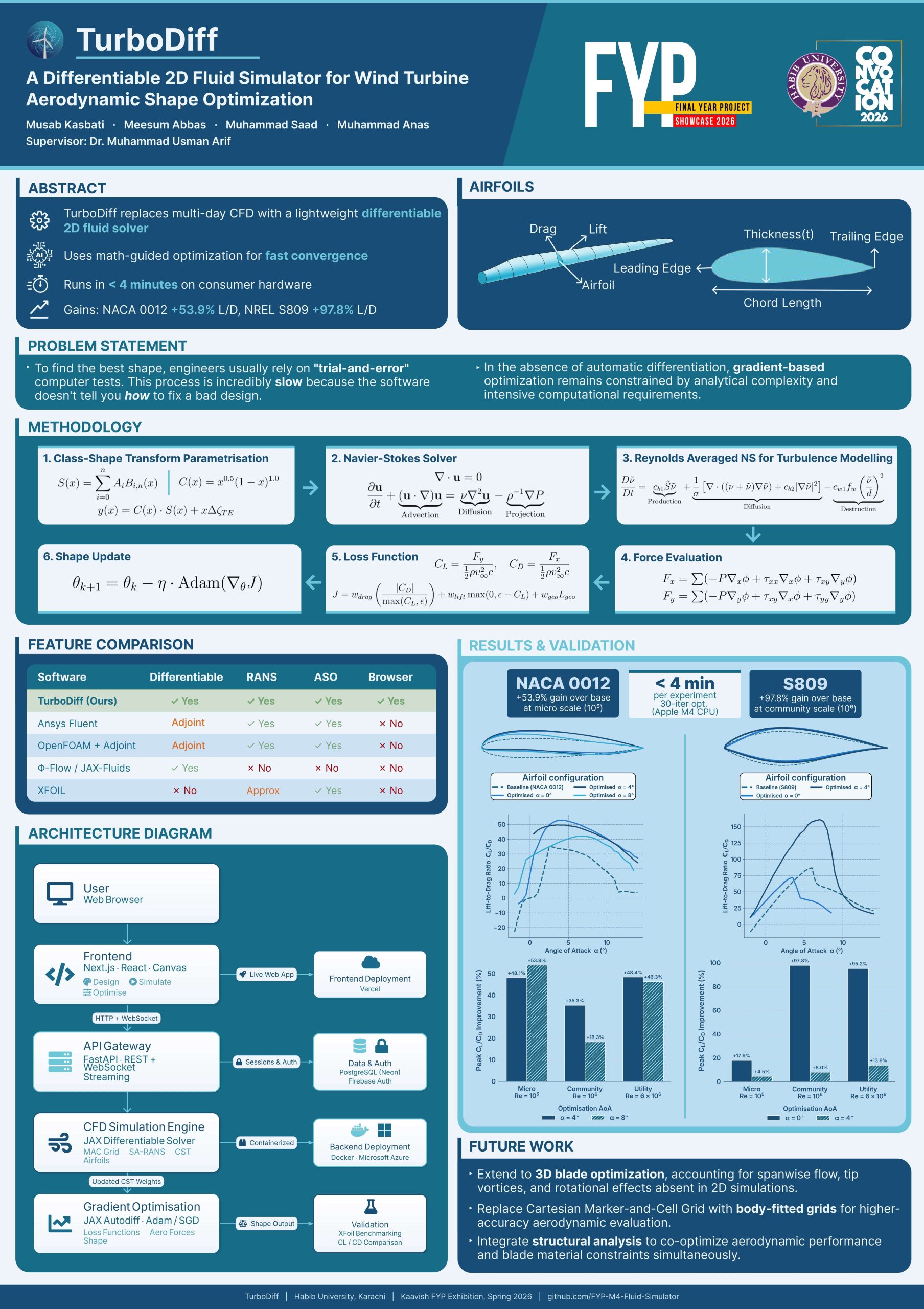
TurboDiff: A 2D Differentiable Fluid Simulator for Wind Turbine Airfoil Optimization
Description
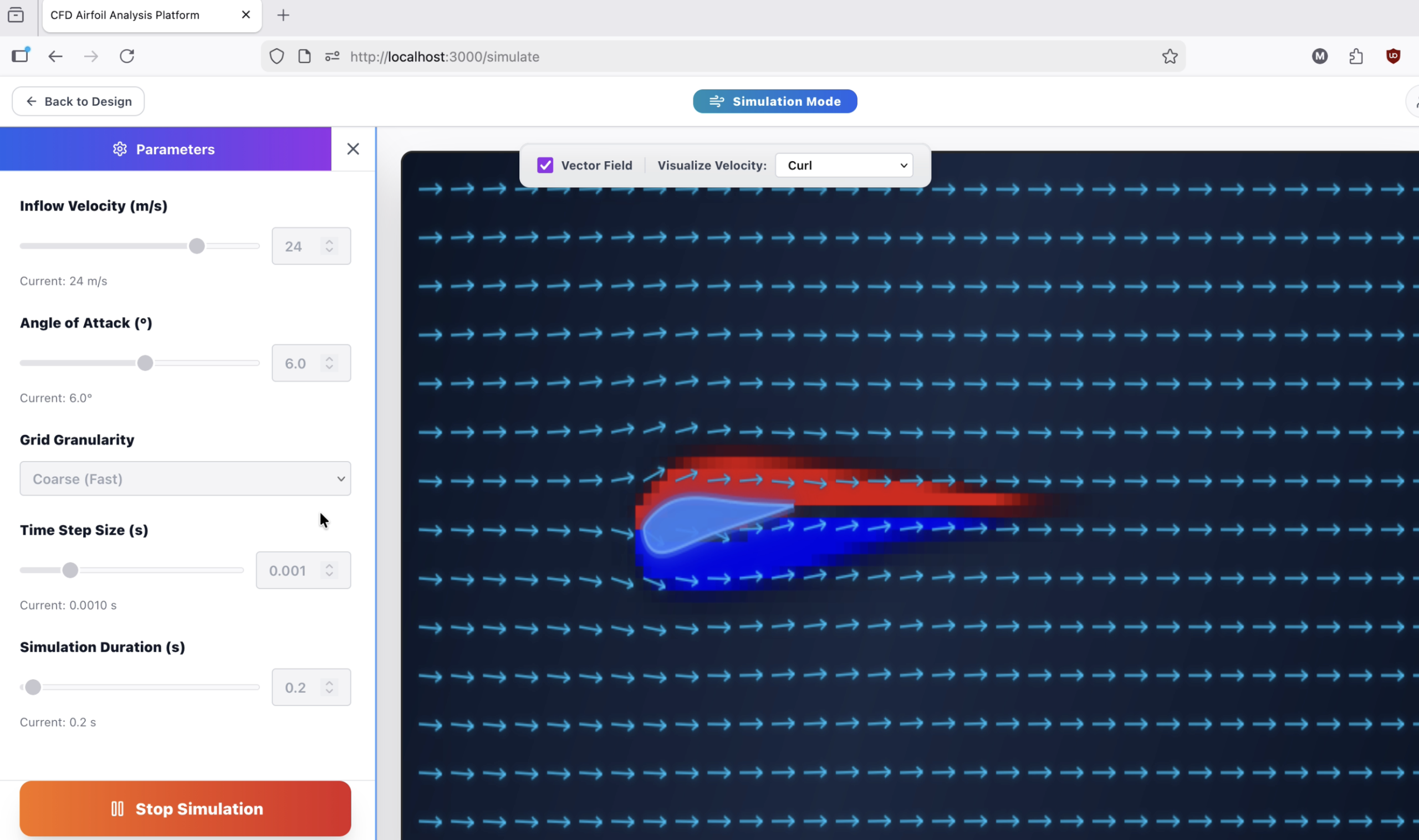
To maximize wind turbine efficiency, traditional design relies on computationally expensive solvers or low-fidelity tools lacking gradient capabilities. We developed TurboDiff, a lightweight, 2D differentiable CFD (Computational Fluid Dynamics) simulator specifically for Aerodynamic Shape Optimization (ASO). By leveraging Automatic Differentiation (AD) and Numerical Optimization, TurboDiff solves incompressible Navier-Stokes equations using Cartesian grids and Signed Distance Functions. This high-performance approach bypasses complex adjoint derivations, instead utilizing automatic gradients to iteratively refine airfoil geometries parameterized by Class-Shape Transformation. The research produced three high-performance airfoil designs tailored for varying power scales. Ultimately, TurboDiff provides an open-source framework bridging differentiable physics and scalable engineering, accelerating high-efficiency wind energy deployment in unique climatic regions like Pakistan’s coastal corridors.
Project Pictures