

 Share Profile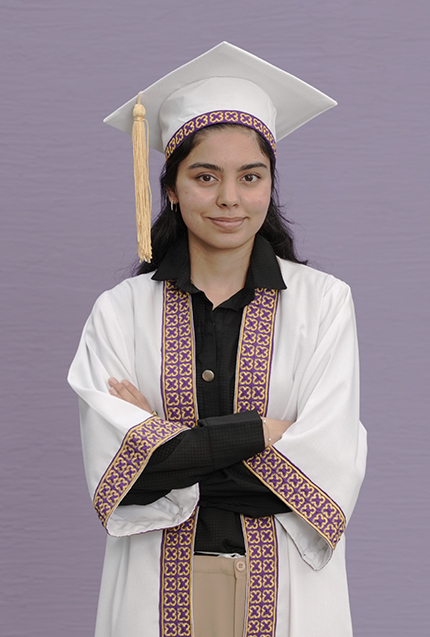
Fakeha Faisal

Aspiration Statement
I'm a Computer Science graduate passionate about NLP & human-centered AI. I aim to pursue a career as an AI/ML Engineer who builds systems that are both powerful & useful to people.
Core Skills
- LangChain
- Python
- PyTorch
- SQLR
Preferred Career Paths
First priority: AI/ML Engineer
Second priority: Data Scientist
Third priority: Product Associate/Manager
Experience
Leadership / Meta-curricular
- Summer Tehqiq Research Program - Undergraduate Researcher
- Office of Student Recruitment and Marketing - Student Ambassador
- HU Throwball Competition - Team Member
- General Secretary, Computer Science And Engineering Club Chapter Of Csec Mindstorm
Internship / Volunteer Work
- Online Coding Instructor, CodeSchool.pk (September 2025 – March 2026)
- Teaching Assistant, Habib University (January 2023 – December 2025)
- Undergraduate Researcher, Habib University (May – August 2023)
Publications / Creative Projects
- Conference Presentation – ObesityWeek 2024 Conference — Abstract presented on a randomized controlled trial analyzing health and sleep metrics, ObesityWeek International Conference, 2024.
- Publication – SemEval 2026 Task 5 system description paper — "ConText at SemEval-2026 Task 5: Rating Plausibility of Word Senses in Ambiguous Stories through Narrative Understanding", Habib University, 2026.
- Research Paper – CLEF 2026 eRisk Lab — Participating in Problems 1 and 3 on early risk detection of mental health conditions from user-generated text, CLEF 2026 International Conference.
Final Year Project
Project Title
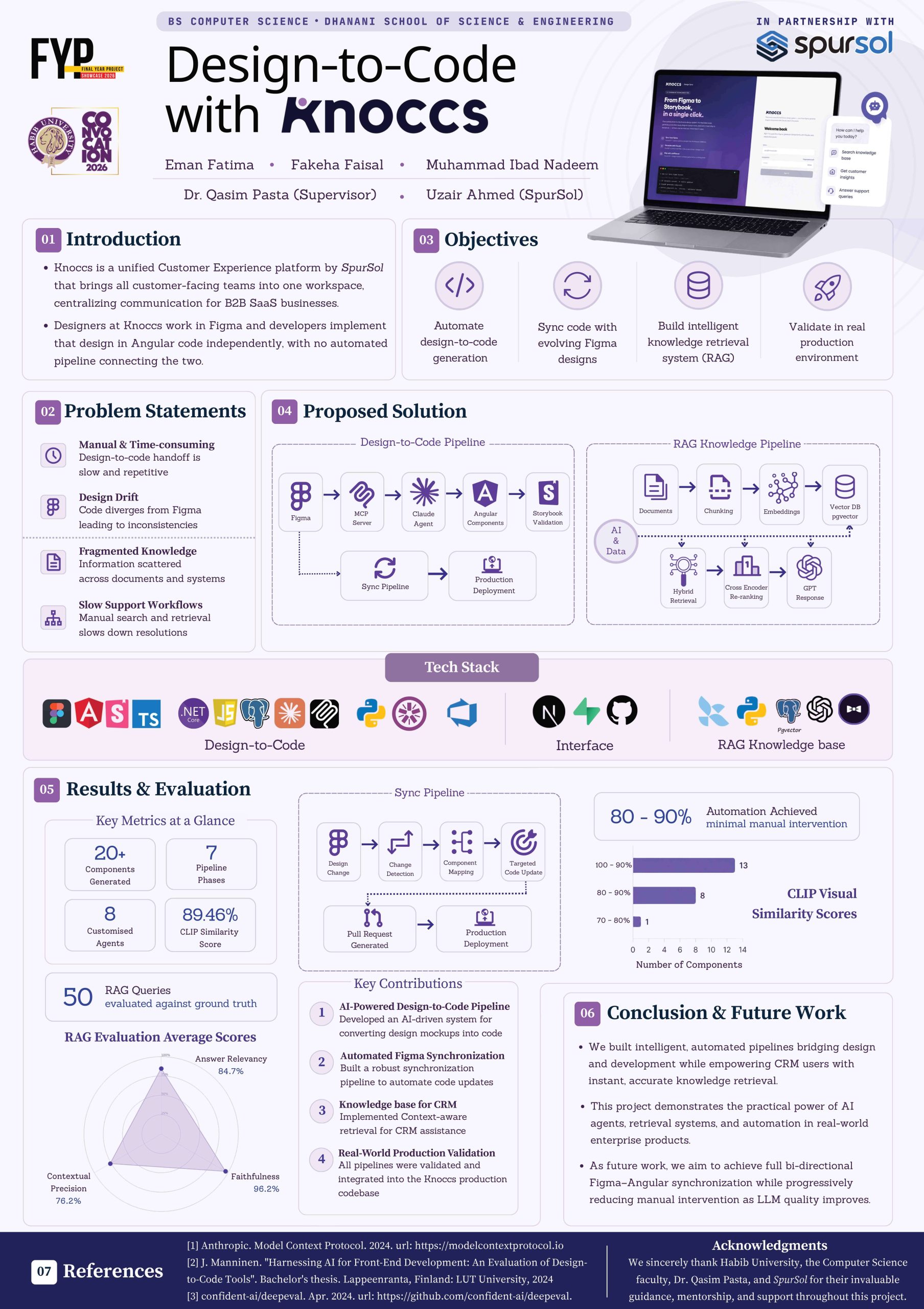
Design-to-Code with Knocks
Description
It's developed in collaboration with SpurSol, aimed at bridging the gap between UI/UX design and software development. It builds a multi-agent AI pipeline that automatically converts Figma designs into production-ready Angular code, reducing manual development time and design-to-engineering handoff effort. My specific contributions focused on building a RAG-based knowledge base that allows users to query Knoccs documentation, as well as developing the Tag Management and Macro Management modules. The RAG system enables faster onboarding and reduces dependency on manual documentation lookup, while the macro and tag features improve workflow automation and organisation across the platform. The aim of the project is to validate how AI can be integrated into real enterprise SaaS products to improve developer efficiency and product scalability.
Project Pictures