
Habib University Brings “Epistemic Reparation” to the Future Universities Alliance Global Summit at Duke
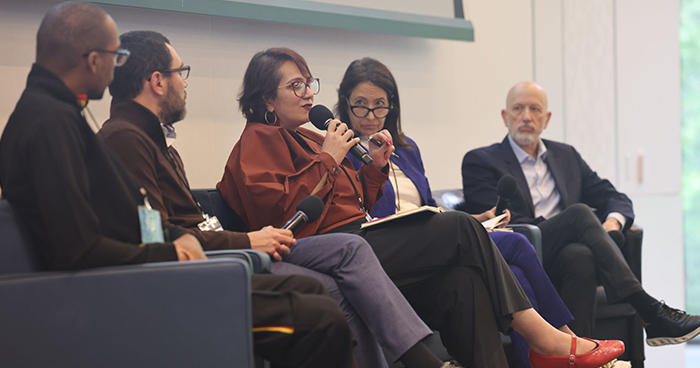
Tatheer Hamdani, Senior Director of Student Affairs and President’s Chief of Staff, Habib University, speaking at the Future Universities Alliance Global Summit
The best way to predict the future is to make it, and Duke University’s inaugural Future Universities Alliance Global Summit did exactly that. The three-day summit, nested within the larger 12-month-long peer-learning program, brought together the alliance’s first Innovation Sandbox cohort from across 23 countries, with participating institutions coming from Australia, Botswana, Germany, Ghana, Honduras, India, Kazakhstan, Mexico, Morocco, Nepal, Nigeria, Pakistan, Qatar, Singapore, South Africa, South Korea, Spain, Tanzania, Thailand, Türkiye, Uganda, the United Kingdom, and the United States.
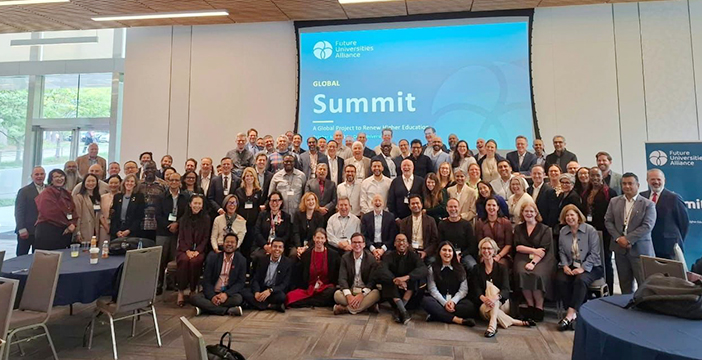
“What connects these institutions is not innovation for its own sake [but] a shared conviction that the central questions facing higher education are fundamentally about what constitutes high-quality learning, how we know it when we see it, and how it can reach more students in more places”, said Noah Pickus, Head of Global Strategy and Partnerships and Senior Advisor to the Provost at Duke University and founder of the Future Universities Alliance.
Habib University participated in Pathway 2: Early-Stage Innovations Within Existing Institutions with a heavy focus on advancing change within established universities, such as engaging staff and faculty in change, working through institutional structures and building durable practices. Within this cohort, Habib University’s work also centres on an internal strategic project that is reimagining the Habib Liberal Core.
“The Alliance is an unusual and valuable idea: bringing new and established institutions together not simply to share what they know, but to learn from one another. Our institutions differ in age, place, and context, yet we kept arriving at the same questions. Learning happens when contexts are different, but the challenge is the same. And more often than not, constraints drive change”, said founding staff member, Habib University, Tatheer Hamdani, and current Senior Director of Student Affairs and President’s Chief of Staff.
Representing Habib University alongside Ms Hamdani was founding faculty member Dr Shah Jamal Alam, Associate Dean of Undergraduate Education and Professor of Computer Science.
During the plenary panel, Ms Hamdani situated Habib University within the country’s political and educational history. She described Habib University’s mission as one of “epistemic reparation”, recovering the lost histories, intellectual traditions and forms of knowledge in Pakistan’s educational landscape. Hence, building an education grounded in Pakistan’s own intellectual and cultural context became Habib University’s core mission and commitment to Pakistani society at large.
Finally, highlighting the university’s commitment to quality education and making a rigorous liberal arts education accessible to students from Pakistan, entirely on merit and irrespective of their financial situation, she spoke of President Rizvi’s philanthropic vision of building Pakistan’s first not-for-profit university of its kind.
Throughout the summit, Habib University was noted for the clarity of its institutional purpose, prompting self-reflection among representatives of longer-established universities, including those in the United States, on the need to revisit their own purpose and on the enduring value of the humanities and social sciences, fields now under significant pressure at many American universities.
“It means a great deal when an institution with Duke’s history chooses to make space for conversations with universities as young as ours. It signals that the future of higher education will be shaped by exchange between the established and the emerging. At Habib, we are reimagining our Liberal Core in that same spirit: drawing on enduring ideas while building new ways of thinking, so our students can respond to crises that are interconnected, urgent, and still unfolding”, maintained Dr Shah Jamal Alam.
Habib University’s participation reflected its ongoing commitment to contributing to global conversations on higher education while advancing its distinctive mission in Pakistan.