
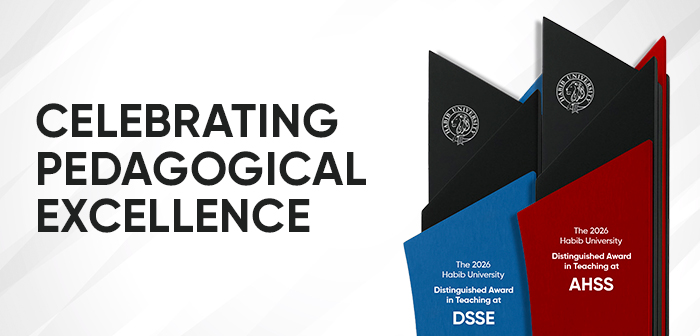
Teaching Excellence Awards: Habib University Honors Faculty
Habib University celebrated faculty contributions by announcing this year’s Teaching Excellence Awards, recognizing Dr. Behroz Mirza, Assistant Professor of Computer Science at the Dhanani School of Science and Engineering, and Ms. Tajreen Midhat, Lecturer II in Social Development and Policy at the School of Arts, Humanities and Social Sciences, for making exceptional contributions to creating a high-quality intellectual experience for students.
Presented during Awards Night 2026, the awards highlight teaching approaches that go beyond content delivery to create genuinely enriching intellectual experiences for students. Nominations are assessed against the University’s framework of Content, Pedagogy, Assessment, and Community Building, the same dimensions that form the foundation of Habib University’s reimagined Faculty Development Framework, recognizing courses that demonstrate rigor, intentional pedagogy, and thoughtful assessment design.
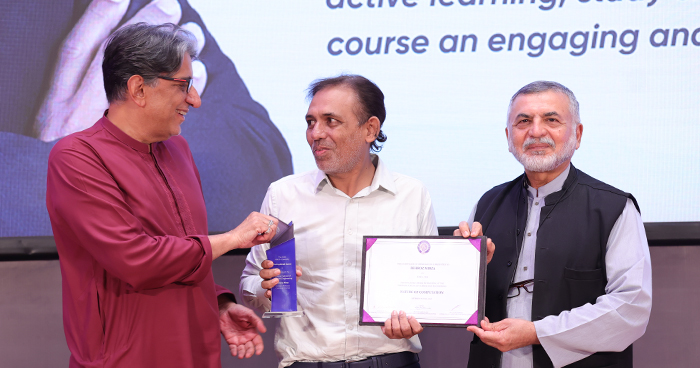
Dr. Behroz Mirza was recognized for CS 212: Nature of Computation (Fall 2025), a course that brought together computation theory, contemporary large language model applications, including the Chomsky Algorithm, and real-world case studies such as the Google Maps patent and the Quadriga crypto case, all woven together through a philosophy of self-cultivation grounded in Yohsin. Rather than treating these as separate threads, the course used them to build a coherent intellectual experience that students found both rigorous and relevant.
In terms of pedagogy, Dr. Behroz drew on inquiry-based active learning, Socratic prompting, collaborative assignments, and a bilingual approach intended to bridge socio-economic diversity among students. Outdoor study circles extended the learning environment beyond the classroom. Assessment was designed with equal intentionality, built around weekly individual challenges, group assignments, and reflective worksheets, each mapped to course learning outcomes with clear rubrics. The result was a course that challenged the perception of theoretical computer science as inaccessible, inspiring students to develop a genuine passion for the subject.
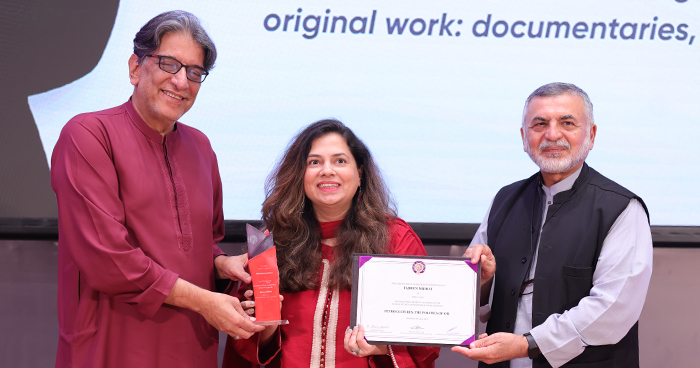 Ms. Tajreen Midhat was recognized for POLI 300: Petrocultures: The Politics of Oil (Fall 2025), a course that took on the complex relationships between oil exploitation, ecology, and everyday life. Drawing on political economy, petrofiction, film, graphic novels, and documentaries, the course examined themes of imperialism, migration, gender, and ecology in ways that were both intellectually grounded and immediately relevant to students’ own contexts.
The course was structured as a lecture-seminar with rotating student facilitators for films and reading circles for novels, supported by small-group instructor tutorials and graded discussions that ensured consistent engagement. Assessments required students to move beyond comprehension and into original production, with documentaries, podcasts, and critical essays replacing conventional examinations. A documentary assignment focused on Karachi gave the course’s global themes a local dimension, prompting students to examine their own city through a critical new lens.
Across both courses, this year’s awardees demonstrated what student-centered teaching looks like in practice: learning environments where students are active participants in their own intellectual development, not passive recipients of information.