Imagine entering a class on the first day of the semester where the lights are dim, and you are asked to take out your phones so you can play a Kahoot quiz. This was the norm in a course called Water: Science, Society, and Policy. It was an intentional departure from convention, designed to set the tone for a course that treats water not just as a scientific subject, but places it within the domains of social, political, and lived reality.
Pedagogical Framing
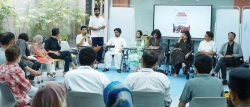
The course Water: Science, Society, and Policy was built around active learning and participation. Over the semester, traditional lecture sessions were merged with tools such as Mentimeter, Bingo-based knowledge checks, role play, and sustained group discussions. Each method served a different purpose. Mentimeter gave quieter students a space to voice opinions, while Bingo tested cumulative understanding from previous lectures in a collaborative, low-pressure format. If you were in this class, irrespective of your social skills, you could have not only enhanced your learning in an unconventional way, but also engaged in a way more suited to your personality.
One of the most rewarding aspects of the pedagogy of this course lay in role play. Students were assigned positions as policymakers, engineers, environmentalists, and community representatives within water-resource case studies. They researched their roles, designed arguments, and entered negotiations that were simulations of real-world tensions. Engineering feasibility clashed with political constraints; environmental priorities met community needs.
In this class, technology remained at the foreground of learning in this class. Platforms like Kululu were used to share and discuss flood imagery from around the world in real time, anchoring abstract concepts in visual evidence. Videos, ranging from documentaries on Karachi’s water crisis to analyses of dam failures in Europe, brought global and local perspectives into the classroom. Students compared case studies across regions, broadening their understanding of how governance, infrastructure, and climate intersect differently across contexts.
The semester’s central project brought theory directly home. Students collected water samples from their own residences and spent two days in the lab testing them. Towards the end, the class had produced multiple maps visualizing water-quality parameters across different neighborhoods of Karachi. The data was reflective of personal, local, and unsettling transforming water quality from an abstract indicator into a shared civic concern.
Learning Beyond the Classroom
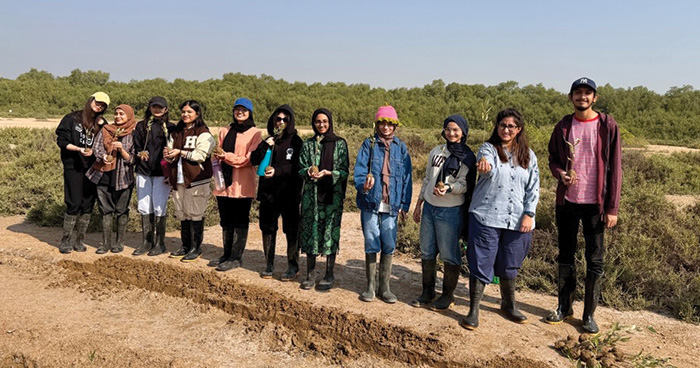
Learning extended beyond campus walls. A field visit to the WWF Wetland Center immersed students in applied water science. They learned directly from practitioners, planted mangroves, trekked through coastal forests, and participated in beach clean-ups. The experience connected ecological theory with stewardship and responsibility.
Throughout the course, students worked in groups on comparative research tasks. One assignment turned each group into a country responsible for presenting its water-resources management system. They examined supply networks, policy successes, failures, and ongoing challenges. Moments of surprise were frequent, as students discovered unexpected innovations in some regions and deep structural failures in others.
Embedding Strategic Vectors into the Course Design
Perhaps one of the most significant contributions of this course design lies in its incorporation of the university’s two strategic vectors: technology and polycrisis. Students were permitted to use AI tools during quick, interactive sessions to spark discussion and exploration, but were prohibited from relying on them for in-depth analysis and original research. Apps, videos, and digital platforms were treated as instruments,s not substitutes for critical thinking. This integration of AI as an instrument enables students to nurture their cognitive effort in an organic rather than artificial way. As for polycrisis, the course consistently framed water within interconnected crises: climate change, governance breakdowns, social inequities, and economic stress. Floods and droughts were discussed not only as environmental events but as triggers for displacement, political instability, and institutional failure. Climate science was translated into societal consequences, and policy trade-offs were examined with an unflinching lens.
By the end of the semester, the results were visible. Student engagement was high, discussions were substantive, and ownership of learning was evident. Peer-to-peer interaction became the norm rather than the exception. More importantly, students left with a deeper understanding that water is never just about chemistry or hydrology, it is about people, power, and the choices societies make under pressure.
From the viewpoint of the global sphere and in a world increasingly defined by water stress, the classroom became a microcosm of the challenges ahead and a testing ground for how future decision-makers might respond.
Dr Hadiqa Maqsood is an Assistant Professor in the Integrated Sciences and Mathematics program at the Dhanani School of Science and Engineering.” Her research interests include Environmental Systems Modeling, Water Resource Engineering, Climate Change, and Sustainable Irrigation to name a few.
Written by Esha Irshad Zaidi (Management Trainee, Marketing and Communications)