
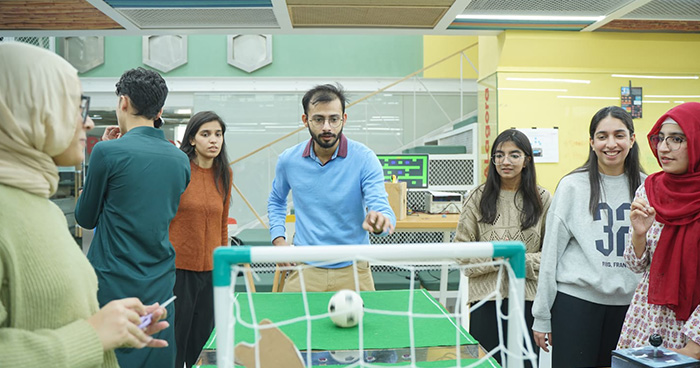
What does it mean to truly understand a system— how it works, responds to inputs, and interacts with people? Computer Science (CS) students at Habib University learn about digital systems and apply concepts from the course Digital Logic and Design (DLD) by designing games that integrate hardware, coding, and visual display.
Rather than approaching digital logic as an abstract exercise, third-semester CS students were tasked with designing games and showcasing them at the DLD Exhibition, held at IDEAL, Habib University, on December 19, 2025. In doing so, students stretched their knowledge base, learning new skills and techniques to successfully execute their projects.
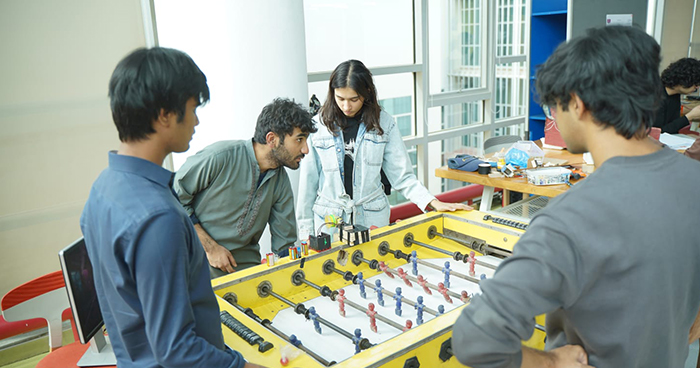
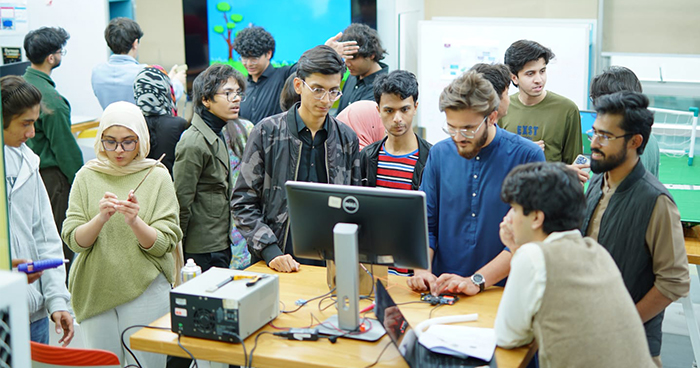
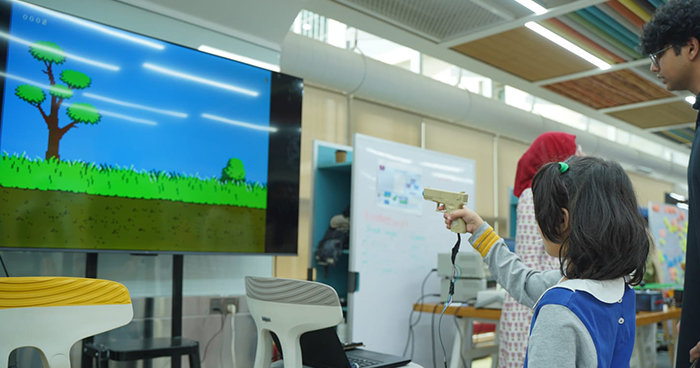
Students demonstrated creativity and innovation through projects such as automating ball extraction in foosball, vintage duck-hunting game played on a large screen, soccer simulations, educational learning games, and others.
One group of students designed a braille learning game to help users and support communication with the visually impaired community, reflecting Habib University’s values of inclusion and social responsibility.
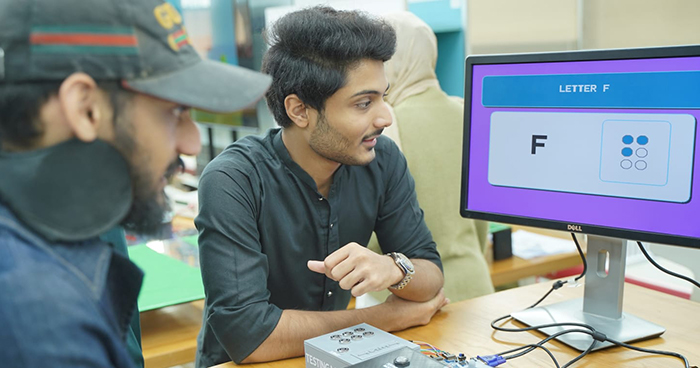
“We wanted to create something that helps our society. We had to go the extra mile to get this game ready,” said Aleena, a member of the group.
“We learned CAD [Computer Aided Design Modeling] to get the perfect boxes [for the gaming console]ready with the help of 3D printing. We also learned soldering and worked closely with research assistants and students from electrical and computer engineering to ensure the system functioned properly.”
Starting from scratch and executing the ideas gave students a confidence boost, teaching them not only technical skills, but also time management, resource management, and interdisciplinary collaboration.
Similarly, other students expanded their horizons by applying their understanding of microprocessors and working closely with hardware to build fully functional systems, broadening their exposure to hardware-level implementation.
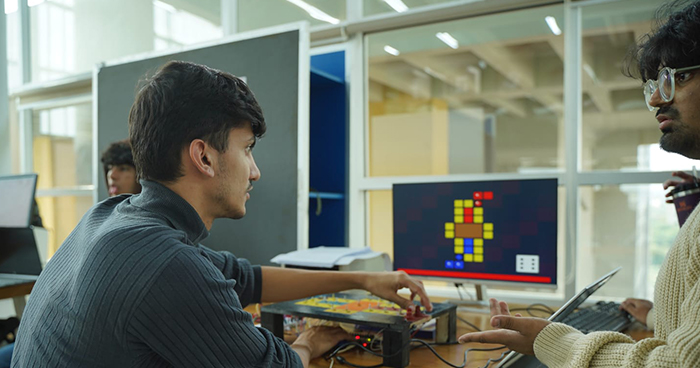
These projects were grounded in the core technical framework of the DLD course. Students learn to design digital systems using Field-Programmable Gate Array (FPGA) boards, implementing logic through state machines and sequential system design.
“Most students design games because they represent different stages of a [digital]system,” said Dr. Muhammad Farhan, Program Director and Associate Professor, Electrical and Computer Engineering, Habib University.
“Students develop a system while considering various constraints, interacting with the real world, and producing outputs in the form of scores or visual displays on a screen. The goal of this project is to integrate multiple subsystems into a fully functioning whole.”
Visitors moved between displays that demonstrated how the DLD Exhibition underpins experiences that feel intuitive and engaging to users.
“The projects have exceeded my expectations,” said a parent of one of the student exhibitors. “They are engaging and thoughtfully designed, and I cannot single out one as the best.”
“The students have definitely worked hard and creatively, but it is a collective effort of faculty and [support]staff. I would say, keep up the good work.”
Within Habib University’s broader experiential learning ecosystem, the DLD Exhibition represents an early but pivotal milestone, preparing students for advanced applied experiences such as final-year projects.
By designing logical, interactive, and user-focused systems, students engage in hands-on, game-based projects that translate ideas into working realities while navigating real-world constraints.
The exhibition exemplifies Habib University’s commitment to rigorous, reflective, and socially engaged education and reaffirms the principle that meaningful learning occurs when students think critically, explore interdisciplinary solutions, and implement them.