At Habib University, the classroom is a dynamic site of inquiry, reflection, and co-creation. With growing conversations around inclusive education, there is a pressing need to reimagine pedagogy in ways that reflect the lived realities of learners in Pakistan. What does it mean for a classroom to be equal? How do we teach across differences of class, language, gender, and geography? And what role do instructors play in creating spaces of belonging?
These were some of the questions that shaped “(Un)Equal Classrooms” a faculty-student collaboration initiated by Ahsan Mashhood, Affiliate Research Fellow and former Dean’s Fellow (2024–25) at Habib University. The project, which emerged during his first experience of full-time university teaching, was equal parts pedagogical experiment and ethnographic inquiry.
“I was documenting everything,” Ahsan shares. “After every class, I would sit with my teaching assistants and colleagues to reflect on what had happened, what had been said, who had spoken, who had remained silent. These conversations turned into fieldnotes. Over time, the notes turned into a question: Could we imagine a more equal classroom in Pakistan?”
A Pedagogical Ethnography: Teaching as Inquiry
Ahsan’s approach to pedagogy was deeply shaped by his training in the social sciences and his commitment to equity. For him, the classroom is never a neutral space, it mirrors broader hierarchies that often go unquestioned: socio-economic class, gender(ed) expectations, English fluency, social confidence, schooling backgrounds, and more.
“Student-centered teaching had been modeled to me by professors who knew how to hold space, who practiced humility, care, and openness,” he notes. “I wanted to bring that energy into my classrooms”
The intentional process of reflection, dialogue, and co-learning is a core component of Habib’s teaching philosophy in Pakistan. Eventually, these individual practices, dialogues and conversations transformed into a public, participatory inquiry.
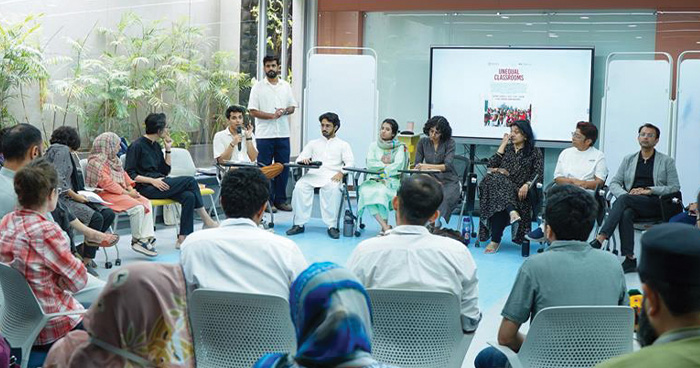
In the Spring semester, Ahsan and his team hosted a live focus group-style event. Five faculty members and five students sat together, side-by-side, and spoke candidly about inclusion, marginality, and the emotional texture of teaching and learning.
“We didn’t want hierarchy,” Ahsan explains. “We didn’t want the faculty on stage and the students in the audience. We sat in a circle, as co-learners, and opened the space to an audience that listened, responded, and witnessed.”
The conversation was transcribed in full, and participants were then invited to write reflections.
They were asked:
- What does an equal classroom look and feel like? Why should we care?
- Recall a moment when you felt included (or excluded) in a classroom.
- How might we redesign the experience of learning in a Pakistani university?
The stories that emerged were textured and powerful: a student recalling the first time a professor asked their opinion rather than quoting a theorist; a faculty member admitting the discomfort of realizing they had overlooked class-based assumptions; a shared recognition that inclusion is not a checklist, but an orientation.
A Toolkit for Inclusive Teaching in Pakistan
From this rich pedagogical archive, ethnographic fieldnotes, conversations, focus group transcripts, and written reflections, Ahsan and his research assistant developed a Toolkit for Inclusive Classrooms in Pakistani Higher Education.
“The toolkit isn’t a rulebook,” Ahsan notes. “It’s more like […] a reflective companion for faculty who are either new to teaching or who are grappling with old pedagogical challenges in a new context.”
Designed specifically for higher education in Pakistan, the toolkit includes:
- Context-sensitive suggestions on inclusive classroom practice
- Strategies for participation beyond English fluency and extroversion
- Approaches to care and authority that do not compromise academic rigor
- Questions to prompt faculty reflection on power, hierarchy, and belonging
The toolkit aims to support instructors who are committed to making their classrooms more just, empathetic, and grounded. It is also an open invitation, for Habib faculty and beyond, to think critically about the pedagogies we inherit, and the ones we choose to practice.
The Ongoing Work of Inclusion
At Habib University, teaching is dialogic, iterative, and deeply rooted in place. Projects like Imagining the Equal Classroom reflect this ethos. They remind us that the work of inclusion is ongoing (as is all good pedagogy). It is in the syllabus, yes, but also in the silence we allow, the questions we ask, the voices we center.
“My students taught me what the classroom could be,” Ahsan reflects. “They taught me that inclusion isn’t about ‘helping the disadvantaged’—it’s about transforming the whole space so that everyone can bring their full self. That is the classroom I am trying to build.”