December 13, 2025 | Karachi
Pakistan stands at a paradoxical crossroads: rich in human potential, yet constrained by instability. Political volatility, policy inconsistency, macroeconomic uncertainty, and brain drain make it one of the most unforgiving environments to build enduring institutions, corporate or otherwise.
Yet Pakistan’s leading corporations have excelled, not just survived. Through ethical stamina, long-term vision, and resilient leadership, they continue to innovate, generate employment, and contribute meaningfully to society.
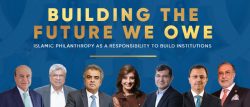
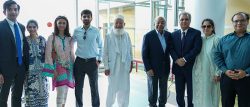
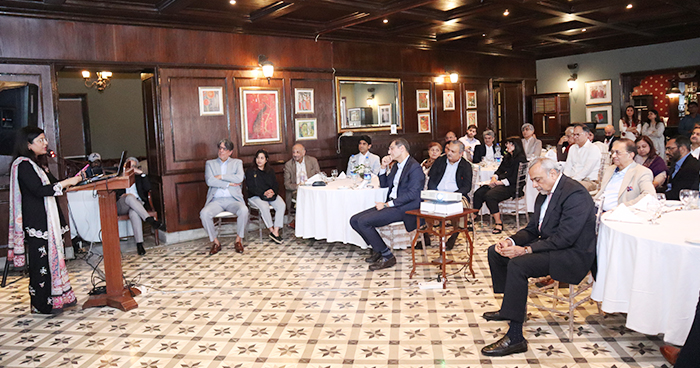
It was against this backdrop that corporate leaders gathered over lunch on December 13, 2025, to reflect on a shared question: what responsibility do resilient institutions bear toward Pakistan’s future? The gathering was graciously hosted by Habib University Board Members Amir Paracha, Chairman & CEO of Unilever Pakistan Ltd., and Asif Peer, CEO & Managing Director of Systems Limited, who convened peers to explore how corporate leadership can strengthen higher education.
A Parallel Climb: Higher Education in an Even Harsher Terrain
If building a successful business in Pakistan is improbable, building a higher education institution that expands access while insisting on excellence is even more arduous. Pakistan’s tertiary enrollment has stagnated between 9–12 percent for over a decade, alarmingly low for a such a youthful nation. Even among those who make it through the gates, quality higher education is accessible to a privileged few.
Habib University emerged in this tumultuous ecosystem, where liberal arts was an unwelcome concept, philanthropy for higher education was rare, academic freedom was constrained, and attracting world-class faculty a challenge. With conviction, Habib pursued a radically different vision in which opportunity is determined by merit, not financial circumstances.
Reflecting on this, Asif Peer observed, “Out of 1,200 students at Habib, 85% are on scholarships and financial aid. Students from matric and intermediate have equal opportunity to compete, learn, and demonstrate their aptitude. That is powerful.”
Today, nearly 70% of Habib students come from low- to middle-income families, studying a alongside peers from international boards on genuinely equal footing.
Leadership, Ethics, and the Enduring Case for Liberal Arts
Leadership was a recurring theme throughout the discussion. In an age shaped by artificial intelligence, participants stressed the enduring value of judgment, ethics, and critical thinking.
As Asif Peer noted, “We have medical institutions, engineering universities, chartered accountancy programs, but launching a liberal arts university was a bold step. In an age of AI, liberal arts sets students apart. AI can teach information, but it cannot teach values, judgment, and critical thinking.”
Habib’s liberal core curriculum is designed to cultivate precisely these capacities: curiosity, imagination, and moral reasoning. As several leaders emphasized, one principled leader can go on to create hundreds, even thousands, of livelihoods, underscoring why higher education remains one of the most powerful levers for national progress.
President Wasif A. Rizvi articulated this perspective succinctly, “The impact of a higher education institution is outsized. Few institutions can create an impact that is truly magnanimous.”
Corporate Philanthropy: An Untapped Lever for Institutional Impact
A pivotal moment centered on corporate philanthropy and its unrealized potential. Globally, the case is clear. In the United States, 38% of corporate philanthropic giving is directed toward higher education, enabling deep industry–university partnerships that fuel innovation, and leadership.
In Pakistan, less than 1% of corporate philanthropy flows toward higher education.
This disparity is not a reflection of limited generosity, but of orientation. Philanthropy directed toward universities is institutional investment. It strengthens the ecosystem that produces ethical leaders and future innovators, who may go on to shape the corporate sector itself.
As Amir Paracha reflected, “At Habib, nobody asks you who your parents are. They ask you who you want to become.”
Rooted in the philosophy of Yohsin, the belief in the inherent worth and dignity of every individual, Habib University positions education as stewardship, not privilege. As Pakistan’s first community-owned university, it invites corporates to move beyond transactional giving and become co-authors in the patient process of institution-building.
Industry–Academia Partnerships for a Shared Future
The message from the gathering was unambiguous: Pakistan’s next chapter of nation-building requires deep, sustained partnerships between industry and academia, not only in the form of financial support, but through mentorship, internships, curriculum co-design, research collaboration, and leadership development.
Such partnerships create a multiplier effect: strengthening universities, enriching industry, and expanding opportunity for the country’s future leaders.
An Awakening, Not Merely an Institution
As the conversation concluded, Amir Paracha offered a personal reflection:
“For the last few years, I have had the honor of walking the corridors of Habib. I have seen its soul very closely. Unlike other institutions, Habib is not just another university. It is an awakening. It is a prayer for Pakistan’s future.”
In a country where resilient corporations have repeatedly pushed the boulder uphill, the invitation now is to push together, aligning corporate leadership with higher education to unlock Pakistan’s vast human potential and shape a future defined not by constraint, but by possibility.