
Inspired to Act: Scrap to Survival
The Inspired to Act (I-Act) program at Habib University encourages students to move beyond classroom learning and transform ideas into meaningful action. It begins with reflection; students revisit concepts, discussions, and experiences from their courses to identify ideas that resonate most deeply. These ideas may emerge from a thought-provoking reading, a lively classroom debate, or even a field experience that challenges their perspective. Through I-Act, students channel these insights into projects such as Scrap to Survival that engage the wider community in diverse and purposeful ways. Read Ayesha Jawed’s blog on her I-Act project that depicts how human experiences can change the way we think about labor and sustainability.
“Where does the waste we throw away every day actually go?”
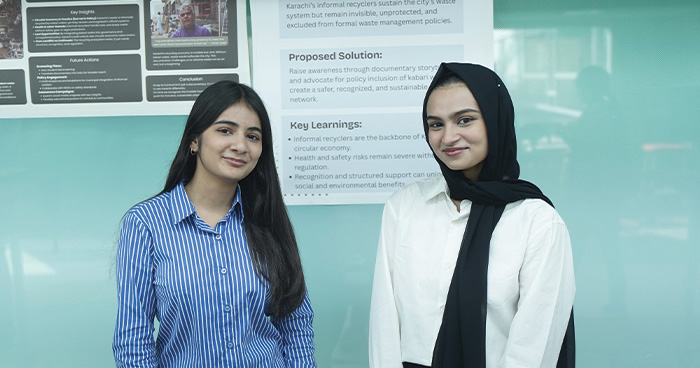
This simple question led to the initiation of our I-Act documentary ‘Scrap to Survival’, which I created along with my teammate Amna Jawed, under the guidance of Sir Farhan Anwar and Ms. Abiha Batool. What began as mere curiosity, soon grew into an exploration of Karachi’s informal recycling economy – a crucial system to the city’s survival. However, it continues to be invisible within the formal urban discourse.
Our documentary aimed at not only being a visual narrative, but an entry into the world of scrapdealers who are often hidden in plain sight.
Inside Karachi’s Informal Recycling Network
Karachi’s recycling system operates largely outside formal frameworks which is driven by thousands of scrap dealers who collect, sort, transport, and resell discarded materials. At every site we visited, we met workers whose livelihoods depend entirely on our trash.
The scrap dealers quietly run their own supply chains and this is what keeps the system in Karachi alive every day. Despite their immense contribution, these workers work without safety nets, job security or recognition as essential contributors to urban sustainability.
Stories Behind the System
At Shershah Market, we interviewed Imran Saeed, who has been part of the recycling industry for over 20 years. He shared how strenuous it is to survive in this line of work where wages are unstable, barely enough to cover daily expenses, and most workers earn around Rs. 500 a day despite the long hours. He also talked about how there is no safety equipment, no insurance, and no support for injuries or accidents yet they continue their work because their families depend on it. Mr Saeed also enlightened us about the process of the entire chain. Once the collection process is over, the scrap dealers bring these materials to godowns or larger scrap shops where the process of sorting, cleaning and separation of each part (metal, plastic, wires, glass etc.) begins. The sorted materials are then ready to be sold to factories where they are subsequently recycled into new product.
This was a reminder that sustainability is not an abstract concept, rather, a human reality. Every recycled item passes through various hands and those hands belong to people who rarely receive any acknowledgment for keeping Karachi’s waste cycle alive.
The Invisible Labor Behind Circularity
Around the world, economies are transitioning from a linear to a circular model where materials continuously re-enter the economy. In Pakistan, however, this circularity exists informally. The problem lies not in the system, but in its invisibility. We talk about circular economies in theory, while those who make it possible in practice still remain marginalized in our country.
Our documentary highlights that Karachi’s informal recycling workers are key tenets of circularity but they remain structurally excluded from policy, planning, and urban governance. Their contribution to climate resilience, waste reduction, and material recovery is significant but they are forced to operate without the protections or benefits that formal worker receive.
Why Formalization Is Necessary
The more time we spent with scrap dealers, the more evident the need for formal recognition became for us. Formalizing this sector is about elevating the people within this system to ensure their access to equal opportunities as formalized workers.
Formalization could include:
- Fair and stable wages
- Occupational safety gear and secure working environments
- Access to health, social security, and government support
- Regulatory frameworks that recognize scrap dealers as climate and urban sustainability actors
- Data driven mapping of informal recycling flows to integrate them into municipal planning
By giving them visibility, cities like Karachi can build more inclusive and resilient waste systems. It is our responsibility to treat them with dignity, fairness, and recognition.
Key Learnings from the Project
Working on Scrap to Survival taught us that sustainability is about people. Every statistic that we see has a face behind it. Karachi’s recycling system works not because of policies, but because thousands of scrap dealers show up every day. They sort, collect, and resell materials that would otherwise pile up as waste. Real progress will begin once when we recognize their skills, include them in the planning processes and listen to their stories, because they matter. By sharing their lives through our documentary, we showed how human experiences can change the way we see labor and sustainability. Seeing their resilience, pride, and expertise made us realize that policies alone cannot create a circular economy. People must be at the center and they must be given equal access to resources to thrive in their sector.
Conclusion
Scrap to Survival was more than a documentary to us, it was a reminder that the future of sustainable cities lies in recognizing the contributions of those whose work often goes unseen. If Karachi is to move towards a circular economy, it must begin by uplifting the scrap dealers who have quietly been doing this work for decades and give them representation.
To watch the full documentary, visit this link.
About the Author
Ayesha Jawed is an undergraduate student at Habib University with a passion for urban research, social documentation, and sustainability. She focuses on highlighting the human experiences within overlooked urban systems and advocating for the rights and dignity of marginalized workers. She hopes to contribute to more inclusive policies in Pakistan that ensure equal opportunities and protection for all.