

 Share Profile
Muhammad Quddusi Kashaf
Hilton Pharma HU TOPS Scholar

Aspiration Statement
I am interested in Computer Vision and Data Science and am looking for roles accordingly.
Core Skills
- C++
- Databases - MySQL/ MongoDB
- MERN Stack
- Microsoft Office
- Python - PyTorch/ Pandas
Core Demonstrated Competencies
- Adaptability
- Collaborates Openly
- Planning
- Takes Initiative
Preferred Career Paths
First priority: Computer Vision/LLM Engineer
Second priority: Data Science Engineer
Third priority: Software Engineer
Academic Awards / Achievements
- Dean's List 2023, 2024, 2025
- High Academic Leap Scholarship 2023
- High Achievement Scholarship 2024
Experience
Leadership / Meta-curricular
- Graduation Committee Member
- Treasurer, Habib University Student Government
- Emerge Students Mentor, Young Leaders Club
- Design Team, Brain.hack() - CSEC (Computer Science and Engineering Club)
- Editor, Pride Press
Internship / Volunteer Work
- Teaching Assistant - Calculus/Operating Systems, Habib University (August – December 2025)
- Computer Vision Intern, Vectracom Pvt Ltd (July – October 2025)
- Data Science Intern, 10pearls (June – August 2025)
Publications / Creative Projects
- Research Paper – Submitted a paper on Natural Language Processing
- Conference Presentation – Attended Summer PhD workshop at Chinese University of Hong Kong
Final Year Project
Project Title
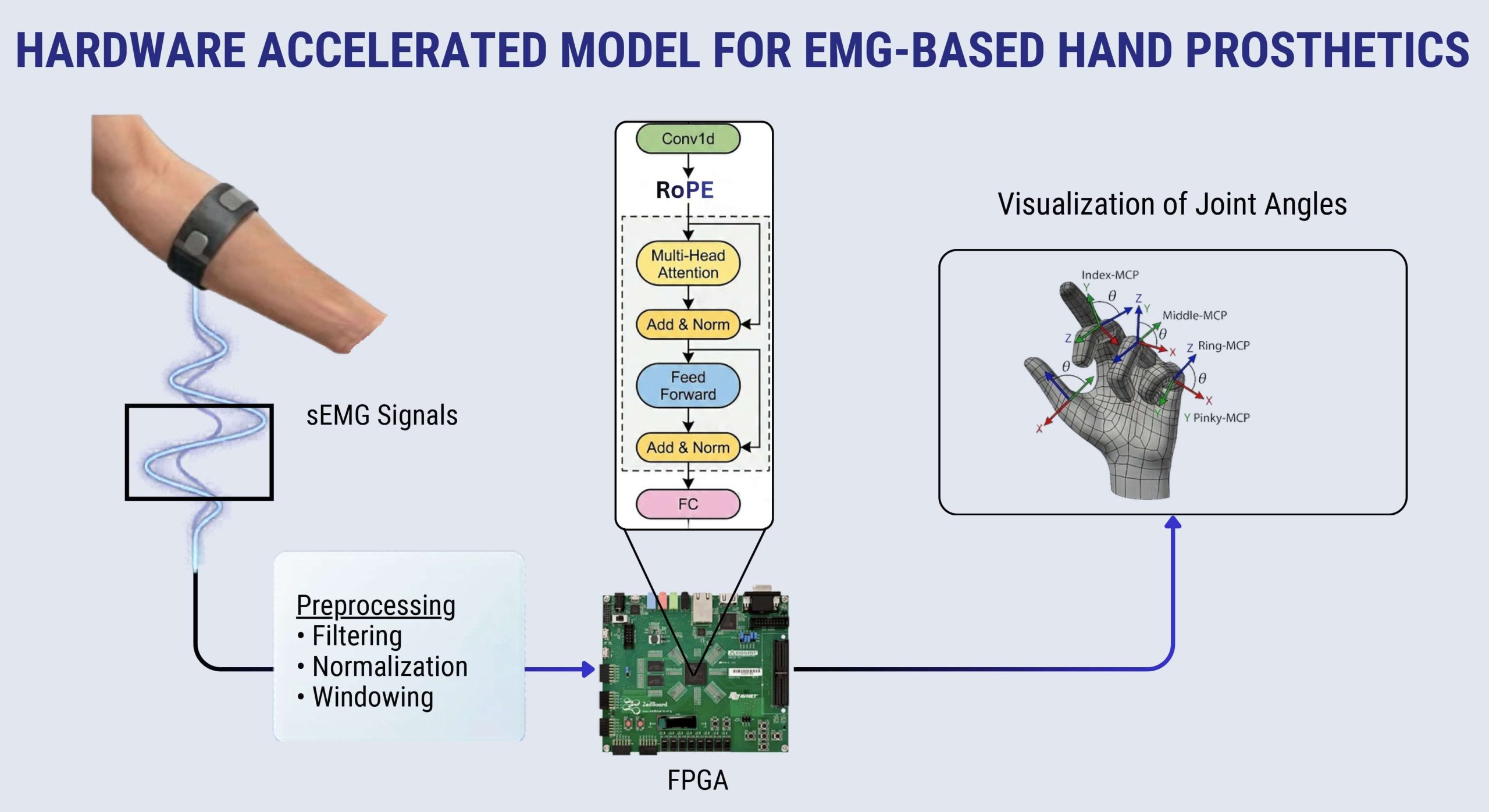
FPGA-Accelerated Transformer for sEMG-Based Gesture Prediction
Description
This project addresses the accessibility gap for advanced prosthetics in Pakistan by developing an affordable, EMG-based control system. The aim is to bridge the divide between rudimentary mechanical devices and high-cost imported myoelectric hands. By leveraging a lightweight, quantized Transformer model, the system tracks continuous hand motion from non-invasive surface EMG signals. To achieve real-time performance, the model is implemented on a low-cost FPGA, utilizing its inherent parallelism for high-speed, power-efficient processing. The purpose is to provide a "brain" for prosthetics that translates muscle activity into accurate joint angles for virtual or physical hands with low latency. This hardware-software co-design ensures high-accuracy gesture recognition on a portable edge device.
Project Pictures