
DURS 2026: A Platform for Undergraduate Research Excellence
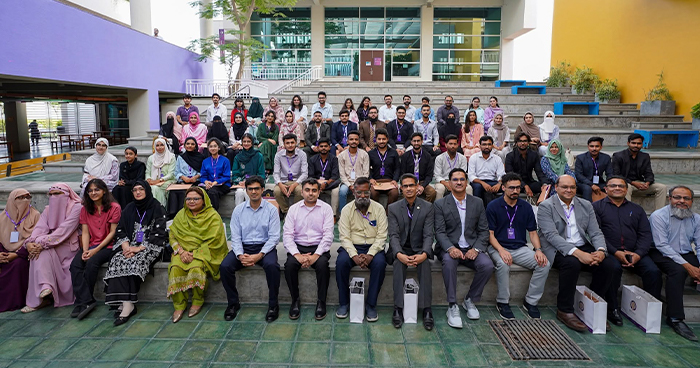
The Dhanani School of Science and Engineering at Habib University hosted its annual Dhanani School Undergraduate Research Symposium (DURS 2026) on May 21, 2026. As one of Pakistan’s premier platforms for young scholars, this year’s symposium transformed the campus into a vibrant hub of intellectual exchange. The event offered undergraduate students a distinct opportunity to present pioneering research, innovative designs, and scholarly contributions to a diverse academic audience, fostering deep mentorship and networking among students, faculty, and industry leaders.
Habib University has long been recognized as a crucible for undergraduate research, offering a rigorous environment that draws brilliant minds from top national institutions to showcase exemplary work. Reflecting the university’s commitment to interconnected knowledge, the symposium featured interdisciplinary projects spanning four critical streams under the theme “Research Across Disciplines: Undergraduate Inquiry in Science, Engineering, and Society.” These crucial areas of inquiry included Artificial Intelligence and Machine Learning, Computational Social Science and Humanities, Sustainable Technologies for Climate and Health, and Robotics and Emerging Technologies.
Beyond the compelling paper presentations and competitive poster exhibitions hosted at the IDEAL Commons, a central highlight of the symposium was the keynote address by globally acclaimed computer scientist Dr. Ihsan Ayyub Qazi from the Lahore University of Management Sciences. In his address, titled “Fake News, YouTube, and AI Doctors: What Data Reveals about Us,” Dr. Qazi provided profound insights into the rapidly changing landscapes of digital health, information integrity, and the development of trustworthy AI systems. His exploration of what data reveals, and critically fails to reveal, about human decision-making sparked an engaging Q&A session. Facilitated by Dr. Basit Memon, the discussion generated thought-provoking dialogue on the ethical and societal implications of future technologies.
Following a full day of rigorous presentations reviewed by a panel of distinguished experts and jury members, the symposium concluded with a closing ceremony celebrating the depth and execution of the student projects. The top honors for the best paper presentation went to Muhammad Annas Shaikh from Habib University for the project titled “Parameter-Efficient Unsupervised Domain Adaptation for Robust White Blood Cell Classification.” The second-place honors for best poster presentation were awarded to Tameema Rehman, Huzaifa Naseer Ahmed, and Anas Ashfaq Siddique from FAST-NUCES for their project, “Ablation study on TransReID with LoRA backbone for efficient Person Re-Identification.”
The seamless execution of DURS 2026 was steered by the dedicated members of the Symposium Committee, led by Dr. Saleha Raza, Interim Assistant Dean of the Dhanani School of Science and Engineering, and Dr. Faisal Alvi, Assistant Program Director. They were supported by committee members Hadiqa Maqsood, Zafar Iqbal, Nida Naeem, Bushraa Yousuf, Zeeshan Nafees, Riza Siddiqui, and Sheikh Bilal Uddin. The university also extended tokens of appreciation to key faculty members and external contributors who lent their expertise, including Dr. Farhan Khan, Sumra Khan, and external session leader Dr. Sheeraz Arif from Salim Habib University.
The success of DURS 2026 further cements Habib University’s legacy of fostering a culture of innovation, contextual problem-solving, and undergraduate research excellence in the region. To join this vibrant academic community, Habib University is currently accepting applications for its innovative undergraduate programs. Prospective students are invited to discover an environment defined by experiential learning, world-class faculty mentorship, and an intellectual space designed to help them realize their full potential.