

 Share Profile
Zubia Rizwan

Aspiration Statement
I aspire to work in the development sector, particularly in consultancies. I am open to opportunities that allow me to utilize my research skills, both quantitative and qualitative.
Core Skills
- Google Earth Pro
- Maxqda
- Qgis
- Stata
Core Demonstrated Competencies
- Acts with Ownership
- Adaptability
- Collaborates Openly
- Effective Presentation Skills
- Problem Solving
- Strategic Thinking
Preferred Career Paths
First priority: Consultant/Research Analyst
Second priority: Project Coordinator
Third priority: Human Resources
Academic Awards / Achievements
- Dean's List 2024, 2025
- High Achievement Scholarship 2025
- President's List 2024
Experience
Leadership / Meta-curricular
- General Secretary, Food and Hygiene Cabinet
- Content Lead, Pride Press
Internship / Volunteer Work
- Research Intern, The Citizens Foundation (December 2025 – January 2026)
- Finance and Media Intern, Karachi Metropolitan Corporation (June – July 2025)
- Research Assistant, Habib University (May 2024 – May 2025)
Final Year Project
Project Title
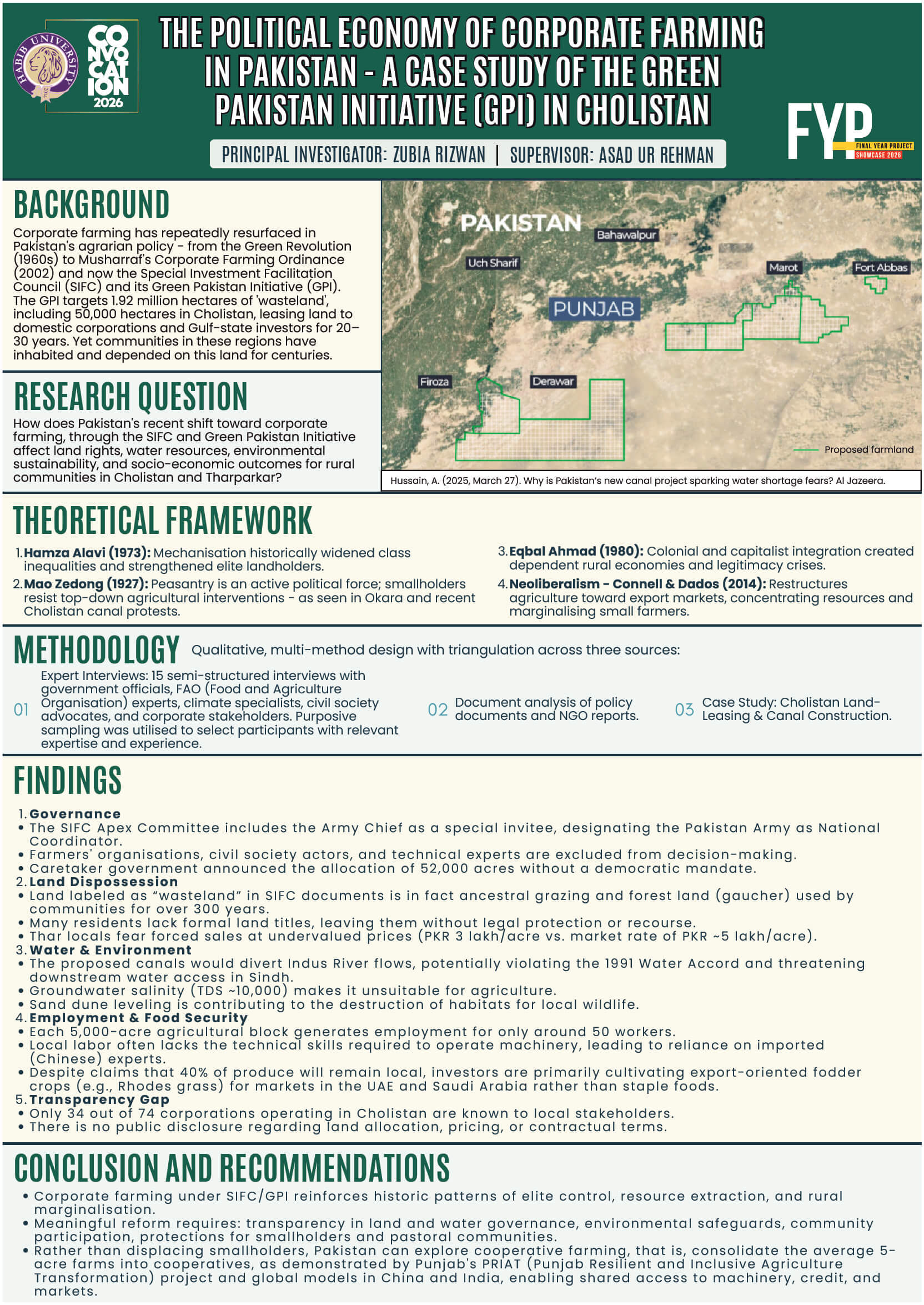
The Political Economy of Corporate Farming: A Case Study of the Green Pakistan Initiative in Cholistan
Description
This paper examines Pakistan’s shift toward corporate farming under the Special Investment Facilitation Council (SIFC) and its Green Pakistan Initiative (GPI). Using a Marxian political-economy framework, it analyses how state-led, capital-intensive agricultural reforms reproduce patterns of inequality and elite control. Through qualitative methods including expert interviews, document analysis, and a case study of the Cholistan project, it explores governance, land and water politics, and socio-economic impacts. The study finds that centralized decision-making sidelines local communities and experts, creating transparency gaps and risks of land dispossession, water diversion, environmental harm, and uneven economic gains. Without accountability, ecological safeguards, and inclusion of smallholders, corporate farming risks deepening existing agrarian inequalities.
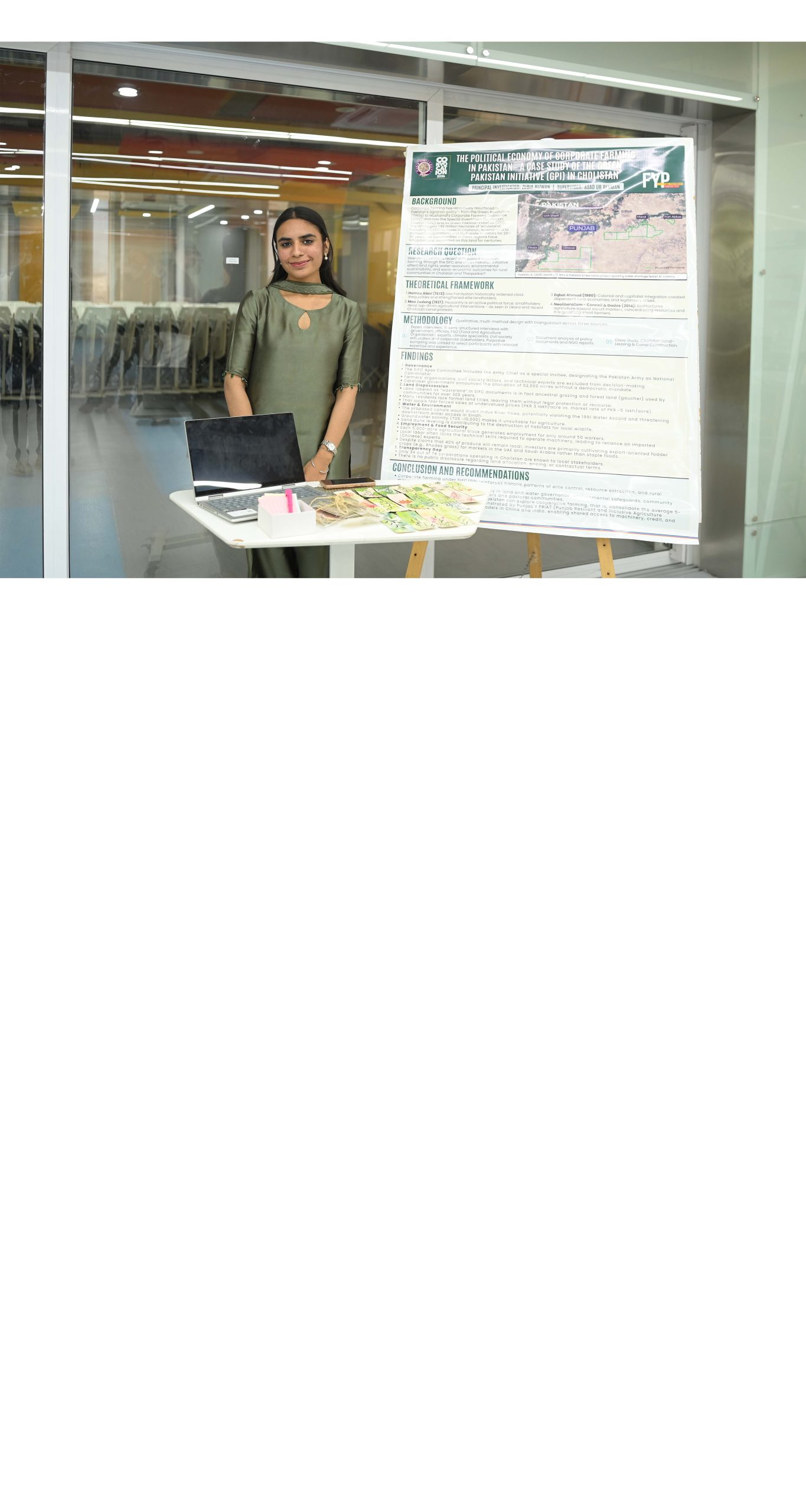
Project Pictures