

 Share Profile
Muhammad Bilal Qureshi

Aspiration Statement
I am deeply interested in automation and artificial intelligence. I leverage robotics through my capstone on autonomous vehicles, while possessing knowledge in deep learning and LLMs enhanced by various projects.
Core Skills
- C/C++
- Deep Learning
- Matlab and Simulink
- Python
- Robotic Operating System (ROS2)
Core Demonstrated Competencies
- Adaptability
- Planning
- Strategic Thinking
- Takes Initiative
Preferred Career Paths
First priority: Robotics Engineer
Second priority: AI Engineer - Deep Learning
Third priority: Systems Engineering
Academic Awards / Achievements
- Dean's List 2023, 2025
Experience
Leadership / Meta-curricular
- President, IEEE (Institute of Electrical and Electronics Engineers)
- Academic Affairs Representative, Habib University Student Government
Internship / Volunteer Work
- Tutor, Epsilon Academy (September 2022 – May 2026)
- Teaching Assistant - Systems Engineering and Project Management, Habib University (September – December 2025)
- Research Intern, Indus Motor Company Ltd (June – August 2025)
- Teaching Assistant - Computer Architecture, Habib University (September – December 2024)
Final Year Project
Project Title
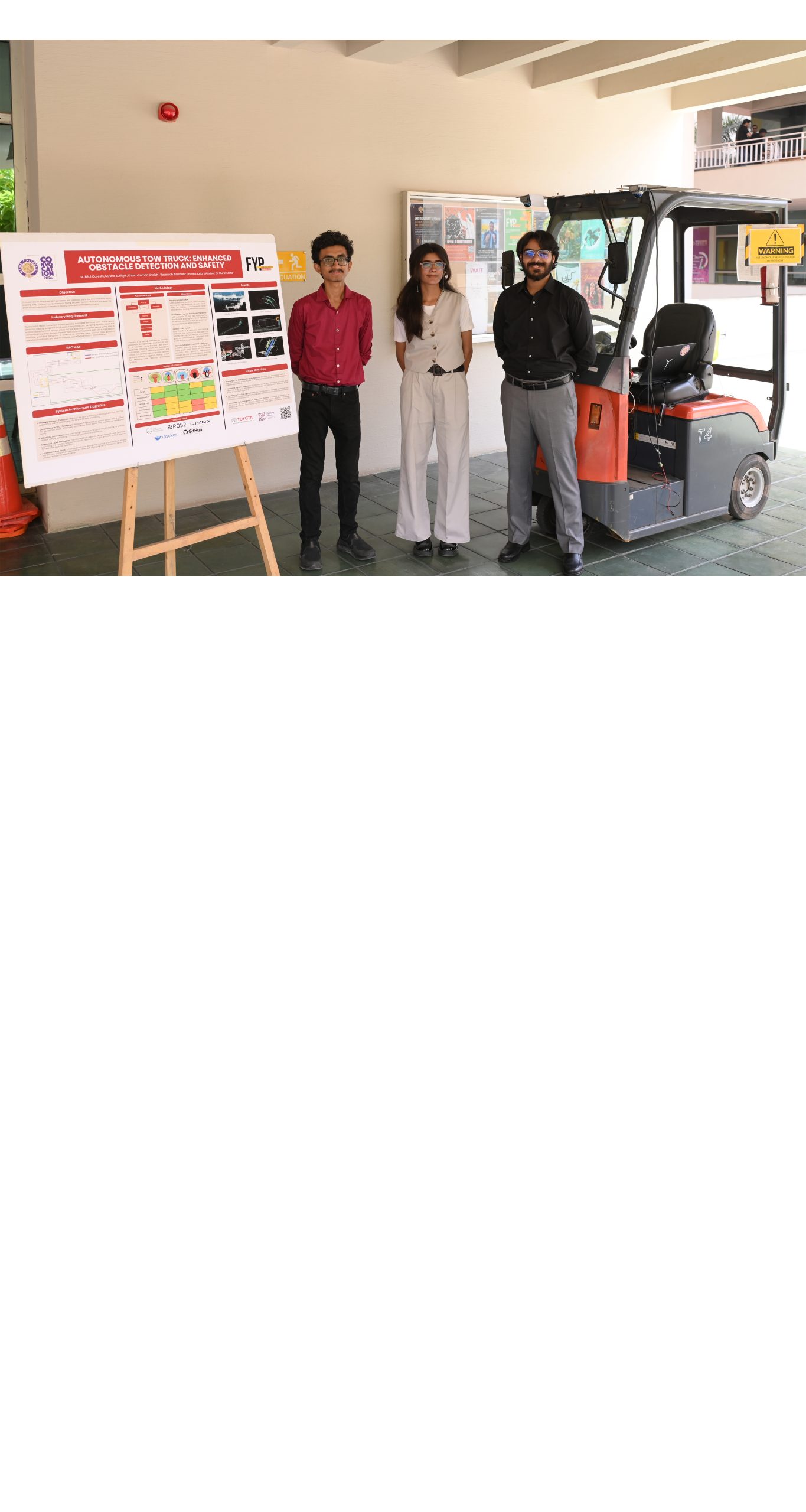
Autonomous Tow Truck - Enhanced Safety and Obstacle Detection
Description
Autonomous tow truck for IMC - Toyota. We started with systems engineering to analyze use cases and determine the optimal design for the vehicle. Our software implementation leverages Autoware, which is built on the ROS2 framework with visualization on RViz, and we use Docker to maintain consistent development environments. Throughout the project, continuous use of Git ensures proper teamwork and a reliable version history. A critical component of my part is the integration of Hardware-in-the-Loop (HIL). On the sensor front, I integrated a Livox MID360 3D LiDAR with Autoware. This setup enabled the successful implementation of the Normal Distributions Transform (NDT) algorithm to achieve accurate spatial localization for the autonomous system.
Project Pictures