

 Share Profile
Haya Akhtar
Recipient of Hilton Pharma Grant

Aspiration Statement
Strategic thinker focused on marketing, consulting, and public policy, applying data analytics, market intelligence, and research to understand systems, inform decision-making, and design impactful solutions across business and social sectors.
Core Skills
- Data Analytics
- Forecasting and Risk Assessment
- Leadership
- Market Intelligence and Insights
- Strategic Design
Core Demonstrated Competencies
- Adaptability
- Agility
- Drive for Results
- Takes Initiative
Preferred Career Paths
First priority: Consultancy
Second priority: Management Trainee Programs (Marketing or Finance)
Third priority: Public Policy Analyst
Experience
Leadership / Meta-curricular
- Singer, Arts and Culture Club
- Performer and Singer, Moseequi & Raqs
- Participant, Philosophy Club
Internship / Volunteer Work
- Intern, HBL (June – July 2025)
- Alfa Lead Intern, Bank Alfalah (July – August 2024)
- Social Media and Marketing Manager, Beasties PK and Justfyi (November 2023 – January 2024)
- Research and Content Writer Intern, Propergaanda (November 2022 – January 2023)
Publications / Creative Projects
- Thesis / Capstone Project – Final Year Capstone selected for the International Conference of Social Capital in Dubai
Final Year Project
Project Title
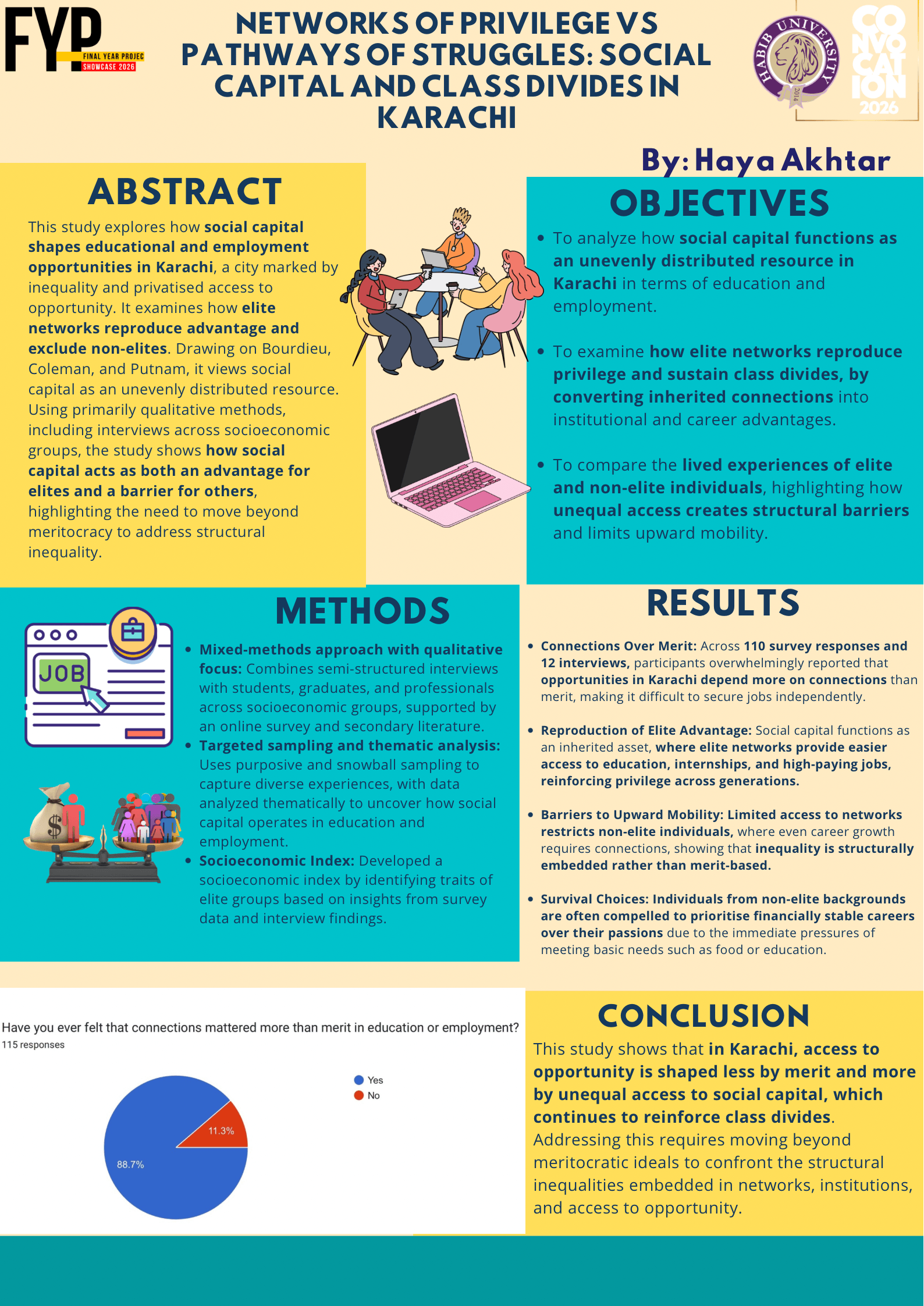
Networks of Privilege vs. Pathways of Struggle: Social Capital and Class Divides
Description
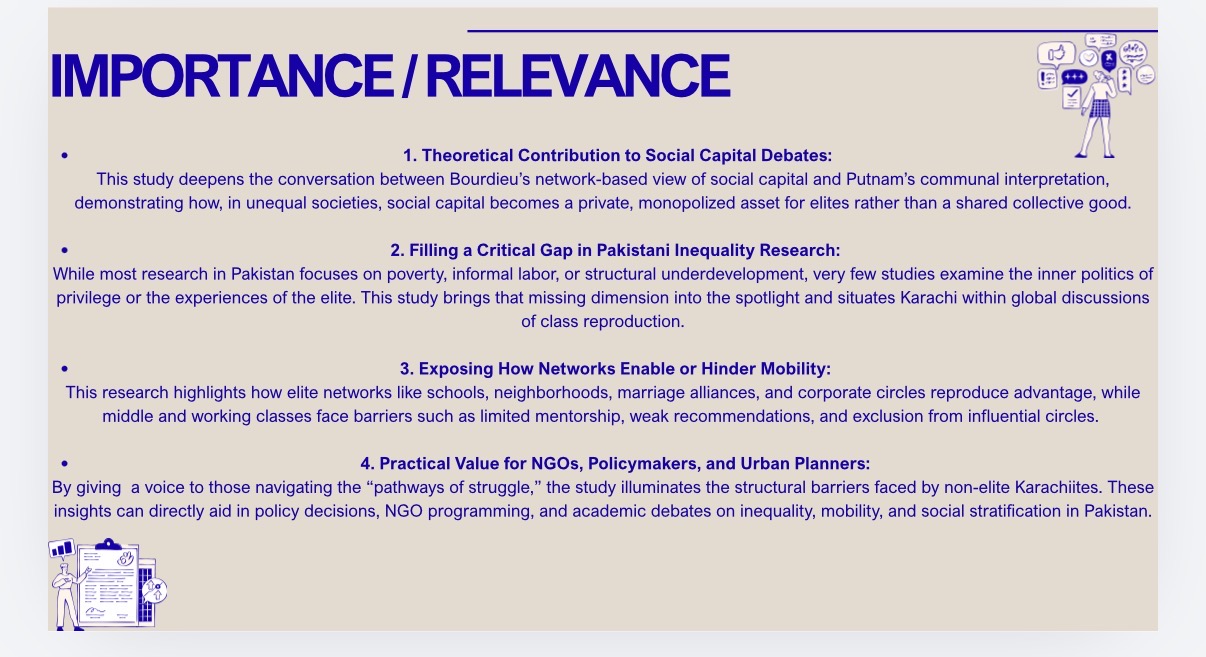
My capstone research examines how social capital shapes educational and employment opportunities in Karachi. The study explores how elite networks provide advantages through connections, institutional prestige, and inherited relationships, while individuals from non-elite backgrounds must rely primarily on merit and personal effort. Using a qualitative-heavy approach, the research draws on semi-structured interviews and an online survey to analyze how access to networks influences internships, jobs, and academic opportunities. The findings reveal that social capital in Karachi often reinforces class inequality, privileging those with established connections while limiting upward mobility for others and, in some cases, restricting it. The project highlights the need to recognise structural barriers beyond meritocracy in order to create more equitable access to opportunities.
Project Pictures