Introduction

This conference examines one of the world's most significant South–South migration corridors. It explores how migration between South Asia and the Gulf has transformed economies, labour markets, families, and transnational social worlds, while raising questions of development, identity, labour rights, and belonging.

Background

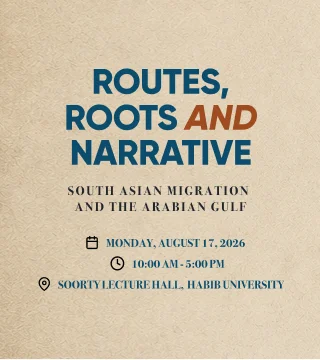
The Routes, Roots, and Narrative: South Asian Migration and the Gulf conference, hosted by Habib University on 17 August 2026, brings together scholars, policymakers, practitioners, journalists, artists, and students to examine one of the most consequential migration corridors linking South Asia and the Gulf. For over five decades, migration to the Gulf has profoundly shaped South Asian and Pakistan’s economy, labour markets, family life, and transnational social worlds, while raising pressing questions about development, mobility, citizenship, labour rights, identity, and belonging.

Situated within the wider context of South–South migration, the conference explores the movement of people from South Asia to the Gulf as a defining feature of contemporary globalisation. While these migrations have generated livelihoods, remittances, and new opportunities for millions, they have also revealed the inequalities embedded within global labour markets and temporary migration regimes. The conference seeks to create an interdisciplinary platform that examines migration not only as a question of economics and public policy, but also as a lived experience shaped by memory, culture, emotion, and imagination.

A distinctive feature of the conference is its commitment to fostering dialogue across disciplines and perspectives. Alongside scholarship on migration governance, labour regimes, development, and political economy, the conference brings together diverse approaches to the study of migration, encouraging exchanges between theoretical, empirical, and interdisciplinary research. By placing these perspectives in conversation, the conference seeks to deepen our understanding of migration as both a structural phenomenon shaped by historical, political, and economic processes and a lived experience that affects individuals, families, and communities across different contexts.

The conference also seeks to engage critically with questions of governance, regulation, and social justice. It invites reflection on recruitment infrastructures, labour protections, temporary migration regimes, transnational care, and the responsibilities of both sending and receiving states. At a time when migration continues to shape societies across South Asia and the Gulf, these conversations are essential for imagining more equitable, ethical, and rights-based approaches to labour mobility.

The conference emerges from two undergraduate courses offered at Habib University that approach migration from complementary perspectives. One of the courses is Global Migration, which introduces students to key debates on the ways migration influences institutions, multilateral and bilateral agreements, and everyday life. The course examines how global inequalities shape migration processes and discourses, as well as their impact on migration policies, governance institutions, and the lived experiences of individuals and communities. The other is Petrocultures: The Politics of Oil, which examines how oil has transformed societies, economies, cultures, and political life, with particular attention to Gulf petro-economies, South Asian labour migration, and the enduring imagination of the "Gulf dream." Together, these courses have encouraged students to think critically about migration through the lenses of political economy, history, sociology, anthropology, literature, and environmental humanities, demonstrating the value of interdisciplinary inquiry in understanding one of the defining migration stories of our time.

By bringing together academics, policymakers, civil society organizations, writers, artists, and migrant advocates, Routes, Roots, and Narrative seeks to create a vibrant forum for interdisciplinary exchange and collaboration. It is envisioned not simply as a one-day conference, but as the beginning of an ongoing conversation on migration, mobility, and justice in South Asia and the Gulf - one that advances scholarship, informs policy, and centres the voices and experiences of migrants themselves.


Read More

August 17, 2026

Conference Programme

Routes, Roots, and Narrative: South Asian Migration and the Gulf

Opening
  1. Arrival

  2. Opening Words

    Gennaro Errichiello Assistant Professor, Habib University

  3. Welcome Note

    Basharat Issa Director, Academic Centers

Session I

Governing Migration: Labour Migration, Policy, Rights and Governance

Chairperson
Farhan Anwar

Associate Professor of Practice, Social Development & Policy, Habib University

  1. Magnus Marsden

    Professor, Social Anthropology, University of Sussex

    Central-South-Gulf Migration through the lens of Bukhara Merchants

  2. Nasra M. Shah

    Professor, Migration and Development, Lahore School of Economics

    Irregular Migration to/in the Gulf: A Review and an Update

  3. Faisal Shabbir

    Technical Advisor, Global Programme Centres for Migration & Development, GIZ Pakistan

    Strengthening Regular Skilled Labour Migration from Pakistan to the Gulf: ZME's Experience in Bridging Evidence, Policy and Practice

  4. Tea Break

  5. Sadia Hameed

    National Project Coordinator, Advancing Fair and Safe Labour Migration, ILO

    Routes, Rights and Resilience: Advancing Human Rights and Labour Protection in the South Asia-Arabian Gulf Migration Corridor

  6. Abira Ashfaq

    Associate Professor of Practice, Social Development & Policy, Habib University

    Juridical Inequality: How Immigration Laws Enforce Labor Hierarchies in the GCC and the US

  7. Panel Discussion & Q&A

  8. Lunch

Session II

Roots and Narratives: Social Worlds of Migration

Chairperson
Zuha Siddiqui

Assistant Professor of Practice, Communication & Design, Habib University

  1. Introduction

  2. Nahrain Al-Mousawi

    Associate Professor, Comparative Humanities, Habib University

    Estranging Labor: The Gulf, Capital and the Fantastic

  3. Tajreen Midhat

    Lecturer, Social Development & Policy, Habib University

    Petroslavery: Narrating Pakistani Labour Migration to the Gulf

  4. Asad Rehman

    Assistant Professor, Social Development & Policy, Habib University

    Many Meanings of Migrant: Semantic Mediation and Spatial Change in Rural Punjab

  5. Noor Shahzad

    Founder and Research Associate, The Migration Collective

    Mobility as Inheritance: The Patrilineal Reproduction of Migration Pathways in Gujrat, Pakistan

  6. Yasmeen Jamali

    Assistant Professor, Social Development & Policy, Habib University

    Migration in the Margins: Measuring Internal Migration and Survey Coverage Gaps in Balochistan

  7. Panel Discussion & Q&A

  8. Concluding Remarks

  9. Tea & Refreshments

Our Team

Dr Gennaro Errichiello

Dr Gennaro Errichiello

Assistant Professor of Social Development and Policy at Habib University, Karachi. His research focuses on migration, mobility, diaspora, and transnationalism, with particular attention to the Gulf region, South–South migration, and the everyday experiences of highly skilled migrants. His work examines migration governance, temporariness, and social integration through a decolonial and ethnographic lens. He has published in leading international journals and regularly presents his research at international conferences.

Tajreen Midhat

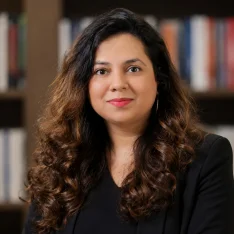
Tajreen Midhat

Lecturer in Social Development and Policy at Habib University. Her research develops a conversation between migration, petrocultures, and oral history, examining the lived experiences of workers and the social worlds shaped by oil economies across South Asia and the Gulf. She is currently leading the research project Petroslavery: Pakistani Migration to the Middle East, which explores Pakistani labour migration to the Gulf through oral histories of returnee migrant workers.